✝ Saint Gregory Palamas, Archbishop of Thessalonica
November 14 / November 27 (Julian Calendar)
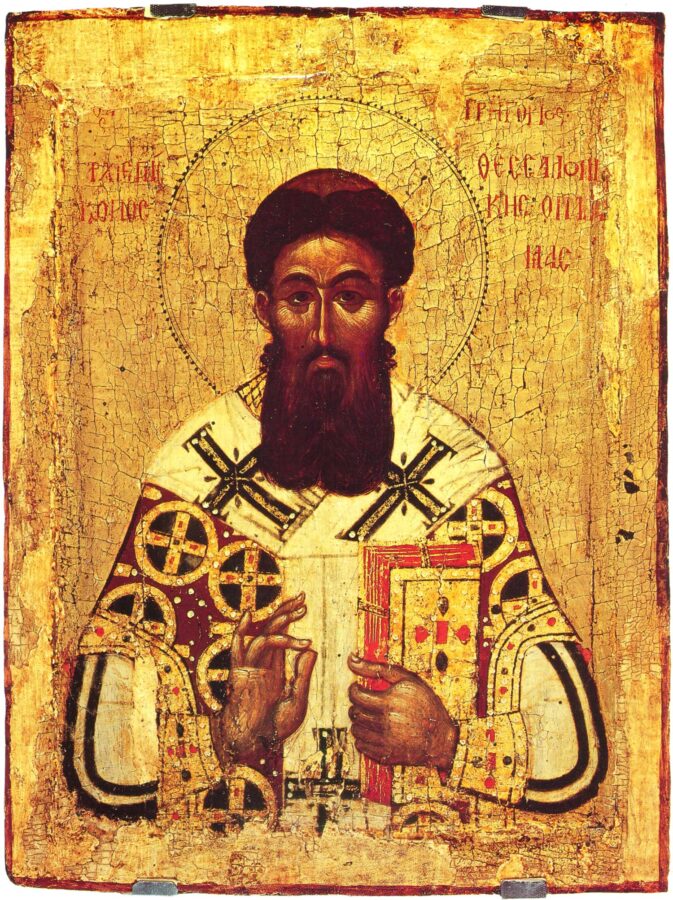
On this day, November 14 according to the Julian Calendar (November 27 civil calendar), the Georgian Orthodox Church commemorates Saint Gregory Palamas, Archbishop of Thessalonica.
Saint Gregory Palamas, Archbishop of Thessalonica, was born in 1296–97 into a distinguished, wealthy and pious Christian family. His parents originally lived in Asia Minor, but during the Turkish invasions they moved to Constantinople, where they found refuge at the court of Emperor Andronikos II Palaiologos (1282–1328). Gregory’s father, Constantine, became a high-ranking court official but soon died. After that, the care of the boy’s upbringing and education was taken on by his mother and by the emperor, who remained loyal to the memory of his late courtier. Thanks to his remarkable attentiveness and diligence, Gregory mastered every subject with ease. The emperor wished to prepare the young man for state service, but at the age of twenty, in 1316 (or, according to another account, 1318), Gregory went with his two younger brothers to Mount Athos and entered the Vatopedi Monastery as a novice. There he struggled under the guidance of the Venerable Nikodemos of Vatopedi (commemorated July 11), by whom he was tonsured a monk. A year later, the holy Apostle and Evangelist John the Theologian appeared to him in a divine vision and promised him his help in his spiritual labours. Soon afterwards Gregory’s mother and sisters also received monastic tonsure.
After the repose of Saint Nikodemos, the venerable father continued his labours of prayer for eight years under the guidance of the Elder Nikephoros, and after the Elder’s death he moved to the Great Lavra of Saint Athanasius. There the saint served first in the refectory and later as a chanter. Thus three years passed. In 1321 Gregory, longing for still higher degrees of spiritual perfection, settled in the small skete of Glossia. Here he became wholly imbued with the spirit of hesychasm and made it the foundation of his life. As early as the fourth to eighth centuries, the ascetics of Egypt and Sinai had developed a whole system of religious, ethical and ascetic teaching, involving particular methods that draw a person near to God: a set posture during prayer, the constant repetition of the Jesus Prayer, the regulation of breathing, and more. Only at the highest level of perfection could a person attain spiritual union with God, with the Lord Jesus Christ, an experience bringing ineffable blessedness and joy. Because this joy could not be expressed in words, the monks preferred silence, and from this comes the very name of this way of prayer: hesychasm, from the Greek word for stillness, quiet and solitude. In 1326, to escape the danger of Turkish raids, Gregory Palamas moved with the brotherhood to Thessalonica, where he was ordained to the priesthood.
Saint Gregory combined the duties of a priest with the labours of a hermit: five days a week he spent in silence and prayer, and on Saturdays and Sundays he came out to the people, celebrated the divine services and instructed the faithful. His sermons made a deep impression on all who heard them in church. Yet, despite his way of life, total withdrawal from society was foreign to him. At times he attended the theological discussions of the educated youth of the city, led by the future Patriarch Isidore. Once, returning from Constantinople, the saint discovered near Thessalonica a place called Veria, well suited to monastic life. He soon gathered a small brotherhood there and guided it for five years. In 1331 Gregory returned to Athos and withdrew to the Skete of Saint Sabbas near the Lavra of Saint Athanasius. In 1333 he was appointed abbot of the Esphigmenou Monastery, and in 1336 he returned once more to the Skete of Saint Sabbas and began the theological work that he did not cease until the day of his death.
In 1328–30 a learned monk named Barlaam, the author of treatises on logic and astronomy, arrived in Constantinople from Calabria. He obtained a chair at the university of the capital and began to expound the writings of Dionysius the Areopagite (commemorated October 3), whose apophatic theology was universally recognized. Barlaam soon went to the Holy Mountain of Athos as well, where he became acquainted with the spiritual life of the hesychasts and, on the basis of the dogma of the incomprehensibility of God’s essence, declared their practice of noetic prayer a heretical error. Barlaam disputed with the monks and tried to prove to them that the Light of Tabor was a created phenomenon; he did not even refrain from ridiculing the monks’ accounts of their methods of prayer and of spiritual illumination.
At the request of the Athonite monks, Gregory Palamas set out his theological arguments in writing. Thus the famous “Triads in Defence of the Holy Hesychasts” came into being (1338). In 1340 the Athonite ascetics, under the guidance of the blessed father, composed a joint response to Barlaam’s attacks, the so-called “Hagioritic Tome.”
At the Church Council of Constantinople in 1341, held in the Church of Hagia Sophia, the debate between Saint Gregory and Barlaam centred mainly on the Light of Tabor. Barlaam’s teaching was condemned as heresy, but the controversy continued for a long time. Barlaam’s disciple, the Bulgarian monk Akindynos, wrote several treatises accusing Saint Gregory and the Athonite monks of stirring up disorder in the Church. Gregory Palamas gave the heretic a fitting reply and convincingly refuted his charges. Nevertheless, Patriarch John XIV excommunicated the Lord’s chosen one (1344) and had him thrown into prison, where he was kept for three years. In 1347, when Isidore (1347–1348) ascended the patriarchal throne, Saint Gregory Palamas was set free and appointed Archbishop of Thessalonica. In 1351 the Council of Blachernae solemnly confirmed the Orthodoxy of his teaching. The people of Thessalonica, however, did not at once accept their new archpastor, and at first he was forced to live in various places. Once, the ship on which the blessed Gregory was travelling to Constantinople fell into the hands of the Turks. For a whole year the holy hierarch was sold like a slave from city to city, yet even then he tirelessly continued to preach the Christian faith.
The blessed Gregory returned to Thessalonica only three years before his death. Before his repose he beheld the holy hierarch John Chrysostom in a divine vision. Gregory Palamas gave up his soul to the Lord on November 14, 1359, at the age of sixty-three. The blessed hierarch was numbered among the saints at the Council of Constantinople in 1368. His Life and the canon for his commemoration were composed by Patriarch Philotheos (1354–1355, 1362–1376).
The Church also commemorates Saint Gregory on the Second Sunday of Great Lent.
May the intercessions of Saint Gregory Palamas be with us all.