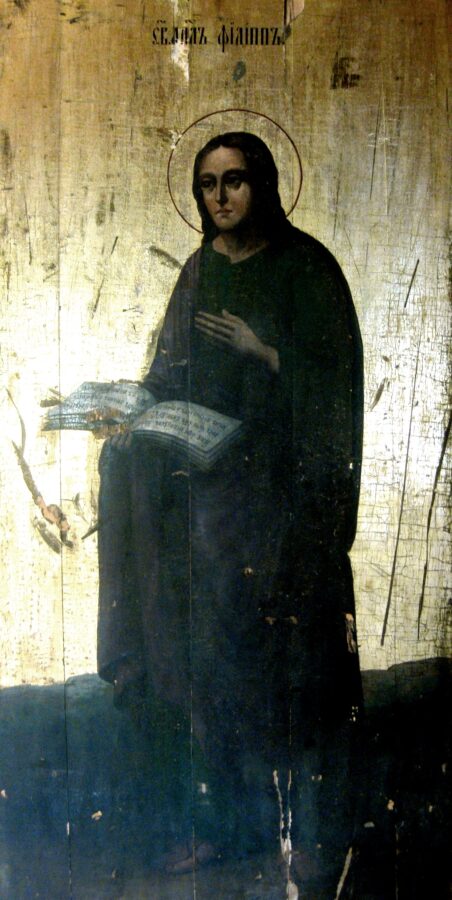
✝ Holy Apostle Philip
November 14 / November 27 (Julian Calendar)
On this day, November 14 according to the Julian Calendar (November 27 civil calendar), the Georgian Orthodox Church commemorates the Holy Apostle Philip, one of the Twelve.
The holy Apostle Philip, a native of Bethsaida in Galilee, was deeply learned in the Holy Scriptures. He rightly understood the meaning of the Old Testament prophecies and lived in expectation of the Messiah. At the very first call, Philip followed the Saviour (John 1:43); he brought the Apostle Nathanael to Christ (John 1:46); the Lord asked him how much money would be needed to buy enough bread for five thousand men (John 6:5–7); he led to the Lord the Greeks who wished to see Christ (John 12:21–22); and it was he who asked the Saviour, “Lord, show us the Father, and it will suffice us” (John 14:8).
After the Ascension of Christ, the Apostle Philip preached the word of God in Galilee, and wondrous miracles accompanied his teaching. From Galilee he went on to Greece, where he preached among the Jews who had settled there. Pharisees came from the Holy City to Hellas to put Philip on trial, led by their high priest. The Apostle exposed the lie of the Jewish high priest, who claimed that Christ’s disciples had stolen and hidden the Saviour’s body: the saint told the assembly that the guards, from whom the rumour had spread, had been bribed by the Pharisees. When the high priest and his companions began to blaspheme God and fell upon the Apostle, they were struck blind; yet through Philip’s prayer all of them received their sight again. Many who witnessed this miracle turned to Christ.
From Hellas, Philip travelled first to Parthia and then to the city of Azotus. From Azotus he went on to Hierapolis in Syria. There, Jews bribed by the Pharisees burned down the house of Heros, who had given the holy Apostle shelter. They meant to kill Philip himself, but when they saw the miracles worked by the Lord’s chosen one, they were moved to repentance, and many of them were baptized. The Apostle consecrated Heros bishop of Hierapolis and continued on his way, travelling through Syria, Asia Minor, Lydia and Mysia. Everywhere he preached the word of God, and for this he had to endure many torments. Philip was accompanied at all times by his sister Mariamne, who shared in all her brother’s hardships.
The Apostle then came to Hierapolis in Phrygia, a city full of pagan shrines, among them a temple dedicated to serpents in which a huge viper made its lair. By the power of prayer, Philip killed the creature and healed many people who had been bitten by snakes. Among those healed was the wife of the city’s governor, who believed in Christ and was baptized. When the governor learned of this, he ordered the arrest of Philip, his sister Mariamne and their companion, the Apostle Bartholomew. At the urging of the priests of the viper’s temple, the pagan ruler ordered Philip and Bartholomew to be crucified. At that moment a terrible earthquake shook the land, and the earth swallowed up those gathered at the place of judgment. Nailed upside down to a cross beside the viper’s temple, Philip prayed that the Lord would deliver his tormentors from the calamity that had befallen them. Seeing what had happened, the people believed in Christ and demanded that the Apostles be taken down. Bartholomew, taken down from his cross, was still alive; once freed, he baptized the new converts and appointed a bishop for them. The Apostle Philip, however, gave up his spirit on the cross.
The saint’s sister Mariamne buried her brother’s body and then set out with the Apostle Bartholomew for Armenia to preach the Gospel. There Saint Bartholomew was crucified (commemorated June 11), while Mariamne continued to preach the word of God among the pagans until her blessed repose in Lycaonia (commemorated February 17).
The day after the feast of the Apostle Philip, the forty-day Nativity Fast begins; for this reason it has also been called “Philip’s Fast.”
May the intercessions of the Holy Apostle Philip be with us all.