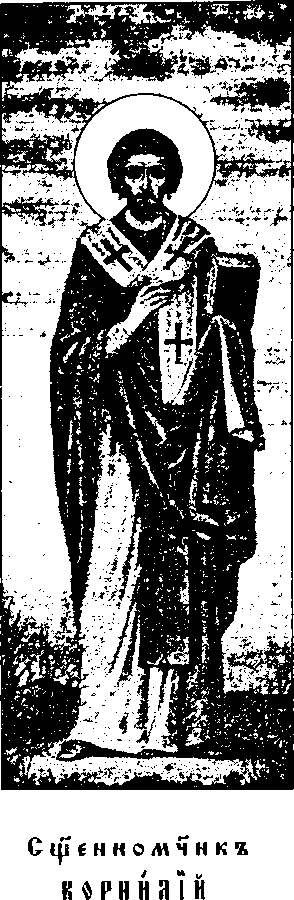
✝ Saint Cornelius the Centurion (1st Century)
September 13 / September 26 (Julian Calendar)
On this day, September 13 according to the Julian Calendar (September 26 civil calendar), the Georgian Orthodox Church commemorates Saint Cornelius the Centurion (1st Century).
Shortly after the Crucifixion and Ascension of the Saviour, Saint Cornelius the Centurion moved from Italy to Caesarea in Palestine. At that time he was still a pagan, yet he was “a devout man, and one that feared God with all his house, which gave much alms to the people, and prayed to God alway” (Acts 10:2). The Lord did not forsake his truth-seeking soul, but enlightened him with the light of faith in Christ.
Once, while Cornelius was praying in his house, an angel stood before him and announced that the Lord had heard his prayer, commanding him to send men to Joppa, to the house of Simon the tanner, to bring Simon Peter. Cornelius at once fulfilled the heavenly command. As his messengers drew near the city, “about the sixth hour,” the Apostle Peter went up onto the housetop to pray. Suddenly he saw heaven opened and a vessel descending, like a great sheet knit at the four corners and let down to the earth, “wherein were all manner of fourfooted beasts of the earth, and wild beasts, and creeping things, and fowls of the air.” A voice from on high commanded the apostle to kill and eat all that he saw. Peter was astonished and refused, and received the answer: “What God hath cleansed, that call not thou common.” This was repeated three times (Acts 10:1–16). By this vision the Lord called His apostle to preach among the Gentiles: the birds and creeping things were an image of the Gentiles, and the threefold letting down of the sheet foreshadowed the threefold immersion in the water of Baptism. Accompanied by the messengers, the Apostle Peter went to Cornelius. There he learned that by the grace of the Holy Spirit Cornelius had come to believe in the incarnate Messiah, and he baptized him together with his household.
After this the saint accompanied the Apostle Peter in preaching the Gospel and was consecrated bishop by his hand. When Peter came to Ephesus with Saints Timothy and Cornelius, he learned that idolatry was especially strong in the city of Scepsis. They cast lots to decide who should preach there, and the Lord chose Cornelius.
The ruler of Scepsis was a certain Demetrius, learned in Greek philosophy, who hated Christianity and worshipped the pagan gods, above all Apollo and Zeus. When he learned of Cornelius’s arrival, he summoned him at once and asked who he was and why he had come. The blessed one replied: “I am a servant of the Son of the living God, and I have been sent here to lead thee up out of the depth and darkness of ignorance and to unite thee with the true Light.” The ruler did not grasp the meaning of these words and ordered him to answer his questions plainly. Then the saint told him who he was and how he had come to follow the Lord, and explained that he had learned that Demetrius and his realm were in great error, and had come to deliver them from it by preaching the true God, the Creator of heaven and earth. The bold answer enraged Demetrius, and he demanded that Cornelius immediately offer sacrifice to the idols.
Brought into the pagan temple, the Lord’s chosen one turned to the east, knelt and prayed fervently. Suddenly a terrible earthquake struck; the temple of Zeus collapsed, and the idols within it were shattered to pieces. The people who witnessed the miracle were seized with dread, while the ruler’s fury only grew. He took counsel with his courtiers as to how he might destroy Cornelius, and the saint, bound hand and foot, was shut up in prison. Meanwhile a servant told Demetrius that his wife Evanthia and his only son Demetrian had been caught in the ruins of the temple. Hearing this, the ruler “rent his garments and was seized with great mourning.” Weeping, he ordered the ruins to be dug out so that the bones of his most beloved ones might be found. The whole city was plunged into grief, but soon Barbatus, the chief of the priests, who had been charged with excavating the temple, brought joyful news: the voices of Evanthia and her son could be heard from beneath the ruins, saying, “Great is the God of the Christians, who has delivered us from this grievous trial through His servant Cornelius.” Overjoyed, Demetrius hastened to the prison to free the deliverer of his wife and son, but an angel had already loosed the saint from his bonds — he was walking about his cell with a book in his hand, glorifying the Lord. Before Cornelius the ruler confessed Christ as the true God and asked him to bring Evanthia and Demetrian out of the ruins. After this Demetrius was baptized with his whole household and court, and soon afterwards, together with his wife and son, he received a martyr’s end for Christ (see the reading for September 11). Cornelius lived for a long time in Scepsis and endured many sufferings; at last he converted the whole city to the true faith and reposed in the Lord in deep old age. His holy body was buried near the ruined pagan temple.
May the intercessions of Saint Cornelius the Centurion be with us all.