✝ the Holy New Martyrs of Georgia
August 14 / August 27 (Julian Calendar)
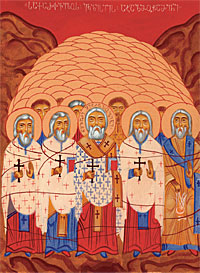
On this day, August 14 according to the Julian Calendar (August 27 civil calendar), the Georgian Orthodox Church commemorates the Holy Martyrs Nazar, Metropolitan of Kutaisi-Gelati; the Archpriests Germane Jajanidze and Ierotheos Nikoladze; the Priest Simon Mchedlidze; the Protodeacon Bessarion Kukhianidze (†1924); and all the New Martyrs who were put to death by the godless during the years of the totalitarian regime.
Metropolitan Nazar (Joseph Lezhava in the world) was born in 1872 in the Imeretian village of Didi Jikhaishi. His forebears had been clergymen, and the future metropolitan was raised from his earliest childhood in an atmosphere of faith and church life.
Nazar received his primary education at the Kutaisi Theological School. In 1892 he graduated with distinction from the Tbilisi Theological Seminary. He was ordained first a deacon, and then, on 22 February 1893, a priest. After great sorrow befell his personal life — first his wife died, and afterwards both his daughters — he was tonsured a monk in 1904. In 1905 the hieromonk Nazar was appointed teacher of homiletics at the school in Vilna; and in 1907 he was transferred to be supervisor of the theological school at Klevan.
In 1910 the hieromonk Nazar was raised to the rank of abbot. In 1911 he became superior of the Wilderness of Saint John the Baptist. On 1 December of that same year Archimandrite Nazar was elevated to the rank of bishop and appointed Metropolitan of Kutaisi.
The pastoral labours of Nazar, Metropolitan of Kutaisi and Gelati, fell in exceedingly difficult times. In 1905 the Georgian clergy raised the question of restoring the independence of the Church of Georgia, which provoked a sharp reaction from Russia.
The struggle for the autocephaly of the Apostolic Church of Georgia continued through 1906 as well. The Holy Synod of Russia was compelled to bring the question of the Georgian Church before the Russian church council, where the matter was decided in the negative.
After the revolution of 1917 the Georgians once again raised the question of the Church’s independence, and on 12 March 1917 the autocephaly of the Church of Georgia was solemnly proclaimed in the Svetitskhoveli Cathedral at Mtskheta. On 16 March an assembly of clergy convened in Tbilisi decreed that from that time onward the divine services in the Sioni Cathedral were to be celebrated in the Georgian language. Metropolitan Nazar stood at the very centre of all these events.
The brief period of the autocephaly of the Georgian Orthodox Church and of national independence was succeeded by new years of repression. The new regime brought new rules. In 1921 private ownership of land was abolished, and the churches and monasteries were stripped of the lands belonging to them. The Gelati Monastery, which lay within Metropolitan Nazar’s diocese, also found itself in grave straits. That monastery of many centuries, which had been called “a new Athens and a second Jerusalem,” ceased to exist in the spring of 1923.
The years 1922 and 1923 are the darkest period in the history of the Church of Georgia. At the initiative of the Bolshevik government twelve hundred churches were destroyed, church treasures were annihilated, a great number of unique manuscripts were burned, and many clergymen and people of national conviction were subjected to repression.
On 23 February 1921, because of the advance of the Red Army, at the proposal of the Menshevik government and by resolution of the Catholicosal Council, the treasures of Sioni and Svetitskhoveli were carried to Kutaisi. At the direction of Patriarch Leonid, four chests of these treasures were buried beneath the balcony of Nazar’s metropolitan residence, which stood at the foot of the Bagrati Cathedral.
After the occupation of the country the Bolsheviks discovered the treasures and arrested Metropolitan Nazar. He was charged with taking part in agitation against the authorities and with concealing the property of Sioni and Svetitskhoveli. When asked at his trial for whom the treasures had been kept, the metropolitan answered: “For the Church and for the Georgian nation.” The court sentenced Nazar to the highest measure of punishment — execution by shooting. This was afterwards commuted to imprisonment and the confiscation of his personal property.
In April 1924, under an amnesty and after two years of imprisonment, Metropolitan Nazar was released. He returned to his diocese, where a very grievous situation met him. The metropolitan was not admitted to his residence, which had been turned into a warehouse; he was obliged to take shelter with his brother’s family.
Without a murmur Metropolitan Nazar bore his cross, which the hierarch was to make radiant by the labour of laying down his life for the faith. At the side of Bishop Nazar stood the clergy of the diocese, who lightened his hierarchical labours and who were likewise cruelly persecuted by the authorities.
The Georgian people could not be reconciled to the atheist regime. In 1924 preparations for an armed uprising began in Georgia. On 28 August, the feast of the Dormition of the Mother of God, the uprising broke out in Kutaisi and soon spread throughout all Georgia. Agents of the Georgian extraordinary commission tracked down the headquarters of the uprising at the Shio-Mgvime Monastery and arrested its leaders. The reprisals of the Soviet authorities knew no limit, and a great many innocent people were punished and shot.
On the eve of the 1924 uprising, on 27 August, a delegation from the village of Rodinouli came to Metropolitan Nazar and asked him to consecrate the village church. At the appointed time Metropolitan Nazar went to the village together with his clergy, and they consecrated the church. That night, while the metropolitan and the priests accompanying him were guests in a house in Simoneti, Chekists suddenly fell upon them, bound them hand and foot, beat them with rifle butts, then tied them to a cart and took them to the village soviet.
The next day the prisoners were transferred to the Kutaisi commissariat of internal affairs and shut up in a dark cell together with other prisoners. Without any trial whatever, a “special troika” shot Metropolitan Nazar in the forest of Sapichkhia, and with him four clergymen: Archpriest Germane Jajanidze, Archpriest Ierotheos Nikoladze, Priest Simon Mchedlidze, and Deacon Bessarion Kukhianidze.
In 1994 an expanded church council, convened with the blessing of Ilia II, Catholicos-Patriarch of All Georgia, examined this event among many other matters and decreed that, together with Metropolitan Nazar, every Orthodox Christian slain in Georgia by the godless for the sake of the Church and the nation should be canonized, and that they should be called the New Martyrs.
May the intercessions of the Holy New Martyrs of Georgia be with us all.