✝ Saint Theodosius of the Kiev Caves
August 14 / August 27 (Julian Calendar)
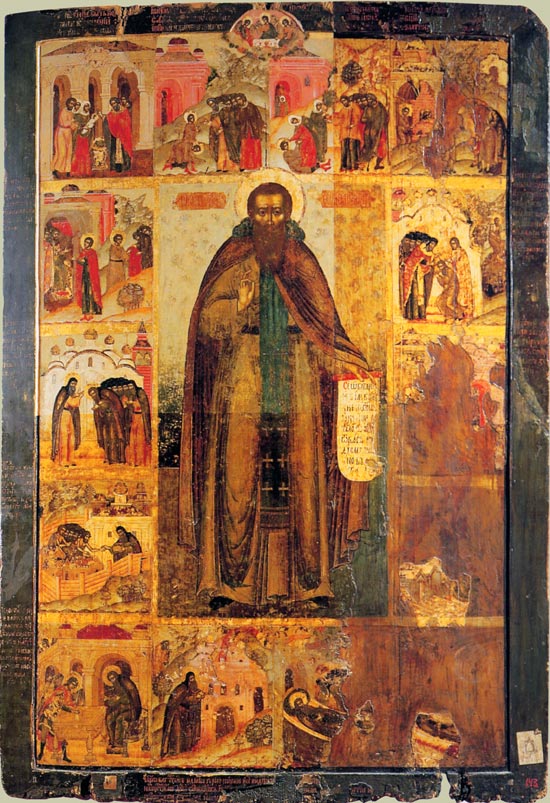
On this day, August 14 according to the Julian Calendar (August 27 civil calendar), the Georgian Orthodox Church commemorates the Translation of the Relics of our Venerable Father Theodosius of the Kiev Caves.
Saint Theodosius of the Caves was born in the village of Vasilevka near Kiev, and while still a child moved with his family to Kursk. Early on he felt drawn to the ascetic life. Even in his parents’ home he lived austerely: he avoided childish amusements and games, went constantly to church, listened attentively to the prayers, and distributed to the poor everything he had. The saint himself asked his mother and father to entrust him to a teacher so that he might learn to read the sacred books, which, through his remarkable gifts, he mastered so quickly that he amazed everyone. Theodosius’ well-to-do parents were displeased that their son dressed like a beggar, sought solitude, and often worked alongside the neighbouring peasants out of a desire to help them.
After his father’s death, the young ascetic secretly left his mother and set out with pilgrims on the road to Jerusalem, but they overtook him and punished him severely for acting on his own. Returning home, Theodosius — despite the prohibitions and threats of his stern yet loving mother — again took up the way of life he had chosen: whatever he received from his parent he distributed to the poor, he fasted strictly, he wore iron chains, and he baked the prosphora for one of the churches.
He was twenty-three years old when he secretly left his family home and was tonsured a monk at the Kiev Caves Lavra by the hand of Saint Anthony. Four years later his mother found her son and begged him with tears to return home, but the saint himself persuaded her instead to become a nun in the convent of Saint Nicholas.
In 1054 Saint Theodosius was ordained a hieromonk, and in 1057 he was chosen abbot. Word of his wondrous labours drew many ascetics to the monastery, where the saint introduced the rule of the Studion Monastery, which at his request was specially copied out for him in Constantinople. Even in the rank of superior, Saint Theodosius performed the most difficult obediences himself. He usually ate nothing but dry bread and herbs; he passed his nights sleepless in prayer, as the brethren more than once observed, though the chosen one of the Lord diligently sought to hide his labours from men. No one ever saw the blessed one lie down to sleep — as a rule he rested sitting up. During the days of Great Lent the saint would withdraw to a cave near the monastery and labour there hidden from all. His garment was a rough sackcloth which he wore directly against his bare body, so that in this beggarly monk it was impossible to recognize the renowned abbot whom everyone venerated.
Once Saint Theodosius was returning from the Grand Prince Iziaslav. The driver, who did not yet know the blessed one, said to him rudely: “You, monk, are always idle, while I labour without ceasing; come down and take my place, and let me ride in the carriage!” The holy elder humbly obeyed and drove the servant himself. When the driver saw that the boyars they met bowed reverently at the sight of the blessed one, he was seized with fear; but Theodosius calmed him, and on reaching the monastery even gave him a meal. The saint did not shrink from rebuking the powerful of this world. Those unjustly condemned found in him a faithful defender. The blessed father cared especially for the poor: in the monastery he set up a special courtyard where all in need could receive food and shelter.
Saint Theodosius foresaw the day of his repose, and in 1074, at the age of sixty-five, he peacefully surrendered his soul to the Lord. The blessed one’s holy remains were buried in the cave he himself had hewn out, where he used to labour during the days of Great Lent; and in 1091 they were translated to the cathedral church of the Dormition of the Mother of God. At the time of the Mongol invasion the incorrupt relics of the holy abbot were buried near the western portal of the great cathedral, so that they might not fall into the hands of the enemy. The blessed father was canonized in 1108.
Six sermons of Theodosius have come down to us, together with two epistles and a prayer for all Christians. The life of the venerable father was compiled thirty years after the blessed one’s repose by his disciple, Saint Nestor the Chronicler.
May the intercessions of Saint Theodosius of the Kiev Caves be with us all.