✝ Holy Women: Olympias the Deaconess (†408–410) and Eupraxia the Virgin (†413)
July 25 / August 7 (Julian Calendar)
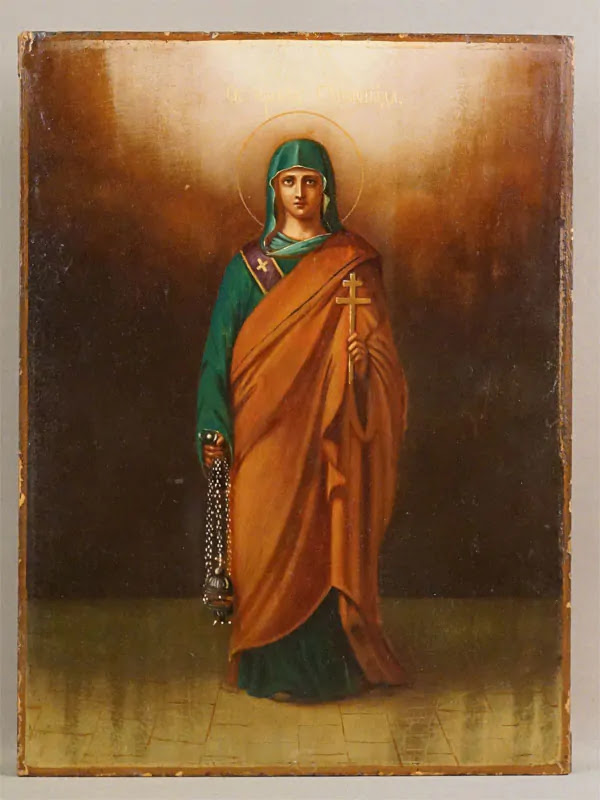
On this day, July 25 according to the Julian Calendar (August 7 civil calendar), the Georgian Orthodox Church commemorates the holy women Olympias the Deaconess and Eupraxia the Virgin.
Saint Olympias the Deaconess was the daughter of the senator Anicius Secundus. While she was still very young, her parents betrothed her to a pious young man, and the wedding was to be celebrated as soon as Olympias came of age; but her betrothed soon died. The blessed one did not wish to marry and chose the life of virginity.
After the death of her parents Olympias inherited great wealth, which she generously distributed to the poor, to orphans and to widows, giving unstintingly to churches and monasteries, to hospitals, and to shelters for the infirm and for strangers.
Patriarch Nectarius (381–393) appointed the holy woman a deaconess, and she fulfilled her duties diligently and blamelessly.
When they visited Constantinople, Olympias greatly assisted and lovingly served the hierarchs Amphilochius of Iconium, Onesimus of Pontus, Gregory the Theologian, Peter of Sebaste, and Epiphanius of Cyprus.
Saint John Chrysostom (†407; commemorated November 13) held the blessed mother in high esteem. Together with the other deaconesses, Olympias grieved deeply over the unjust expulsion of the innocent hierarch from his see. When Chrysostom was leaving the church for the last time, he called her to himself together with the deaconesses Pentadia, Procla and Silvina, and told them that the case stirred up against him was drawing to its close and that they would likely never see him again. He then asked them not to abandon the church, and to obey the hierarch who would be appointed in his place.
After John Chrysostom was driven out, the cathedral of Holy Wisdom burned down. The fire spread to the neighbouring buildings and consumed a great part of the city. All the supporters of the exiled hierarch were accused of the crime, and Saint Olympias too was interrogated. Although no evidence whatever was found against her, she was nevertheless forced to pay an enormous fine, as though she had hired those who started the fire. After this the blessed one left Constantinople and went to the city of Cyzicus on the Sea of Marmara; but her enemies did not cease their persecution: the holy woman was seized and in the year 405 exiled to Nicomedia, where she endured many afflictions and sorrows. From his own exile the hierarch John Chrysostom wrote to the blessed one, consoling and encouraging her: “Only one thing is fearful — sin. All the rest is a fable: treachery or flattery, falsehood or hypocrisy, evil speech, slander, loss of property, banishment, the sharpest swords, the sea, or even the whole world risen up against you. Whatever these trials and afflictions may be, they are temporary and swiftly passing; they touch only the corruptible body, and can do no harm to the valiant soul.” And again: “Let nothing that befalls you trouble you; do not call upon this man or that, do not chase after shadows, for human help is a shadow. Call upon Jesus, whom you serve — call upon Jesus unceasingly!”
Saint Olympias reposed in the year 409, in exile. The blessed one appeared to the bishop of Nicomedia and instructed him to place her body in a coffin and commit it to the sea: “Wherever the waves cast the coffin ashore, there let my body be buried,” she told the bishop. The holy relics floated to a place called Brochthoi, near Constantinople. The people who lived there, having been informed of this from on high, reverently brought the saint’s body out of the sea and buried it in the church of the Apostle Thomas. Later, during an invasion of the barbarians, that church burned down, but the relics of the venerable mother remained unharmed. In the days of Patriarch Sergius (610–638) the holy relics were translated to Constantinople and placed in the women’s monastery which Saint Olympias herself had founded.
The venerable Eupraxia was the daughter of Antigonus, a nobleman of Constantinople and a kinsman of the holy right-believing Emperor Theodosius the Great (379–395).
The wealthy and influential Antigonus and his wife Eupraxia were distinguished by their fear of God and their compassion, and they named their only daughter Eupraxia as well. Antigonus soon died, after which the mother withdrew from the imperial court and, under the pretext of inspecting her estates, set out with her daughter for Egypt. There, near the Thebaid, stood the women’s monastery of Tabennisi, with a strict rule. The life of its ascetics drew the devout widow. She wished to help the convent, but the abbess Theodula refused, declaring that the nuns had entrusted themselves wholly to the Lord and desired to acquire no earthly treasure. The superior accepted only candles, incense and oil.
At that time little Eupraxia was seven years old. The monastic life pleased her, and she desired to remain in the convent. Her mother asked the child to be humble, never to dwell on her noble birth, and to serve the Lord and the sisters with diligence. Soon Eupraxia the elder (commemorated January 12) reposed. When he learned of this, Emperor Theodosius sent her daughter a letter, reminding her that at the age of five her parents had betrothed her to the son of a senator, and that he now desired Eupraxia to fulfil the promise her parents had given. In her letter of reply the saint informed the emperor that she had already joined the company of the brides of Christ, and asked him to distribute the estates she had inherited to the Church and to the poor.
Eupraxia made her ascetic struggle ever more severe. At first she took food once a day, then once in two or three days, and at last only once a week. The blessed one laboured diligently in the bakery, washed the dishes, swept the rooms, and served the sisters with love.
The enemy of the human race inflicted many evils upon the blessed mother: once, while drawing water, she fell into the well and the sisters rescued her; while chopping firewood for the bakery she struck her foot with the axe and was gravely injured; she fell from a staircase and injured her eye. All these trials Eupraxia bore with patience. For her unceasing struggles the Lord granted His chosen one the gift of working wonders: through her prayer a deaf and mute paralysed child was healed, and a demon-possessed woman was set free from captivity to the evil one. The sick began to be brought to the monastery in the hope of receiving help, while Eupraxia grew ever more humble, counting herself the last among sinners. Shortly before the holy mother’s repose the abbess beheld a vision: in a radiant hall Eupraxia bowed down before the King seated upon a throne and surrounded by angels, and the Most Holy Virgin showed the bride of Christ the luminous dwelling prepared for her, and told her that she would come to abide there after ten days. The abbess and the sisters wept bitterly, unwilling to be parted from Eupraxia. The saint herself, on learning of the vision, also wept, for she counted herself unprepared to pass over into eternity. Eupraxia fell ill, took to her bed, and after ten days — at the age of thirty — reposed in peace (†413).
May the intercessions of Saints Olympias and Eupraxia be with us all.