✝ Venerable Paul of Xeropotamou
July 28 / August 10 (Julian Calendar)
On this day, July 28 according to the Julian Calendar (August 10 civil calendar), the Georgian Orthodox Church commemorates Venerable Paul of Xeropotamou.
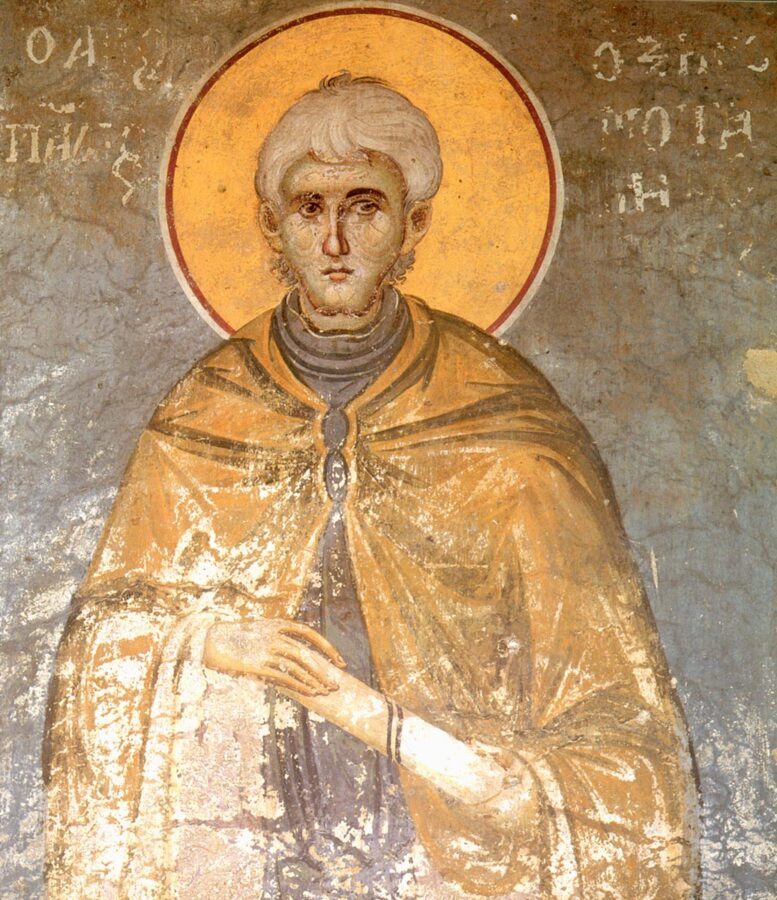
Venerable Paul of Xeropotamou — Procopius in the world — was the son of the Byzantine Emperor Michael Kuropalates. Deeply and thoroughly educated, the emperor’s son was among the most enlightened men of his age. Yet the blessed one turned away from all that passes away and made his way to the Holy Mountain, to the place called Xeropotamou. There the monastery built by the Empress Pulcheria in honor of the Holy Forty Martyrs had already fallen into ruin. Amid the deserted ruins the saint fashioned a small cell and settled within it; soon he was tonsured a monk and, under the name Paul, gave himself over to ascetic struggle. Out of humility the venerable father revealed his learning to no one, but his strict, ascetic life soon made his name renowned. He came to be called Paul of Xeropotamou, and the retreat where he labored is to this day called Xeropotamou — the “dry stream.”
When the saint’s kinsman, the Emperor Romanos, ascended the throne of Byzantium, he prevailed upon the blessed father — through the Protaton of the Holy Mountain — to come to Constantinople. Amid the splendor and luxury of the palace the saint appeared in his old, tattered robe, a cross in his hand, and by the laying of his hand upon the head of the gravely ill emperor he healed him. The grateful Romanos offered him a place at the imperial court, but the venerable father had no desire to return to a vain life so foreign to his soul. He asked only one thing: that the sovereign see to the restoration of the ruined monastery of Xeropotamou. The saint’s wish was fulfilled, and the monastery rose again. When its church was consecrated, a portion of the Life-giving Cross of the Lord, granted to Paul by the emperor, was enshrined upon the holy altar.
The monastery gradually filled with monks, and the silence-loving abbot entrusted the care of the brotherhood to one of his disciples, while he himself withdrew to a distant wilderness for ascetic labor. Soon his spiritual children, unwilling to be parted from their elder, disturbed his stillness there as well. Then he once more sought the necessary means from the Emperor Romanos and built a new monastery in the name of Saint George, translating portions of the Life-giving Cross there.
The Lord revealed to Venerable Paul beforehand the approach of his end. He summoned the brethren of Xeropotamou and of the Monastery of Saint George and gave them his final instruction. On the day of his repose the holy father put on his mantle and, with his customary humility, recited the prayer of Ioannikios the Great, repeating it without ceasing: “My hope is the Father, my refuge the Son, my protection the Holy Spirit; O Holy Trinity, glory to Thee” — and he received the most pure Body and Blood of Christ.
The blessed one had asked that his body be buried on the peninsula opposite the Holy Mountain; but by divine providence the ship came to shore at Constantinople. The emperor and the patriarch received the precious relics with reverence and solemnly enshrined them in the church of the Holy Wisdom (Hagia Sophia). After the sack of Constantinople by the crusaders, the incorrupt relics of Saint Paul were translated to Venice.
May the intercessions of Venerable Paul of Xeropotamou be with us all.