
✝ Venerable John the Dwarf (Kolobos) (5th Century)
November 9 / November 22 (Julian Calendar)
On this day, November 9 according to the Julian Calendar (November 22 civil calendar), the Georgian Orthodox Church commemorates Venerable John the Dwarf.
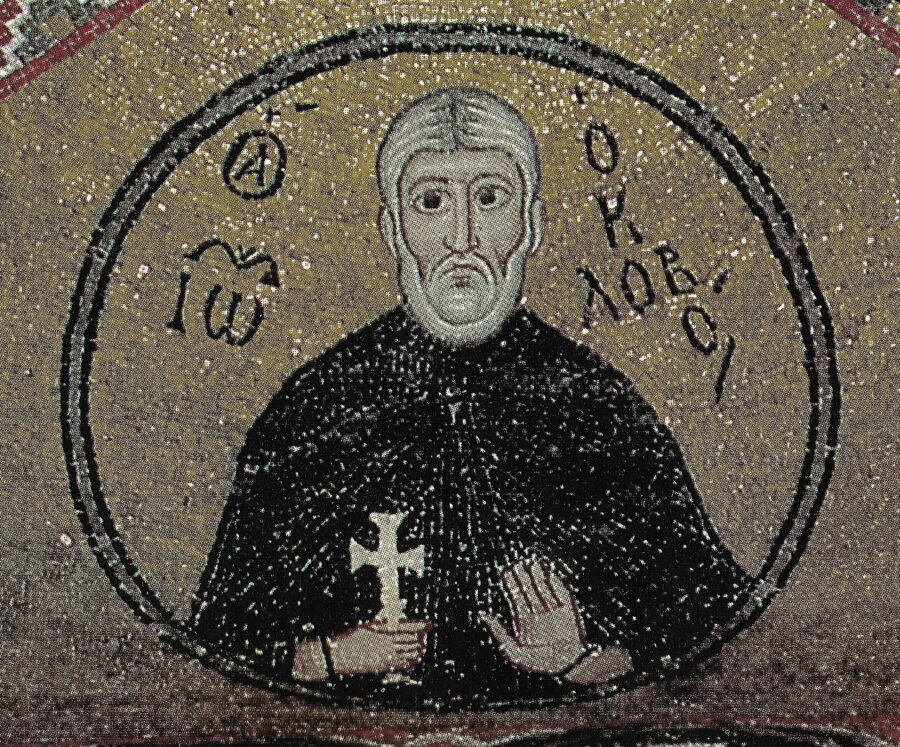
Venerable John Kolobos (in Greek, “the Short”) labored in the 5th century in the monastery of Venerable Poemen the Great (commemorated August 27) in the desert of Scetis in Egypt. (It was from the name of this desert that the secluded dwellings set apart from a monastery, where monks struggle in solitude, later came to be called “sketes.”) He came to the monastery together with his brother Daniel. Once Venerable John, as if in imitation of the life of the angels, decided no longer to care for clothing or food; he took off his garments and left his cell. At night, when it grew very cold, he could no longer bear the chill, came back and knocked at Daniel’s door. For some time his brother would not open to the blessed one, telling him that angels do not care for the body. The saint understood that he had trusted too much in himself. After this lesson John went to Venerable Poemen, a teacher of firm and unshakable will, asked for his spiritual guidance and promised to obey him in everything.
To train the young monk in patience, Saint Poemen gave him a strange obedience: for three years blessed John carried water to a withered tree, which in the end was covered with green leaves and laden with fruit. This miraculously revived tree was called “the Tree of Obedience.” Later the Lord’s chosen one himself guided ascetics who sincerely sought salvation. Among his spiritual children were Venerable Arsenius the Great (commemorated May 8), blessed Thaisia (commemorated May 10) and many other renowned ascetics.
The holy father was distinguished by a wonderful love for mankind and a tender consideration for others. Once he left the skete with several brethren. Night overtook them on the way, and in the darkness their guide lost the road. “Father, what shall we do? Wandering like this could even be the death of us,” the monks complained to Venerable John. The saint replied: “Say nothing to the guide: the poor man will be ashamed and grieved, he will take offence and perhaps even begin to murmur. Let us rather do this: I will pretend to be ill and say that I cannot go on, and we will stay here until dawn.” John did so, and the others declared that they too would stay with him. They all halted, spent the night in that place, and did not wound their neighbor’s heart.
Many of Venerable John’s wise sayings, parables and counsels have come down to us. In one parable the saint says: In a certain city there lived a charming but dissolute woman. The ruler of the city loved her and, wishing to make her happy, asked for her hand on condition that from then on she would live a pure and chaste life. The woman gave her promise, and the ruler married her. When her former lovers learned of this, they said to one another: “The governor has taken our beloved from us — how can we lure her out? If we go to his house, he will recognize us and punish us severely. Better to pass near our friend’s house and give a whistle as a signal to call her out. She will know us by the sound and come out to us herself.” And so they did. But their hopes were disappointed: when the woman heard the whistling, she stopped her ears, ran into her husband’s inner chamber and locked herself in.
The meaning of this parable is this: the dissolute woman is the soul; her lovers are the passions; the lord of the city is Christ; the marriage is repentance; the whistling is the temptations of this world; and the inner chamber is a life lived according to the commandments of the Lord.
The Life of Venerable Paisius the Great (commemorated June 19) is also attributed to Saint John.
The Lord’s chosen father reposed in the first half of the 5th century, in the year 422 or 430.
May the intercessions of Venerable John the Dwarf be with us all.