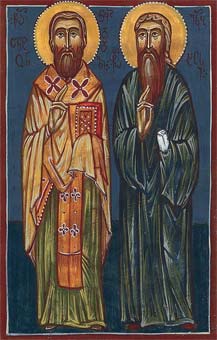
✝ Venerable Anthony, Metropolitan of Chqondidi (†1815), and His Disciple Hieromonk Iakob
October 13 / October 26 (Julian Calendar)
On this day, October 13 according to the Julian Calendar (October 26 civil calendar), the Georgian Orthodox Church commemorates Venerable Anthony, Metropolitan of Chqondidi, and his disciple Hieromonk Iakob.
Venerable Anthony of Chqondidi, one of the most eminent figures of the Church of Georgia, was born into the large family of Otia Dadiani, ruling Prince of Samegrelo. His mother, Gulkani, was the daughter of Shoshita III, Eristavi of Racha. Five sons and one daughter, Mariam, were raised in the family; Mariam later became Queen of Imereti as the wife of King Solomon the Great. The children received their first education from their mother, a woman who carried on the traditions of the mothers of old and whose living faith and good works were an example to all. After his father’s death the young Anthony (his secular name is unknown) was raised at the court of his brother, Katsia Dadiani. He was being prepared for secular service, and so he was taught secular literature, poetry, philosophy and the arts more deeply than Holy Scripture and the works of the Fathers. Anthony also knew Tatar, a language that was then highly prestigious and indispensable. Yet it came to pass that Anthony resolved to embrace monasticism, and he was soon tonsured.
Having become a monk, Anthony felt an ever greater thirst for ecclesiastical learning. He turned to the monks of Martvili, under whose guidance he studied the writings of the holy Fathers. To complete his education, French missionaries were brought to him to teach him scholastic philosophy. Anthony approved neither of the Frenchmen’s conduct nor of their teaching, for he discovered that the French monks were mixing the tares of heresy into Orthodox doctrine. Once, at dinner, Anthony said to the Latin monk: “Can you pour wine into this glass of water so that the two do not mix?” The Latin teacher answered that this was impossible. Then Anthony said: “Just as water and wine cannot be poured into one glass without mixing, so one man’s mind cannot hold both Orthodox and heretical teaching without the one mingling with the other.” From that day he dismissed the Latin monk.
The desire for learning gave Anthony no rest. “I was sick with longing for learning and sought a physician,” he himself writes. At that time word reached Samegrelo that a school of philosophy had opened in eastern Georgia, and around 1757 Anthony set out for Tbilisi, to the court of King Erekle II, whose wife Darejan was his paternal aunt.
After returning to Samegrelo, in 1761 Venerable Anthony was consecrated Bishop of Tsageri. In 1765 he had to travel to Tbilisi, for Erekle’s sister Elisabed was being given in marriage to Anthony’s brother, Katsia Dadiani. During the Divine Liturgy the young Anthony was handed a blank sheet of paper; by the custom of the time this meant that he was to deliver the sermon. It was the feast of Pentecost. Anthony preached so beautifully and so wisely that the delighted Catholicos embraced and kissed him at the ambo.
In 1777 Grigol of Chqondidi, son of Bezhan Dadiani, reposed. That same year Anthony of Tsageri ascended the throne of Chqondidi, while the see of Tsageri passed to his kinsman Sopron.
The preaching of Anthony of Chqondidi had an immeasurable influence on his hearers. Angelic virtue was imprinted on his face, worn thin by fasting. By order of this wondrously kind hierarch, a meal was prepared every day for the poor and destitute at the residence of Chqondidi, and this custom was kept thereafter by all the hierarchs of Chqondidi.
In the eighteenth century certain nobles of Samegrelo introduced the most terrible practice of selling captives. Anthony firmly opposed this evil custom. He anathematized the buyers of captives, would not allow a priest into their homes, and closed the church of their village. In 1792 and 1794 local councils were held under Anthony’s presidency, which passed stern judgment on those who bought captives. These severe measures achieved their aim: the guilty begged forgiveness, accepted their penance, and redeemed the captives they had sold.
In 1789 Metropolitan Anthony left the see of Chqondidi, took up the simple labour of a monk, and withdrew into solitude at the Nakharebau Monastery, which he himself had built. He enriched this monastery with holy relics, ancient icons, extensive estates and peasants. In the year before he stepped down from Chqondidi (1788), he persuaded the ruling prince, Katsia Dadiani, to free all church lands from secular taxes. Ever at Saint Anthony’s side stood his closest friend and helper, Hieromonk Iakob, about whom no biographical information has come down to us.
Venerable Anthony reposed at a great age in 1815 in the monastery he had built, and he was buried there.
May the intercessions of Venerable Anthony of Chqondidi and Hieromonk Iakob be with us all.