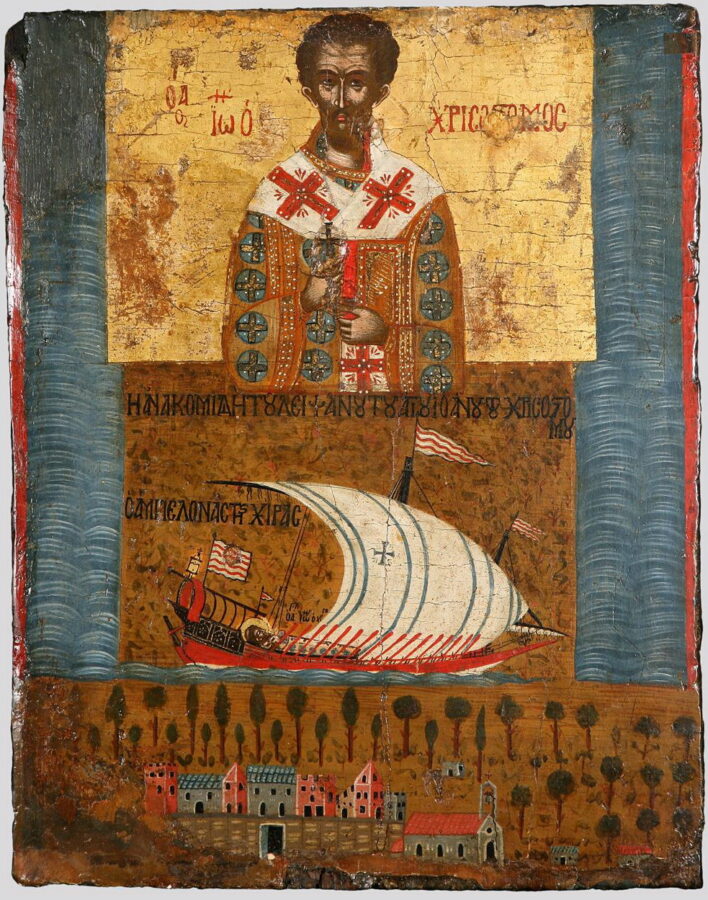
✝ Saint John Chrysostom, Archbishop of Constantinople (†407)
November 13 / November 26 (Julian Calendar)
On this day, November 13 according to the Julian Calendar (November 26 civil calendar), the Georgian Orthodox Church commemorates Saint John Chrysostom, Archbishop of Constantinople.
Saint John Chrysostom was born in Antioch around the year 347. His parents, Secundus and Anthusa, were noble and God-fearing people. Secundus held the rank of military commander and enjoyed great respect at the imperial court, but he died early, and the upbringing of the young John fell entirely upon his mother, who had been widowed while still very young, at only twenty years of age. Anthusa instilled in her son the spirit of Christian piety, and at the same time gave him a secular education under the guidance of the renowned scholars of that time. At eighteen John went to Athens to complete his education. There, by his wisdom and learning, he soon surpassed all his peers and many philosophers as well, which also earned him envious enemies. Even then many pagans were converted to the faith of Christ through the saint’s preaching. The Archbishop of Athens resolved to ordain him a priest and to appoint him as his successor. When John learned of this, he secretly slipped away from Athens and returned to his native Antioch.
In Antioch Saint John lived in seclusion; nothing of this world attracted him, and together with his friend Basil (later Bishop of Raphanea) he wished to become a monk. Then his mother Anthusa reminded him that she had no one else left in this world to comfort her, and begged him: “Do not leave me while I am still alive.” John heeded his mother’s request and set aside his intention for a time, but even at home he lived like a hermit, spending all his time in fasting and prayer. During this period John drew close to the Patriarch of Antioch, Saint Meletius, who baptized him and appointed him a reader in the Church. Three years later Anthusa died. John buried his mother with honor, then distributed all his property to the poor, set his slaves free, and withdrew to a monastery, where he spent his days in strict ascetic labor. It was here that Saint John wrote his works On the Priesthood, On Compunction, and the Letter to Theodore.
One night one of the monks of this monastery, Eusebius, saw that John was visited by two apostles clothed in radiant garments — John and Peter. John held a scroll in his hand, and Peter held keys. John the Theologian handed him the scroll and said:
“The Lord grants you the deepest wisdom, that you may instruct the flock of Christ and silence the heretics!”
Saint Peter then entrusted him with the keys:
“I am Peter, the keeper of the keys of the Kingdom. The Lord gives you too the keys of the Church, so that whomever you loose shall be loosed, and whomever you bind shall be bound.”
John fell at the apostles’ knees and cried out:
“Who am I, the last among men, that I should take upon myself so great and so difficult a task?”
But the apostles raised him up and said to him:
“Arise, take courage, and fulfill that to which the Lord Jesus Christ calls you. Preach the word of God to the people and do not fear difficulties: God has willed that through you many souls be converted to the faith of Christ and come to know the true God. Know also that many trials await you for preaching the truth, but endure them with courage, for by this path you will inherit the Kingdom of Heaven.”
The saint continued to live in the monastery and labored tirelessly for the salvation of his soul. Soon he became renowned as a wonderworking father, and great numbers of people came to him to receive healing and to hear his soul-profiting words. To flee human glory, Saint John withdrew still farther, into a cave. He lived there for two years, but his severe ascetic struggles so weakened his health that he no longer had the strength to care for himself and was forced to return to Antioch. This too happened by the providence of God, so that through his preaching many pagans would be converted to the faith of Christ and many Christians would be strengthened in the faith. The Patriarch of Antioch, Saint Meletius, received John with great love, ordained him a deacon, and kept him at his side for six years. Many of John Chrysostom’s works belong to this period.
When Saint Meletius reposed, John again returned to the monastery where he had labored before, and spent three more years there. At that time the Patriarch of Antioch was Flavian. Once, while he was praying at night, an angel of the Lord appeared to him and commanded him to go to the monastery where John was laboring and bring him back: from then on the saint was to preach the teaching of Christ publicly. At the same time John too received a vision — an angel commanded him to obey Flavian. And indeed the patriarch himself came to the monastery, where the monks received him with great honor and led him into the church. The patriarch celebrated the Liturgy and announced to the brethren that he must take John with him. Everyone was grieved at parting with Saint John, but they submitted without a word to the will of God.
On the very next day after their arrival in Antioch, John Chrysostom was ordained a priest. During the laying on of hands all beheld a miracle: a white dove, flying in from somewhere, circled above Saint John’s head. From then on the pastor devoted himself with great zeal to the care of his flock: twice a week, and sometimes even daily, he instructed the people from the ambo. Saint John diligently explained the Holy Scriptures to the people, for he considered this work especially needful and essential. He left us commentaries on the books of the Old Testament, on the Gospels of Matthew and John, and on the Acts of the Apostles; he especially loved the Epistles of the Apostle Paul and often expounded them.
Because of the great crowds, not everyone who wished was able to hear Saint John’s sermons, so many wrote down his words and passed them on to one another. These words were read at meals and in the public squares, and people learned them by heart. Whenever it became known that John was preaching somewhere, everyone hurried there: city officials and judges left their business, merchants their shops, craftsmen their workshops — all rushed to hear John and tried not to miss a single word he said. That is why the saint was called “the sweet-speaking,” “honey-flowing,” and at last “Chrysostom,” the Golden-Mouthed. Saint John strove to make his words equally understandable to the learned and to the simple; he preached tirelessly and always found a word of consolation for his flock.
Meanwhile Nectarius, Patriarch of Constantinople, died, and for a long time no successor could be found. At last the Byzantine Emperor Arcadius sent a messenger to Flavian and ordered him to send John Chrysostom to Constantinople. Antioch was plunged into deep sorrow. The people would by no means part with their beloved pastor. They all gathered in the great church of Antioch and, despite Flavian’s exhortations, would not allow the emperor’s envoys to take Saint John away. Nor did John Chrysostom himself wish to go, for he did not consider himself worthy of the patriarchal office. Then the emperor was filled with even greater curiosity — he wished to see who this man was who had won such love from the people. He ordered his servants to take Saint John secretly out of Antioch, and they did so.
As he approached Constantinople, the whole city came out to meet John Chrysostom, and the emperor too received him with honor. Soon a Church council was convened, at which John Chrysostom was elected Patriarch of Constantinople. His enthronement took place on February 21, 398. The emperor came with his nobles to the patriarch to receive his blessing. The patriarch blessed the emperor and exhorted him to uphold firmly the holy Orthodox faith, to avoid communion with heretics, to attend church often, and to be merciful and just. John Chrysostom labored zealously for the spiritual good of his flock, mercilessly denouncing evil habits, impurity, envy, greed, adultery, and every kind of uncleanness. He preached love, mercy, moral purity, and justice, and called everyone to a life pleasing to God.
Once, in the days before Pascha, John Chrysostom was grieved at heart by the unseemly behavior of the people — the very people he loved so much and for whose spiritual progress he cared so deeply. On Wednesday of Holy Week a violent storm arose that threatened to flood the city. The people were frightened, repented, and thronged to the churches. But as soon as the danger had passed, they forgot the stern warning, and on Saturday they again gave themselves over to unbridled merriment: they flocked to the circuses and theaters and began holding banquets. Shaken to the depths of his heart, on the first day of Pascha John addressed his ungrateful flock with his famous homily Against the Spectacles.
John Chrysostom cared not only for Constantinople but also for the surrounding lands. He sent experienced pastors to the nearby cities to preach the divine law and to strengthen Christianity. He utterly destroyed the pagan altars that had stood for centuries in Phoenicia, brought back to the faith of Christ peoples who had earlier been led astray by the Arians, and converted to Christianity the Scythians along the Danube — in short, he illumined the whole world with the light of faith. Saint John cared especially for the sick and the poor. He built many hospitals and shelters for the homeless, appointed attendants and physicians for them, and helped them unceasingly in word and deed.
Once the holy hierarch traveled to Asia Minor, for he knew that the sin of simony — the buying and selling of priestly rank — had spread in the Church there. The saint exposed this lawlessness, severely punished the guilty priests and bishops, and appointed worthy men in their place. After this he returned again to Constantinople.
Despite his high rank, John Chrysostom never abandoned strict monastic asceticism: he spent all his free time in solitude, in prayer and fasting; he slept little, ate little, and never attended banquets or spectacles.
Saint John fearlessly denounced the sins of the powerful — their greed, covetousness, and injustice — and warned them of God’s wrath for their lawless deeds. For this he earned the enmity of many nobles: the saint’s words only provoked irritation in them, for they did not want to give up their sins and found it hard to hear rebuke. They slandered the saint, tried to discredit him in the eyes of the people, and sought somehow to be rid of him. Nevertheless, the saint’s fame grew ever greater, and many came from distant lands to hear him. Among John Chrysostom’s enemies one was exceedingly powerful — Empress Eudoxia. She was possessed by a terrible passion of covetousness and greed; she stopped at nothing to amass wealth and seized her subjects’ property by force or by deceit. Every sermon in which John Chrysostom denounced covetousness the empress took as directed against herself, and she hated him fiercely. Eudoxia resolved to remove the patriarch, whatever it might cost. Among the saint’s enemies were also Theophilus, Patriarch of Alexandria, several bishops, and those priests whose enjoyment of a lawless life was hindered by the saint’s preaching.
Then Theophilus of Alexandria convened a council in Constantinople, which condemned Saint John in his absence and deposed him from the patriarchate. The emperor, won over by the empress, agreed to the council’s decision and ordered the saint’s banishment. Outraged, the people gathered at the church; they denounced the emperor and empress and defended their hierarch. For three days no one could approach the church. But Saint John did not want a new accusation brought against him — that he had disobeyed the emperor’s command — and so he quietly slipped out of the church and gave himself up to the soldiers.
When the people learned of this, they set out to stone Bishop Theophilus, who took fright and fled Constantinople in haste. The people surrounded the imperial palace and demanded the saint’s return. That same day a great earthquake struck, which frightened Empress Eudoxia, and she begged the emperor to bring the patriarch back. Boats crossed the Sea of Marmara as the emperor’s messengers urged Saint John to return. The hierarch agreed. The people of Constantinople came out to meet their patriarch with lighted candles, and soon the sea was filled with boats ablaze with torches. When they entered the city, the people, singing psalms, led him into the church with great honor. The saint offered prayer to God and then addressed the people, who listened with hope to their beloved hierarch. The people rejoiced, and the saint’s enemies scattered.
The patriarch continued his ministry, but the peace did not last even two months. Near the Church of Hagia Sophia, Empress Eudoxia erected a tall column bearing her statue and held great festivities and games at its unveiling. The noise reached the church and disturbed the celebration of the Divine Liturgy. Saint John asked the city prefect to stop the riotous celebration, but he paid no heed to the patriarch’s words. Then Saint John delivered a stern sermon of rebuke in the church, which began: “Again Herodias rages, again she is troubled, again she dances, again she seeks the head of John!”
This was swiftly reported to Eudoxia, and she was told that by Herodias he clearly meant her. The empress flew into a rage and tearfully implored the emperor to convene another council against John Chrysostom. Letters were again sent to all the bishops who had taken part in the previous council, and once more the saint’s enemies assembled. Only Theophilus, Patriarch of Alexandria, did not appear, for he remembered well how the previous council had ended for him, though he sent three bishops in his place. The lawless council again condemned Saint John.
As Pascha approached, the emperor, on the advice of certain bishops, sent word to John Chrysostom:
“Leave the church, for two councils have condemned you! I cannot enter the church while you are there!”
John replied:
“Jesus Christ entrusted the Church to me, and I cannot abandon it of my own will. Let your servants come and remove me by force; then I will not have to answer before Christ for abandoning the Church of my own accord.”
The emperor hesitated at first, but then, at the urging of the patriarch’s enemies, he did indeed send one of his commanders, Marinus, to the church with orders to remove the patriarch by force. Until the order for his exile arrived, he was permitted to remain in the patriarchal residence for two months. During this time the saint suffered many trials through the malice of his enemies. Twice they sent hired assassins against the hierarch, but the house was vigilantly guarded by the patriarch’s faithful people, who saved him.
On the day of Pentecost Saint John was handed the order to depart into exile. One of the nobles advised him to leave the city secretly, so as to avoid unrest and bloodshed among the people. Then the saint called together several faithful bishops and clergy, as well as the deaconess Olympias, and bade them farewell. Everyone wept, and Saint John himself wept, for they sensed that they were parting from one another forever. Soon the hierarch secretly left the house and made his way to the seashore, where soldiers were waiting for him: they put the saint in a boat and sent him on his way.
After Saint John’s banishment a great fire broke out in Constantinople, clearly a manifestation of God’s wrath. Many buildings burned, great wealth was destroyed, and the palace where the councils against John Chrysostom had been held was consumed, yet the people remained unharmed. The saint’s enemies declared that the fire had been set by his supporters.
Meanwhile Saint John Chrysostom was traveling toward his place of exile. The soldiers escorting him beat and tormented him cruelly, carrying out the empress’s orders, for Eudoxia wanted the hierarch to depart this life as soon as possible. The soldiers set the saint on a donkey and drove him on with all their might, giving him no rest; they made him spend the nights in the filthiest inns, starved him, would not allow him to enter churches, and showered him with abuse. Monks and nuns whom they met along the way wept bitterly at the sight of the sufferings of this great father.
When the saint reached the city of Cucusus in Lesser Armenia, he was received with great honor by the bishop of that city, Adelphius, who had been told in a vision beforehand of the guest who was to come. In Cucusus he converted many unbelievers by his preaching; people came from every side to hear him, and his old acquaintances and admirers even came from Antioch. News of this reached Constantinople. The saint’s enemies grew alarmed — even in exile John Chrysostom was dangerous to them. Soon an order arrived in Cucusus that he was to be taken still farther away, to the shore of the Black Sea, to the city of Pityus (Bichvinta). Once again the saint’s torments began: the soldiers treated the prisoner even more cruelly than before; they bypassed villages and towns so that he would have no chance to rest, and through heat and wind they mercilessly drove on the donkey on which Saint John rode. This journey finally exhausted the saint. One night the holy apostles John and Peter again appeared to him, announced his approaching end, and told him also that the empress would be severely punished for her crime. Saint John was accompanied by two priests and a deacon, faithful to him, who with their own eyes beheld the holy apostles and gave glory to God. A few days later they reached Comana (in Abkhazia, Georgia). Near this town stood a church of Saint Basiliscus, a bishop martyred in the time of Emperor Maximian. The travelers spent the night by the church. During the night Saint Basiliscus appeared to John and said: “Take courage, brother John! Tomorrow we shall be together!”
The next day Saint John entered the church, vested himself in his hierarchal vestments, and distributed his own clothing to those who accompanied him; then he celebrated the Divine Liturgy, received Holy Communion, blessed everyone, bade farewell to all, and with the words “Glory be to God for all things” commended his soul to the Lord. This took place on the day of the Exaltation of the Cross in the year 407, when Saint John Chrysostom was sixty years old. He had governed the Church of Constantinople for six years and had spent three years in exile.
The priests and the deacon who had accompanied the saint bitterly mourned the hierarch’s death. Soon they traveled to Rome to Pope Innocent and told him in detail of the saint’s persecution and repose. Innocent sent a stern letter to Arcadius in which he wrote: “You have driven out a true shepherd and handed his flock over to strangers. But God, the righteous Judge, will punish you for this crime just as He punished Cain for the murder of his brother Abel!”
Honorius, the Western emperor and brother of Arcadius, likewise wrote him a letter full of reproach. As a result of all this, Arcadius was seized by terrible fear and trembling; he repented of his deeds and sought out all who had fought against John Chrysostom, punishing some with death and stripping others of their priestly rank. The bishops who had taken part in the lawless council and in the persecution of John Chrysostom he cast into prison. Nor did the empress escape punishment: the emperor put her away from himself, shut her up in a separate palace, and forbade anyone to have contact with her.
God Himself repaid the saint’s enemies: on some He sent terrible diseases, on others sudden death; some were struck dumb, and Theophilus, Patriarch of Alexandria, lost his mind and died in that state. God’s wrath overtook Empress Eudoxia as well: she was stricken with a severe hemorrhage, worms swarmed upon her, and she gave off so terrible a stench that no one could come near her. The physicians could do nothing to cure her illness. Then Eudoxia herself said to them: “You cannot help me — God is judging me because I persecuted Patriarch John.” She returned to their owners the possessions she had unjustly seized, but nothing could relieve her illness, and Eudoxia soon died. As a reproof of her lawlessness, the coffin in which Eudoxia lay shook for thirty-two years, until the son of Arcadius and Eudoxia, Emperor Theodosius, translated the saint’s relics from Comana to Constantinople (this took place on January 27, 436). Then the emperor besought Saint John to forgive the empress her terrible sin. The saint heard him, and from that time Empress Eudoxia’s coffin ceased to shake.
Thus God punished the saint’s enemies, while Adelphius, Bishop of Cucusus, who had once received Saint John with love, was granted this vision: an angel led him into Paradise and showed him the place where all the holy fathers and teachers of the Church dwell. Adelphius looked for Saint John but could not find him anywhere, and he came out grieving. The angel asked him:
“Why are you downcast? Everyone who enters here comes out joyful, even if he went in sorrowful, but you do the opposite: you went in joyful and come out with a sorrowful face!”
Adelphius answered:
“I grieve because among these holy fathers I could not find my beloved teacher John anywhere.”
“You must mean John, the preacher of repentance?”
“Yes,” answered Adelphius.
“No man in the flesh can behold him, for he stands before the throne of the Lord together with the Cherubim and Seraphim,” said the angel.
Adelphius rejoiced and gave thanks to God for revealing this mystery. Saint John Chrysostom, the great God-pleaser who endured many sufferings for Christ, rests in the Kingdom of Heaven, while his writings have helped the faithful on the path of salvation for many centuries and help them still today: they raise up the fallen, encourage the despairing, console the mourning, and open the door of repentance to sinners.
May the intercessions of Saint John Chrysostom be with us all.