✝ Holy Protomartyr and Equal-to-the-Apostles Thekla
September 24 / October 7 (Julian Calendar)
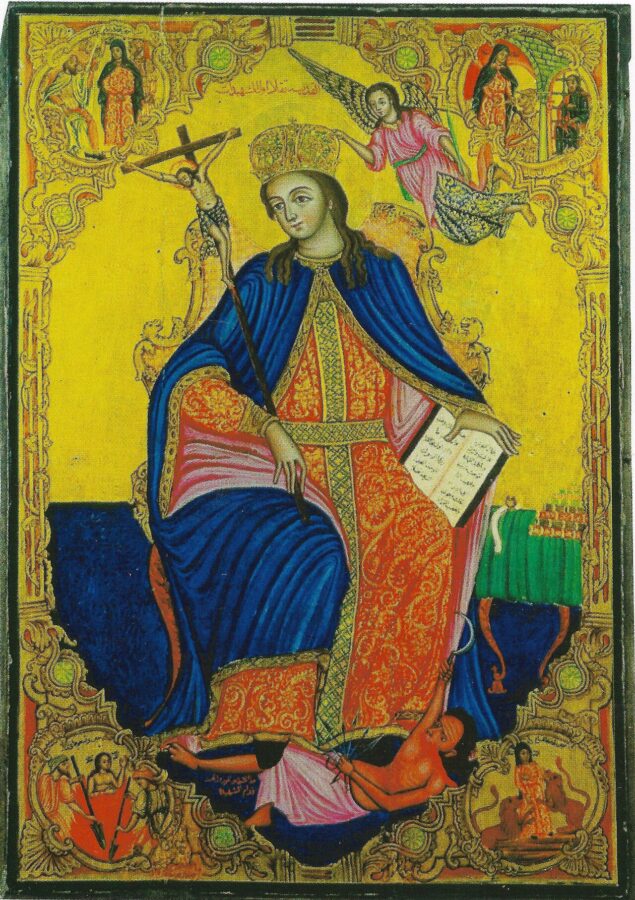
On this day, September 24 according to the Julian Calendar (October 7 civil calendar), the Georgian Orthodox Church commemorates Holy Protomartyr and Equal-to-the-Apostles Thekla.
Holy Protomartyr and Equal-to-the-Apostles Thekla was born in the city of Iconium. She came from a noble and wealthy family and was remarkable for her extraordinary beauty. At eighteen, Thekla was betrothed to a distinguished young man, Thamyris, but the blessed one then heard the preaching of the Apostle Paul, who had come to the city at that time. She loved the Savior with her whole heart and firmly resolved to keep her virginity for Christ’s sake. Her mother pressed her to marry. Thekla’s betrothed denounced Paul to the governor of the city: “He will deprive young men of their wives and virgins of their husbands, for he lays down the law that none should marry.” The Apostle was bound and thrown into prison. By night Saint Thekla slipped out of her house, bribed the guards of the dungeon, and made her way into Paul’s cell. For three days the virgin sat at the saint’s feet, listening to his teaching, “sweeter than all honey and honeycomb,” and growing in the faith. When Thekla’s absence was noticed, her parents sent servants everywhere to look for her. At last they found the blessed one in the prison and took her home by force.
The governor had Paul scourged and driven out of the city. For a long time they urged Thekla to consent to marriage, but neither her mother’s tears and anger nor the governor’s threats could extinguish in her the love of her heavenly Bridegroom, the Lord Jesus Christ. Then her mother, forgetting everything, in her fury herself demanded of the judge that her daughter be put to death. Thekla was sentenced to be burned. Making the sign of the Cross, the martyr climbed fearlessly onto the pyre. At that moment the Savior Himself appeared to her, blessed her future labors, and filled her soul with inexpressible joy. The flames leaped high but did not touch Thekla; they encircled her like a ring. Suddenly the sky thundered, and a torrential rain mixed with hail put out the fire. The terrified executioners scattered, while the martyr, preserved unharmed, left the city and, with the help of a young Christian, found the Apostle Paul. Saint Paul and his companions, among them the Apostle Barnabas, had taken shelter in a cave near the city and were praying fervently that the Lord would strengthen Thekla amid her sufferings. The holy virgin traveled with them as far as Antioch. There a nobleman named Alexander was captivated by her beauty and wished to possess her. The young man could not restrain his passions; “he embraced her shamelessly and kissed her in the streets.” Thekla “turned away from him and drove him off,” and at last tore his cloak, pulled the garland from his head, and “made him a laughingstock before all.” Alexander could not bear the humiliation and brought the saint before the governor. Her persecutors condemned her to death. Twice hungry beasts were loosed upon the blessed one, but they did her no harm. Finally Thekla was tied between two bulls, and the animals were goaded with red-hot irons to bolt in different directions and tear the virgin apart; but by God’s will the bulls did not move from their place, the strong ropes snapped like a spider’s web, and the saint was unharmed. The crowd cried out: “There is one God, the God of Thekla, one God, who has delivered Thekla!” The governor himself understood that Almighty God protected the martyr, and commanded that the handmaid of Christ be set free. With the blessing of the Apostle Paul, the saint settled in a cave on the desolate mountain of Kalamon near Seleucia in Isauria and lived there for many years, preaching the word of God. Thekla turned countless idol-worshippers to Christ, and the Church rightly calls her Equal-to-the-Apostles.
Thekla had also received from the Lord the miraculous gift of healing, and she healed everyone without charge. Because of this the pagan priests rose against her. The godless believed that the “goddess” Artemis loved Thekla for guarding her purity and had granted her the power to work wonders, so they bribed men “foul in life and youths in years” and sent them to the saint to use force against her. When the lawless men, “many as dogs,” were already very near, the blessed one asked God for help. From heaven a voice answered: “Fear not, Thekla, for I am with you!” The rock split open, received the handmaid of Christ, and closed again. Thus her chosen one gave her soul to the Lord (1st century).
The Life and Martyrdom of the Holy Protomartyr and Equal-to-the-Apostles Thekla
The holy apostles Paul and Barnabas, while preaching the Gospel, came to Iconium and lodged in the house of Onesiphorus. This is the same Onesiphorus whom Saint Paul mentions in his epistle to Timothy: “The Lord grant mercy unto the house of Onesiphorus; for he oft refreshed me, and was not ashamed of my chain.” The apostles often went to the synagogue and boldly preached the word of God, setting the people there on the path of salvation and instilling in them faith in Jesus Christ. Many heeded their teaching and believed in the Lord Christ on seeing the miracles and signs they performed. So it is told in the Acts of the Apostles: “And it came to pass in Iconium, that they went both together into the synagogue of the Jews, and so spake, that a great multitude both of the Jews and also of the Greeks believed… Long time therefore abode they speaking boldly in the Lord, which gave testimony unto the word of his grace, and granted signs and wonders to be done by their hands.”
At that time there lived in Iconium a virgin named Thekla, of a distinguished and noble family. Her mother’s name was Theocleia. The most beautiful eighteen-year-old girl was betrothed to a certain Thamyris, one of the city’s leading young men, notable for wealth and good looks. Thekla too saw the miracles worked by the apostles, and sitting by a window in the house of Onesiphorus, she listened to their preaching. The virgin gave her full attention to their words.
The seed of the Lord’s word fell on good ground; by the action of the Holy Spirit it took deep root in Thekla’s heart and flourished: she received faith in the Son of God, loved the Lord, and clung to Him with her whole soul. It was just then that Paul, by divine inspiration, was preaching on virginity and chastity. Among other things he said that if a young woman remains a virgin for the love of Christ, she is made equal to the angels, she will win Christ’s favor, and the immortal Bridegroom will bring her into the heavenly kingdom. Paul preached so much on this theme that he stirred Thekla to keep her virginity. The holy virgin immediately chose to leave her betrothed rather than all the sweetness of the vain world, and vowed to serve Christ in purity until the end of her life. So the wise virgin won the heavenly Bridegroom and, aflame with fiery love, followed Him. Her heart melted like wax with longing to draw near the incorruptible Bridegroom, as though David’s psalm were fulfilled in her: “My heart is like wax; it is melted in the midst of my bowels.” So carried away was Thekla by Paul’s preaching that for three days and nights she took no food or drink and forgot sleep. Like Mary, who “sat at Jesus’ feet, and heard his word,” with her mind fixed on God alone, Thekla too fed only on the word of God, as Scripture says: “Man shall not live by bread alone, but by every word that proceedeth out of the mouth of God.” When Theocleia learned of this, she rushed in fury to Onesiphorus and tore her daughter by force from the work so profitable to her soul, heaping reproach and abuse on the holy apostles. She snatched from Christ’s flock her daughter, already made new in Christ, and took her home. There she summoned Thekla’s betrothed, Thamyris, and rebuked him: “Do you not care at all about your bride? Can you not see that she has lost her mind? Look how those wandering deceivers have bewitched Thekla, who confuse foolish people with their lofty words! For three days now she has not left them, and does not even want to come into the house.”
Thamyris spoke to Thekla tenderly and sweetly, but the virgin would hear nothing and even avoided looking at her betrothed. Her heart was already given to another Bridegroom, “fairer than the children of men.” Him alone she beheld with the eyes of the soul; with Him she conversed in thought. This bodily bridegroom inspired only loathing in her. Thamyris understood that Thekla no longer loved him and was deeply grieved. Beside herself with rage, Theocleia threw her daughter to the floor, beating her and tearing at her hair in her bitterness. When the beating was over, she shut her child in a room and left her for a long time without food or drink. Yet she herself, filled with natural motherly love, secretly mourned her daughter’s fate. When her heart softened, she brought Thekla out, clasped her to her breast, kissed her and begged her in tears not to abandon her handsome, rich, noble, and universally respected bridegroom. She brought Thamyris back and seated Thekla beside him at table. The virgin sat silent, her back turned to her betrothed, her eyes lowered, not touching the food, and in her heart thinking only of her heavenly Bridegroom. When Thamyris tenderly drew her to him and wanted to kiss her, Thekla at once spat in his eyes and slipped from his arms as a bird escapes a snare. Her daughter’s conduct so enraged Theocleia that she fell on the virgin and almost beat the life out of her. Bitterly grieved, Thamyris went to the governor to complain about the Apostle Paul.
“A stranger has appeared in our city,” Thamyris told the governor, “and with his sorcery he has led the people astray, turned them from the worship of the gods, and persuaded them to believe in Christ, whom the Jews crucified. He has bewitched my bride Thekla too. He has turned the virgin’s former love into hatred. She will not even look at me. I am loathsome to her as a leper, and she shrinks from me as if I were a beast. It is this sorcerer who has extinguished the fire of her love for me.”
The governor summoned Paul and questioned him: who are you, where are you from, and what business have you in my city? The apostle opened his apostolic lips and, as was his custom, began to preach the word of God. For some reason the governor did not wish to examine the matter and put off the trial to another time. He had Paul put in irons and thrown into the dungeon: “Let him stay there until I have time to question him more closely.” When Thekla learned that Paul had been imprisoned on her account, at night she quietly slipped out of the house and went to the prison. She offered the guard her golden ornaments, asking only to be let in to the apostle. Saint John Chrysostom tells of it: “Hear what I tell you of Saint Thekla: to visit Paul she gave the guard her gold, while you are unwilling to part with even a small coin to see Christ.” The prison guard gladly took the jewels and led the virgin to Saint Paul. At the sight of the apostle tears of joy burst from Thekla; she fell on her knees before the prisoner of Christ and kissed his chains. At first Saint Paul was troubled to see the maiden, but when Thekla told him what she had endured from her mother and betrothed because she was moved to keep her virginity, he rejoiced greatly. He praised the young woman’s courage, kissed her on the head, and blessed her. “You are the bride of Christ,” he said, “and my firstborn daughter, whom the Gospel has borne a second time.” Thekla remained a long time in the prison. As a daughter sits at her father’s feet and listens, so she settled at Paul’s side, hearing his fatherly instruction and keeping it in her heart like “a pearl of great price.” The apostle tirelessly taught her the Christian faith, trained her in the love of God, and urged her to keep godly reverence. So he strengthened Thekla in the teaching of Christ. Saint Gregory of Nyssa also tells of this: “The apostle once poured into the ears of the holy virgin the perfume (that is, the teaching) adorned with the white lily of godly reverence. By the drops that flowed from the lily of her heart, Thekla put to death the outward man within her, quenching every vain thought and desire.”
Saint Epiphanius also bears witness to this: “Thekla had a betrothed, handsome, the first man in the city, quite wealthy, honored, and distinguished; but she found Paul, and his words made her abandon her betrothed bridegroom. Thus the saint renounced all earthly goods to gain the heavenly.”
Meanwhile, in the house of Theocleia, they began to search for Thekla. When they could not find her anywhere, they began to cry out and lament. The mother wept for her child, Thamyris for his bride, the servants for their mistress. The servants ran this way and that, asking everywhere for Thekla, in the streets and in the houses, but in vain. Only after a long time did they discover that she was in the prison. They hurried at once to fetch her. Entering the cell, they found Thekla sitting at Paul’s feet, as if rooted to the spot, listening breathlessly to the apostle’s teaching. They seized the girl at once and took her home, and immediately reported what had happened to the governor. He at once convened a court and ordered Paul brought. At the apostle’s appearance the crowd cried out: “Governor, this man is a sorcerer; put him to death!”
Thamyris demanded the death sentence most furiously, complaining that Paul had separated him from his bride. Then they called Thekla and asked her: “Why have you rejected so fine and noble a bridegroom? Why do you no longer wish to marry?”
The virgin looked silently at Paul and gave no answer. Then Theocleia lost all restraint; forgetting even natural motherly love, she raged like a lioness, became like a furious she-bear, and in her wildness shouted to the governor: “Burn this wicked servant girl, worthy of death! She is no longer my daughter; she does not listen to me. Have her burned as an example to others! Let the sight of such a punishment strike fear into the daughters of the whole city, so that they never again resist their mothers’ will as this wicked and unruly girl has done. No, this is not my offspring, not the fruit of my womb, but a cursed branch and a withered shoot. Burn her!”
So insistently did the mother demand her daughter’s burning, and Thamyris Paul’s punishment. The governor investigated the apostle’s case at length but could find no charge against him except the preaching of Christ. He did not put him to death; he only had him scourged and expelled from the city, so that he might not persuade other virgins to refuse marriage. Barnabas was driven out together with Paul, and Onesiphorus was banished with his sons. Paul himself longed to leave that city, since besides the governor, Theocleia, and Thamyris, unbelieving people were also persecuting him for his witness to Christ. Saint Luke mentions this in the Acts of the Apostles: “But the unbelieving Jews stirred up the Gentiles, and made their minds evil affected against the brethren… But the multitude of the city was divided: and part held with the Jews, and part with the apostles. And when there was an assault made both of the Gentiles, and also of the Jews with their rulers, to use them despitefully, and to stone them, they were ware of it, and fled unto Lystra and Derbe, cities of Lycaonia, and unto the region that lieth round about,” and from there to Antioch. For a few days at first they stayed in a cave on the road to Daphne near Iconium, wishing to learn Thekla’s fate. They fasted and prayed earnestly that the Lord would strengthen the virgin and grant her mercy. And so it happened:
For a long time the governor tried to persuade Thekla to return to her betrothed, but achieved nothing. Then, at Theocleia’s insistent demand, he sentenced the virgin to burning. They hauled dry wood, hay, and brushwood and kindled a great pyre. The servants seized Thekla and tried to lead her to the pyre. The martyr made them let go, walked swiftly to the fire herself, made the sign of the Cross, climbed up, and stood on top of the pyre ready to die. Her fear of material fire vanished, for the immaterial flame of divine love itself was burning in her. As she gazed steadfastly, the Lord appeared to her in the likeness of Paul and commanded her to stand firm. Hence Saint Cyprian says in his prayer: “Appear to us, as You appeared to Paul in prison, and to Thekla in the fire.”
They stoked the fire and the pyre blazed up. But to everyone’s astonishment the flame leaped high and encircled Thekla. They were still more amazed when suddenly it thundered and a downpour began. The pyre was put out. The governor, with the watching crowd, quickly withdrew from the place. Everyone took shelter in their houses, so terrified were they by the thunder and lightning. Thekla came down. The fire had not harmed her in the least. She did not return to her mother’s house nor linger in Iconium; she left the city and set out to find her spiritual father, Paul. On the way she met one of Paul’s disciples, whom she had seen in the house of Onesiphorus, going to the city to get bread. The holy virgin recognized him and asked: “Where is Paul, the apostle of Jesus Christ?”
The disciple led Thekla to the cave where Paul and those with him were fasting and praying for the holy virgin. When they saw Thekla whole and unharmed, they rejoiced greatly, raised their eyes and hands to heaven, and gave thanks to God for the deliverance of His handmaid. They gave Thekla bread to eat and took a little themselves. From there Paul and Barnabas passed through Lystra and Derbe, preaching the Gospel and healing the sick. Thekla accompanied them to Antioch. As they approached that city, they happened to meet on the road the city’s leading man, Alexander. Like pagans generally, he was a young man given over to desires and lawless deeds. When he caught sight of the holy virgin, he was captivated and filled with impure lust. He thought Thekla was Paul’s wife and offered the apostle much gold not to hinder him in this matter. When he learned that she was an unmarried virgin, his passion grew and he resolved to take Thekla as his wife. He tried to persuade the virgin to love him, but Thekla fled from him “as from a roaring lion that walks about seeking whom it may devour.” Alexander did not cease his efforts to ensnare Thekla’s heart. Once, seeing Thekla among the people going along the road, he could no longer restrain his burning heart; he lost his head and forgot all shame, seized the virgin and threw his arms about her neck. The saint begged the frenzied youth with tears: “Do not force me, I am a stranger; do not compel me, I am a handmaid of God. I have left my betrothed for the Lord’s sake. Can I fulfill your desire?”
With these words she slipped from the young man’s hands, tore his clothing, and put him to shame before everyone. The governor of the city was filled with rage and, learning that she was a Christian, quickly brought her before the ruler. When the virgin was asked why she refused marriage, she answered: “My Bridegroom is Christ, the Son of God. I am wedded to Him in a spiritual union.”
The ruler pressed her to renounce Christ and marry. Meeting her firm refusal, he pronounced sentence: let the virgin be thrown to the beasts. Two charges were laid against Thekla: piety and chastity, that she believed in Christ and, young and beautiful, refused marriage. The punishment was put off till morning, and meanwhile a woman named Tryphaena took Thekla to her house. Tryphaena was of royal descent and held in great honor in the city. Later she too believed in Christ. Saint Paul the Apostle mentions her in his epistle to the Romans: “Salute Tryphena and Tryphosa.”
Tryphaena and Thekla spent the whole night in spiritual conversation. Morning dawned. A vast crowd flocked to the spectacle. The ruler too came with his subordinates. Saint Thekla was led out like a sheep to slaughter and set before the beasts to be devoured. The beasts were loosed, but they only circled the martyr and did not approach her. As once in Daniel’s pit, so now God shut their mouths. The spectators were astonished at this wonder: the bloodthirsty animals had put aside their fury and become like sheep in gentleness. Some glorified Thekla’s God, but others blasphemed and said: “She has a charm in her clothing, and that is why the beasts do not touch her.”
The ruler and his subordinates insisted on the same: she is a sorceress and has bewitched the beasts. They decided that the next day still more numerous beasts, maddened by hunger, would be loosed. Thekla was taken back to Tryphaena. Seeing Thekla return unharmed from the place of punishment, Tryphaena was overjoyed.
All night the ruler kept the beasts hungry so that, ravenous, they would quickly tear the virgin apart. And so the next day the saint was again brought to the place of execution. Tryphaena followed behind in tears, grieving that so holy a virgin was to be put to death innocent. Thekla was set on a raised place. The shameless ruler ordered the virgin stripped: “She has a charm in her clothes, and that is why the beasts do not approach her. Strip her and let us see whether she survives.”
Thekla’s garments were torn off and she was set before the people. The modest virgin, covered only by shame, repeated David’s words: “The shame of my face hath covered me.” Lions and bears, maddened with hunger, were let out. Coming out of their cage, the beasts at the sight of the naked virgin lowered their heads to the ground, cast down their eyes as though ashamed to look on virginal nakedness, and drew back. It was a wondrous sight! The beasts were ashamed, unable to look on the naked virgin, while men gazed shamelessly. At this spectacle the dumb animals became accusers and judges of men. The bloodthirsty by nature became like reasonable human beings, and reasonable human beings like wild beasts. Did they gain anything by it? They stripped the modest virgin before everyone to dishonor her, but in doing so increased her honor. Here is what Saint John Chrysostom says when he speaks of the stripping of two women, Potiphar’s wife and Thekla: “What profit had the Egyptian woman, aroused by passion, from undressing in the bedchamber? What harm came to the protomartyr Thekla, stripped before the whole city? Stripped of her garments, Thekla did not sin, nor was she filled with lawlessness like the Egyptian. On the contrary, she was exalted, as a saint. Her nakedness, seen by so many, became a crown, while the secret undressing of the impure woman was a disgrace.”
A lioness approached the stripped saint, lay down at her feet and licked them, as though paying homage to her virginal modesty. Saint Ambrose mentions this: “You could have seen the beast stretched on the ground licking the saint’s feet, silently attesting that it would do no harm to a virgin’s body. The animal that had been thrown to her to be devoured forgot its natural traits and took on the character that men had lost.”
When the people saw that the beasts did not dare even to touch the holy virgin, they began to shout: “Great is the God whom Thekla confesses!”
Yet the persecutor still did not recognize the divine power and devised another way to kill Thekla. He had a deep pit dug and filled with various reptiles, snakes and vipers, and ordered the saint thrown into it. But He who had earlier shut the mouths of lions now blunted the forked tongues of the serpents, quelled their fury, and destroyed their venom. To everyone’s amazement the martyr came up out of the pit safe and sound. The wicked persecutor was long at a loss what to do; at last he had two strong bulls brought, had Thekla tied by the feet between them, and ordered the bulls pricked with red-hot rods so that they would bolt in different directions and tear the martyr in two. But even by this torment they could do Thekla no harm; the strong ropes with which she was bound to the bulls snapped like a spider’s web. The bulls dashed this way and that, while the saint remained in the same place, whole and unharmed. The astounded ruler then admitted that the power of God was working in the virgin. He summoned her and asked: “Who are you? What power do you have, that nothing could harm you?” She answered: “I am a handmaid of the living God!”
She said nothing more. The ruler, fearing the God who protected Thekla, ordered that she be clothed with honor and released. He also decreed: “I grant freedom to Thekla, the handmaid of God.”
The saint went to Tryphaena’s house. What joy came upon the whole household when they learned that Thekla had been released in peace! The virgin stayed there a short while, preaching the word of God and instructing the people in the faith of Christ. Longing to see her spiritual father and teacher, Paul, she at last found him and wished to go with him, but the apostle would not permit it: “Those going to battle do not take their bride along.”
Thekla received from the apostle his blessing to go to Seleucia. There, in the desert near Seleucia, she settled on a mountain. She labored in fasting, prayer, and contemplation of God, worked countless miracles, and healed every illness. The people living round about brought their sick to her. Thekla instilled faith in the Lord and healed. Once a pagan priest rode by on horseback not far from Thekla’s dwelling. Thekla was gathering herbs for food. The priest was captivated by her beauty and filled with foul desire. He spurred his horse and rushed at the virgin to carry out his evil wish. Clothed with God’s power, the saint seized the rider at once and flung him down with such force that the priest lay unconscious for three days. Passers-by looked in amazement at the priest sprawled on the ground like a dead man, unable to understand what had happened to him. On the third day the news reached the city. A great crowd gathered. The priest came to himself, stood up, and said: “I saw a goddess, and she struck me down.”
Worn out with pain, he barely reached home. He summoned a painter and had him paint the young woman. By God’s providence the painter made the picture resemble Saint Thekla; the likeness was very lifelike. The painter handed the finished picture to the one who had ordered it. When the priest saw such a likeness, he exclaimed: “This is exactly the virgin I saw!”
He took the icon, kissed it, and was instantly and completely healed. Afterward he kept the saint’s image in his house with honor. Through the holy virgin’s preaching he later believed in Christ together with his household. The Equal-to-the-Apostles remained a long time in those parts, set many on the path of salvation, and helped many in trouble and sickness. The doctors and sorcerers of Seleucia were left idle and their income fell, because all the sick were taken to Thekla. An end had come to their devilish tricks. They were distressed and enraged at the virgin who healed without silver. Filled with envy and spite, they resolved to hire foul youths to violate Thekla. In their hatred they plotted: “The virgin Thekla is pure, and that is why the great goddess Artemis favors her. The goddess hears her request and gives her power to heal the sick. If we defile her, Artemis will leave her, she will lose the power to heal, and then our medical art will flourish.”
To carry out the foul plan they indeed found shameless youths. They made them drunk and charged them to violate Thekla. They paid them much money for this loathsome deed and promised more if they carried out the task. The foolish and unbelieving did not know that it was not Artemis who gave Thekla the power to heal, but the grace of Christ! The corrupt and drunken youths set out toward Saint Thekla. As soon as she saw them, Thekla asked: “What do you want, my children?”
In answer she received foul language, and at once she understood their evil intent and fled. She who had not feared wild beasts now fled from shameless men. Like wolves chasing a sheep, they pursued the virgin’s trail, driven by foul desire. They were just about to overtake her when Thekla asked the Lord to deliver her from the hands of the lawless. At God’s command the stone mountain that stood nearby split open and received the holy virgin. This mountain became the resting place of her honored body. There Saint Thekla gave her soul to the Lord. She was ninety years old then. And now, in unending life, she glorifies the Giver of life, Christ our God, with the Father and the Holy Spirit, now and ever and unto ages of ages. Amen.
May the intercessions of Holy Protomartyr and Equal-to-the-Apostles Thekla be with us all.