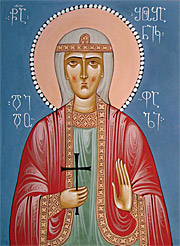
✝ Holy Great Martyr Queen Shushanik (†475)
August 28 / September 10 (Julian Calendar)
On this day, August 28 according to the Julian Calendar (September 10 civil calendar), the Georgian Orthodox Church commemorates Holy Great Martyr Queen Shushanik (†475).
Saint Shushanik was the wife of Varsken, the pitiakhsh (governor) of Hereti. Raised in a Christian family, the queen was distinguished from childhood by her fear of God and her love for Him.
At that time the Persians ruled over Kartli. Seeking to establish good relations with the Persian court, Varsken visited the Persian king Peroz, willingly renounced the true faith, accepted Mazdaism, and promised the king that as soon as he returned to Kartli he would make his wife and children accept his new religion as well.
As he approached Kartli, Varsken sent messengers ahead to Tsurtavi, the seat of his principality, so that his subjects might receive their returning lord with fitting honours.
The blessed Shushanik, who had long sensed her husband’s indifference toward the faith, answered the messengers like a prophetess: “If he is alive in spirit, may you live — both he and you. But if you are dead in spirit, let your greeting return to you.” When Shushanik learned of Varsken’s apostasy, she fell to the ground and with bitter tears lamented the wretched man who had denied Christ: “Wretched Varsken has become pitiable, for he has denied the true God, confessed the fire-worship and joined himself to the godless.” Then Shushanik left the palace, took her four children with her and sought refuge in the church. She placed her children before the altar and cried out to the Lord: “O Lord God, they are Thy gift, and do Thou preserve them, who were enlightened from the holy font by the grace of the Holy Spirit, that they may be one flock of the one Shepherd, our Lord Jesus Christ.”
After the evening prayers the holy queen went to a house standing near the church; “she entered there full of bitterness, leaned in a corner and wept with bitter tears.”
That evening Saint Shushanik was visited by her confessor, the priest Jacob. He wept at the queen’s plight and warned his spiritual daughter: Varsken is merciless and will torment you terribly; if you have no confidence in your own steadfastness, it would be better to avoid a confrontation with him. To this Saint Shushanik replied: “It is better for me to die at his hands than to be united with him and lose my soul, for I have heard from the Apostle Paul: ‘A brother or a sister is not under bondage in such cases, but let them depart.'”
Three days later the pitiakhsh himself arrived in Tsurtavi. The very next day he summoned the bishops and priests and said to them gently: “Now do not shun me, nor hold me in abhorrence.” But the priests rebuked the apostate: “You have destroyed yourself, and you are destroying us as well.” Angered by their rebuke, Varsken resolved to win over his wife, but Shushanik bitterly exposed him and sent him a firm reply: “You have denied the true God and worshipped fire; and as you have denied your Creator, so do I despise you, and though you bring many torments upon me, I will have no part in your deeds.”
Enraged by this answer, Varsken sent his brother Jojik and Bishop Aphots to bring Saint Shushanik back to the palace. The queen again refused to return home. Jojik knew that Varsken would bring her to the palace by force, and begged her to return of her own will. Shushanik took the Holy Gospel and the books of the holy martyrs, went to the palace and shut herself in a small cell there.
Two days later Varsken returned to the palace and invited Saint Shushanik to share a meal together with his brother and sister-in-law. The queen did not wish to share a table with a husband who had betrayed Christ, nor did she wish to forgo the martyr’s crown: she struck from her hand the cup that Jojik’s wife offered her, and by this once more expressed her desire to suffer for Christ.
Varsken, like a wild beast, beat his wife savagely. Jojik barely managed to tear the half-dead Shushanik from his hands. The pitiakhsh ordered the queen bound and put in chains. Then, again at Varsken’s command, the shackled queen was led into a cell and a guard was set over her.
In the morning the pitiakhsh visited Shushanik. Then he ordered his servant to let no one in to her, and himself went off to hunt.
Shushanik’s confessor managed to enter the captive queen’s cell, and when he saw her tortured face he could no longer contain his grief and wept aloud. Saint Shushanik calmly said to him: “Do not weep for me, for this night has become for me the beginning of joy.”
The priest Jacob begged the saint to allow him to wash the blood from her mouth and the ashes from her eyes and to apply ointment to her wounds. Shushanik answered: “Priest, do not say that, for this blood is the cleansing of my sins.”
Before setting off to war against the Huns, Varsken took back from Shushanik the jewellery he had once given her. Meanwhile Great Lent arrived. The holy queen once more moved into a small dark cell near the church and spent the Holy Forty Days in fasting, prayer and tears.
On his return from the war Varsken asked after Shushanik. One of his close courtiers advised him to say nothing to her during the holy fast. After Lent, Varsken dragged the queen to the palace with blows, struck her three hundred times with a rod, and ordered a chain to be put on her neck and her to be thrown into prison.
Saint Shushanik spent six years in prison. Throughout that time she never ceased her prayer, fasting and other works pleasing to God. While in prison she herself encouraged the Christians who came to comfort her, and instead of receiving help she herself helped those in need. Through her prayers the sick were healed and the childless were granted children. Through Shushanik’s prayers a leprous Persian woman was healed and converted to the true faith. What horrified the queen most of all was that her children had been won over to fire-worship — “with great weeping she beat her head upon the ground” — yet she still gave thanks: “I thank Thee, O Lord my God, for they were never mine, but were Thy gift. As Thou willest, Thy will be done, O Lord, and preserve me from the works of the enemy.”
Before her death the holy martyr blessed everyone and asked to be buried in the place from which her lawless husband had first dragged her away; then she repeated the words of the psalm, “Blessed is the Lord my God, for in peace I shall lie down upon it and sleep,” and commended her soul to the Lord.
The clergy and the people buried the tortured queen’s body in the place she had bequeathed.
In the 6th century the Georgians translated Shushanik’s relics to Tbilisi and buried them in the Metekhi Church of the Mother of God.
May the intercessions of Holy Great Martyr Queen Shushanik (†475) be with us all.