✝ Holy Great Martyr Euphemia the All-Praised (†304)
September 16 / September 29 (Julian Calendar)
On this day, September 16 according to the Julian Calendar (September 29 civil calendar), the Georgian Orthodox Church commemorates the Great Martyr Euphemia the All-Praised.
The holy Great Martyr Euphemia the All-Praised was the daughter of pious Christians, the senator Philophron and Theodosia. She suffered for Christ in the year 304 in the city of Chalcedon, on the shore of the Bosphorus.
Priscus, the governor of Chalcedon, ordered all the inhabitants of the city and its surroundings to appear and worship the idol of Ares, threatening those who disobeyed with torture and death. Forty-nine Christians who refused to take part in the idol worship gathered in one house and offered the Bloodless Sacrifice to the Lord. Among them the virgin Euphemia “shone like a radiant star in beauty of body and of virtue, in the flower of youth and in nobility of birth.” Soon the hiding place of the faithful was discovered. They were seized and brought before Priscus. The governor first tried to win the confessors over with flattery, and then for nineteen days subjected them to terrible tortures, but achieved nothing. Powerless, he sent the martyrs to the tribunal of Emperor Diocletian (284–305), but kept Euphemia, the youngest of them, with him, hoping that once she was left alone he could easily bend her to his will.
Separated from her companions, the virgin fervently prayed to the Lord to strengthen her for the struggle that lay before her.
The executioners bound the lamb of Christ to a wheel fitted with blades. As it turned, the martyr’s body was cut and pieces of her flesh fell all around. The blessed one prayed aloud. And suddenly the wheel stopped of itself, and the godless could not set it in motion again by any means. An angel of the Lord came down from heaven, set Euphemia free and healed her wounds. Rejoicing, the saint gave thanks to the Lord.
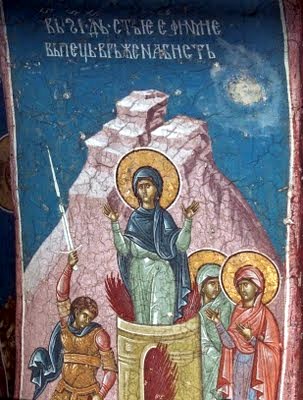
Even this miracle did not bring the governor to his senses, and he ordered the soldiers Victor and Sosthenes to throw the martyr into a heated furnace. But they beheld angels of fearsome and awesome appearance, refused to carry out the order, came to believe, and openly confessed the God of Euphemia. The confessors were thrown to wild beasts to be torn apart. Facing death, Victor and Sosthenes fervently entreated the all-merciful Lord to grant them the Kingdom of Heaven. Their sincere prayer was heard, and the souls of the repentant departed in peace into eternity (c. 304). The beasts did not even touch their bodies.
Other soldiers then cast Saint Euphemia into the furnace, but she remained alive. By God’s help she came through many other torments unharmed, which the governor explained away as the martyr’s sorcery. At last it was decided to throw the chosen one of the Lord to the wild beasts in the circus. Before the sentence was carried out, the saint fervently asked the Lord to take her from this world. Four lions and three bears were set loose upon her, but the beasts approached the blessed one meekly and reverently and “kissed the traces of her footsteps.” Only one bear bit her on the foot, leaving a small wound, and Euphemia gave up her spirit. A voice was heard from on high: “Run upward to the Giver of crowns, O contender in the good struggle; having now finished the course, receive the reward of your labors.” Suddenly the earth shook violently. The terrified guards and onlookers scattered, and her parents took up the holy body of the victorious martyr and buried it with honor near Chalcedon.
Later a magnificent church was built over the tomb of the Great Martyr Euphemia. In this church, in the year 451, the sessions of the Fourth Ecumenical Council were held, during which the holy God-pleaser wondrously confirmed the truth of the Orthodox faith and put an end to the raging of the Monophysites (this miracle is recounted in detail in the reading for July 11).
After the Persians captured Chalcedon, the incorrupt relics of Saint Euphemia the All-Praised were transferred to Constantinople in 620. During the dominion of the iconoclasts, the reliquary containing this holy treasure was cast into the sea. Pious sailors took it up into their boat. Later the holy relics came to the island of Lemnos, and in 796 they were returned once more to Constantinople.
May the intercessions of the Great Martyr Euphemia the All-Praised be with us all.