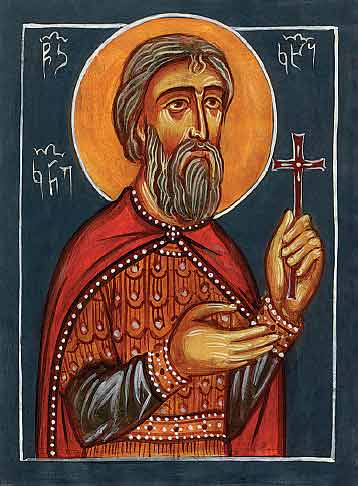
✝ Holy Great-martyr Constantine-Kakhi, Prince of Kartli (†852)
November 10 / November 23 (Julian Calendar)
On this day, November 10 according to the Julian Calendar (November 23 civil calendar), the Georgian Orthodox Church commemorates Holy Great-martyr Constantine-Kakhi, Prince of Kartli (†852).
The holy Great-martyr Constantine was born around the year 767. He lived in Kartli, and he received the surname “Kakhi” because of his Kakhetian origin, from “the land of his fathers.”
A man of great wealth who possessed every earthly blessing, he was well known not only in Georgia and the Caucasus but also at the imperial court of Byzantium as a God-fearing and exceedingly charitable man.
The Christ-loving prince considered himself the greatest of sinners and often said: “I have no hope for the remission of my sins except through the shedding of my own blood for Him Who shed His blood for us.”
Constantine greatly desired to venerate the holy places of Jerusalem. Arriving there, he gave generous gifts to the churches, visited the deserts of the Jordan, received prayers and blessings from the desert fathers and the abbots of the churches, and returned to his homeland filled with joy. After his return to Georgia, Constantine sent thirty thousand pieces of silver to Jerusalem every year for the holy places there.
In 853–854 Kartli was invaded by an Arab army many thousands strong, led by Bugha the Turk. In this campaign fifty thousand people perished in Tbilisi alone, and afterwards the invaders laid waste to Kartli, Kakheti and the mountain regions.
The eighty-five-year-old prince, together with his son Tarkhuj, took command of the army of Kartli. An unequal battle between the Arabs and the Georgians was fought on the approaches to Gori. Despite fierce resistance, the Georgians were defeated, and the enemy took Constantine and Tarkhuj captive.
An inscription at the Ateni Sioni church tells of this terrible episode in the history of Kartli briefly and vividly: “On the 5th day of the month of August, on Saturday, in the koronikon 73, in the year 239 of the Ishmaelites, Bugha burned the city of Tbilisi, seized the Emir Sahak and killed him; and in the same month of August, on the 26th, also a Saturday, Zirak captured the Kakhian and his son Tarkhuj.”
The captive Prince Constantine was brought before Bugha the Turk, who asked him in astonishment: “Did you not know that you could not escape my hands by fleeing?… Behold, God has delivered you into our hands this day to be destroyed.” Saint Constantine answered meekly: “God has delivered us into your hands not out of love for you, nor because of your deeds, but because we did not keep His commandments; for this reason He has cut us down by the hand of a disobedient people.” The humble and repentant prince saw that the sins of the Georgians were the cause of the country’s misfortune. In prison the saint courageously endured his trial. He wrote letters to the desert fathers and the abbots of the churches, asking them to pray for him.
Soon afterwards Constantine-Kakhi was sent in chains to the Babylonian city of Samarra, to the Caliph Jafar. Jafar knew how important a figure he was for the Georgians and for all of Christendom; he greeted him courteously and proposed that he change his faith, promising him honor and glory in return, while also threatening him: “If you do not obey me, you will die by the edge of the sword, and I will give your flesh as food to the birds of the sky.”
Strengthened by Christ, the venerable prince boldly replied: “I do not fear your sword, but I fear Him Who is able to destroy both soul and body, and Who has power again to give life, as He gives death. Therefore I will joyfully endure for His name, for He is the true God, the mighty Sovereign and Prince of Peace, the Father of the age to come.”
Hearing this, Jafar had Saint Constantine thrown into a dungeon, and then sent to him two Armenian nobles who had renounced the faith and been honored by the caliph. Saint Constantine answered them: “Say this to your king: do not expect any such thing from me, even if the custom of the kings of Babylon compels you, for they too opposed the truth; but command what you intend to do, and do it. And you, why do you stand over me and press upon me, that I might become like you? Depart from me henceforth, so that I may seek out the commandments of my God.” Then he lifted up his hands and began to pray: “I sing to Thee, O Lord God of hosts, God of the ages, Who hast given me strength to stand against this wicked judge, as Thou didst say beforehand: ‘Give Me your hearts, and I will give you My strength.’ Make me worthy of the light of Thy countenance, for to Thee have I fled, O Christ, Son of God.” As Saint Constantine stood in prayer, “streams of tears flowed from his eyes… and those standing around struck him on the face and tormented him with many torments, but they could not stop his tongue from singing praise.”
The caliph ordered the executioners to behead Saint Constantine. A foreigner cut off the head of the martyr as he stood in prayer and “brought it to his king, as the head of John the Baptist was brought to Herod.” This took place on November 10, the day of the commemoration of the holy Great-martyr George.
The saint’s body was hung on a high pole to terrify the people, and afterwards it was buried. Several years later the Georgians translated the relics of Saint Constantine-Kakhi back to their homeland.
May the intercessions of the holy Great-martyr Constantine-Kakhi, Prince of Kartli be with us all.