✝ Holy Apostle and Evangelist Matthew (†60) and Righteous Fulvian of Ethiopia
November 16 / November 29 (Julian Calendar)
On this day, November 16 according to the Julian Calendar (November 29 civil calendar), the Georgian Orthodox Church commemorates the Holy Apostle and Evangelist Matthew (†60) and Righteous Fulvian, Prince of Ethiopia, named Matthew in Holy Baptism (1st century).
The holy Apostle and Evangelist Matthew, the son of Alphaeus, was a native of Capernaum in Galilee. He worked as a publican, that is, a tax collector, and lived in considerable prosperity. Like all other publicans, he was despised and shunned by his countrymen as a man in the service of the Roman occupiers. Yet Matthew, though a sinner, was far better than the Pharisees — those hypocrites who prided themselves on their outward, feigned piety. And it was upon him, the publican scorned by all, that the Lord Jesus Christ fixed His divine gaze. Once, when the Lord was in Capernaum, He went out of the city and, followed by a great multitude, made His way toward the seashore. There Matthew was sitting at the tax office. The Lord approached him and said:
“Follow Me!”
Matthew heard these words not only with his bodily ears but with his heart, and at once he rose from his place at the tax office to leave everything behind and follow the Lord. He did not stop to reason that the great Teacher and Wonderworker was calling him, a sinful and despised publican; with his whole being he heeded the Lord’s call and followed Him without a word. Filled with joy, he resolved to invite Jesus Christ to his house and receive Him worthily. The Lord did not refuse the invitation and visited Matthew’s home. That day many of Matthew’s neighbours, relatives and friends gathered there, most of them sinners and publicans; they reclined at table with our Lord and Saviour, conversing with Him and listening to Him. Several scribes and Pharisees were also present. Seeing that the Lord was not ashamed to be among sinners and publicans and to share their meal, they murmured and said to His disciples:
“Why eateth your Master with publicans and sinners?” (Matthew 9:11).
But the Lord, hearing their words, said to them:
“They that be whole need not a physician, but they that are sick. But go ye and learn what that meaneth, I will have mercy, and not sacrifice: for I am not come to call the righteous, but sinners to repentance” (Matthew 9:12–13).
From that time Matthew abandoned all his possessions and followed Christ, and never again parted from Him, remaining His faithful disciple. Soon he was found worthy to be numbered among the Twelve chosen Apostles of the Lord. Together with the other disciples he accompanied the Lord through Galilee and Judea, listened to His divine teaching, beheld the countless miracles He performed, himself went preaching to the lost sheep of Israel, and at last became a witness of the Saviour’s Passion on the Cross and His redeeming death, and then of His all-glorious, radiant Resurrection and Ascension into heaven.
After the descent of the Holy Spirit upon the holy Apostles, Saint Matthew, together with the other Apostles, at first remained in Palestine, preaching the Gospel in Jerusalem and its surroundings. But the time came when the Apostles had to leave Jerusalem and carry the word of God to the nations scattered throughout the world, to convert them to the true faith. Before Saint Matthew left Jerusalem, the Jews there who had become Christians asked him to set down in writing the deeds and teaching of the Lord Jesus Christ, so that even in his absence they might always remember them. The other Apostles then present supported this request of the faithful of Jerusalem, and Saint Matthew undertook this great work. His Gospel was written eight years after the Lord’s Ascension.
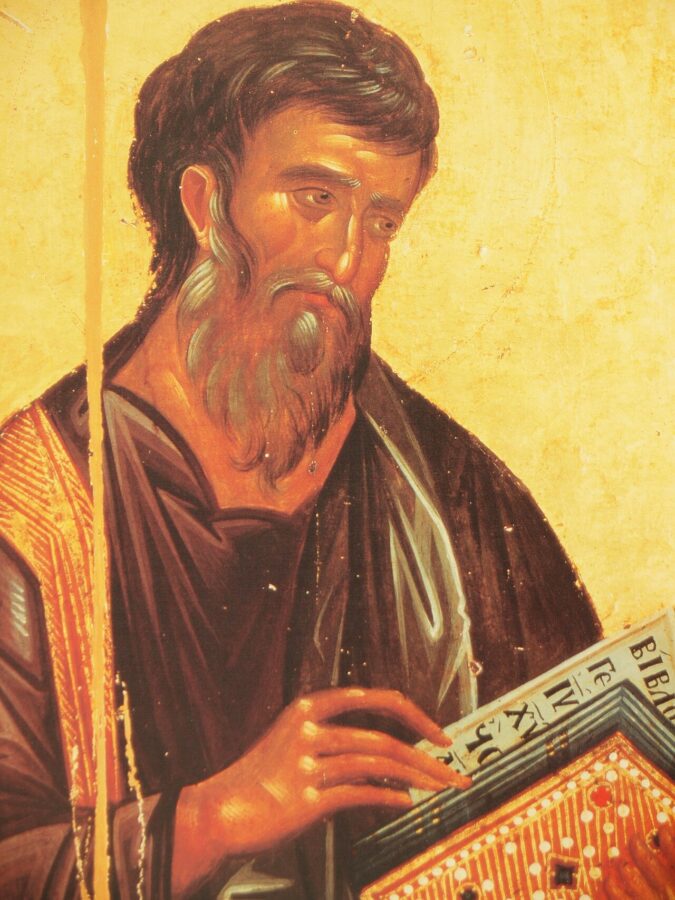
It is the earliest written of the books of the New Testament (completed around the year 41 after the Nativity of Christ), and for this reason it holds the first place among them. The Gospel of Matthew was written in the Syro-Chaldean, or Aramaic, dialect of Hebrew, then the common language of all Palestine, and was intended first of all for Jews who had converted to Christianity. Therefore it gives special attention to the Law and to showing that Jesus is the true Messiah promised by God to the forefathers of the Hebrew people. For the same reason the Gospel of Matthew begins with the genealogy of Jesus Christ as the descendant of David and Abraham, and throughout speaks above all of Christ’s taking flesh and becoming man. This feature of Matthew’s Gospel is reflected in the icons of the holy Apostle, on which he is depicted together with an angel-like man, symbolizing the Gospel he wrote.
Having departed from Jerusalem, the holy Apostle Matthew preached the word of God in many lands. He carried the Good News through Macedonia (north of Greece), Syria, Persia, Parthia (a great land in Asia southeast of the Caspian Sea), Media (west of Persia and south of the Caspian Sea), and all of Ethiopia, whose enlightenment with the Gospel fell to him when the Apostles cast lots to decide where each would preach the true faith. In that land he enlightened many with the spiritual light of the Gospel, and at last he came to a country of a dark-skinned people known for cannibalism, whose manners and conduct resembled those of wild beasts. Here Saint Matthew the Evangelist entered a city called Myrmena, converted several people to faith in Christ, founded a small church for them and appointed his companion and fellow-labourer Plato as their bishop, while he himself went up a nearby mountain, fasting strictly and praying fervently to God for the conversion of this cruel, unbelieving people. And there, on that deserted mountain, the Lord Himself appeared to the holy Apostle in the form of a beautiful youth holding a staff in His right hand, and greeted His disciple. Then He handed him the staff and commanded him to go down from the mountain into the city and set up the staff at the entrance of the church he had founded, adding:
“By My divine power this staff will grow into a great tree and will bear abundant good fruit, far surpassing the fruit of other trees in size and sweetness; washed in the water of the spring that will rise at its roots, these cannibals will acquire beauty of face, and all who taste the fruit of the tree will forget their beastly ways and become good and gentle people!”
The holy Apostle Matthew received the staff from the Lord’s hands, went down into the city and set out to fulfil the command. The wife and son of Fulvian, the ruler of that city, were possessed by evil spirits. Mother and son happened to meet the Apostle as he walked along the street, and began to cry out in fierce, terrifying voices:
“Who sent you here with that staff? Why do you want to destroy us?”
Saint Matthew forbade the unclean spirits to cry out and drove them away. The healed mother and son bowed down before the Apostle and quietly followed him. Bishop Plato, learning of Matthew’s arrival, came out with the clergy to meet him. Saint Matthew went to the church and did everything as the Lord had commanded: at the door he set up the staff received from Christ, which immediately, before the eyes of all present, became a great tree with wide-spreading branches, laden with excellent, large and sweet fruit, and from its roots a spring of water flowed forth. At this sight everyone was astonished and greatly amazed. The whole city gathered to see the miraculous tree — all ate of its fruit and drank of the clear water. Meanwhile the holy Apostle Matthew, standing on a raised place, preached the word of God to the citizens in their own tongue. That day all believed in Jesus Christ as the true God, and the holy Apostle baptized them there in the water of the miraculous spring. And indeed, according to the word of the Lord, all who had been cannibals came out of the waters of Baptism with faces made beautiful; even their dark skin was changed to white. Together with bodily purity and beauty they acquired spiritual beauty as well, for they put off the old man and put on the new — the Lord Jesus Christ.
When the ruler of the city learned of the healing of his wife and son and of the miracle that had taken place, at first he rejoiced; but then, at the devil’s prompting, he was filled with anger against the Apostle, because the whole city was coming to him and being baptized, turning their backs on their former idols. For this reason Fulvian resolved to kill him.
But that same night the Saviour appeared to Saint Matthew and said to him: “Take courage — in the trial to come I will be at your side and will help you.” The next morning, while the holy Apostle was in the church with the faithful singing praises to God, the ruler of the city sent four soldiers to seize him. When the armed men reached the Lord’s temple, darkness suddenly enveloped them, and in terror they barely managed to make their way back. Fulvian asked them why they had not seized Matthew and brought him. They answered:
“We heard him speaking, but we could see nothing. That is why we could not seize him and bring him!”
Then Fulvian grew even more furious and sent many armed soldiers to the church, saying, “Bring him to me by force, and if anyone resists and defends Matthew, kill him on the spot.” But these soldiers too returned in disgrace, for as they drew near the temple a heavenly light suddenly shone around the holy Apostle so that they could see nothing; terrified, they threw down their weapons there and fled back, half-dead with fear, to report everything to their ruler. Fulvian, beside himself with rage, gathered all his retinue and set out furiously for the church to seize the Apostle himself. But as soon as he approached Saint Matthew at the temple, he was suddenly struck blind; terrified, he stumbled this way and that, begging, “Help me, give me a guide!” And when no one dared approach him, he began to entreat the Apostle: “Forgive my offence and restore my lost sight!” Then Saint Matthew, in the sight of all, made the sign of the Cross over the ruler’s eyes, and at once they were opened. But the ruler had regained only his bodily sight, for his great malice had blinded him completely: he attributed so great a miracle not to divine power but to sorcery. He took the Apostle by the hand and led him toward his house as if to honour him, while in his heart he treacherously plotted to burn the Lord’s Apostle alive as a wicked sorcerer. Saint Matthew perceived the evil ruler’s secret intention and exposed Fulvian’s treachery.
“O deceitful tormentor!” he said to the ruler. “Will you soon carry out against me what you have planned? Do what Satan has put into your mind! As you see, I am ready to endure death for my God!”
Then Fulvian ordered the soldiers to seize the holy Apostle, throw him on his back upon the ground and nail him by his hands and feet to a beam. When this had been done, the servants, again at the ruler’s command, gathered a great heap of brushwood and branches, brought pitch and sulphur, piled it all upon the Apostle and set it alight. But when the pyre was blazing high and all thought that Matthew had been completely consumed, the fire suddenly died down and went out, and the holy Apostle appeared alive, unharmed and glorifying God the Creator. Yet Fulvian raged all the more at this sight. He would not acknowledge in what had happened the power of God, which had kept the holy preacher of Christ alive and brought him unharmed through the fierce fire. Instead he brought false accusations against Saint Matthew, calling him a wicked sorcerer and magician.
“By his evil sorcery Matthew put out the fire!” he told the people. “And by his magic he stayed alive!”
Then he ordered his servants to bring still more firewood, branches and brushwood, to heap them upon Matthew, set them alight and pour pitch over them from above. Besides this, he had his twelve golden idols brought and set up around the pyre, so as to overcome Matthew’s “magic”; he himself stood beside the blazing pyre, calling upon his “gods” for help — let Matthew not escape the consuming power of the fire, let him be turned to ashes! But the holy Apostle, even in the flames, prayed before the Lord of hosts and powers that He might show His invincible omnipotence to the people gathered there, reveal the utter powerlessness of the pagan idols and put to shame the foolish people who trusted in them.
And suddenly the flames fell with a terrible roar upon the golden idols, which instantly melted like wax in the heat of the fire; the fire also burned many of the pagans standing nearby. From the melted idols a flame in the shape of a serpent burst forth and rushed toward Fulvian; the stunned ruler could neither flee nor escape the danger. He fell helpless to the ground and with humble entreaty begged the holy Apostle to save him from destruction. As soon as Saint Matthew rebuked the fire, it subsided at once and the serpent-shaped flame vanished. Then Fulvian wished to bring Matthew out of the fire with honour. But the holy Apostle, having finished his prayer, committed his holy soul to the Lord (this took place around the year 60 after the Nativity of Christ).
Then the ruler Fulvian ordered a golden bier to be brought and the venerable body of the holy Apostle, which the fire had left entirely unharmed, to be laid upon it; he had it clothed in precious garments, and together with his nobles lifted it up and carried it into his palace. Yet he had not yet acquired perfect faith, and so he ordered an iron coffin to be forged, sealed on every side with molten tin, and cast into the sea. And he said to his nobles:
“If He who preserved Matthew unharmed from the fire also protects him from sinking in the water, then let us believe that He is the true God; let us worship Him and turn away from all our ‘gods,’ who could not save even themselves from perishing in the fire!”
After the iron coffin with the Apostle’s venerable relics had been cast into the sea, Saint Matthew appeared by night to Bishop Plato and said:
“Tomorrow go to the seashore east of the ruler’s palace, and there you will find my relics cast up on dry land!”
In the morning the bishop went to that place with a great multitude of the faithful, and indeed found there the iron coffin with the venerable relics of the holy Apostle, just as had been revealed to him in the vision.
The ruler Fulvian also learned of this and came to the seashore with his nobles. This time he believed finally and wholeheartedly in our Lord Jesus Christ, and confessed in the hearing of all that He alone is the one true God, who had kept His servant Matthew unharmed both in life — from burning in the fire — and after death — from vanishing in the depths of the sea. With tears he kissed the coffin in which the holy relics lay, begging forgiveness for his former sins and for having insulted and tormented the Apostle himself, and he expressed a fervent desire to receive holy Baptism. Bishop Plato, seeing Fulvian’s faith and zeal, prepared him for Baptism, instructed him in the true faith, and then baptized him. And when he laid his hands upon the newly baptized man to give him a new name, suddenly a voice from on high was heard, saying:
“Call him not Fulvian, but Matthew!”
Indeed, having received through holy Baptism the name of this Apostle of the Lord, the former ruler always strove to imitate his life: soon he handed over his princely authority to another, renounced all worldly cares and gave himself wholly to prayer in the Church of God. For this he was found worthy to be ordained a priest by Bishop Plato. Three years later, when Bishop Plato reposed, the holy Apostle Matthew appeared in a vision to the former ruler, now a priest of the Church of Christ, and told him that it was he who must succeed the blessed Plato on the episcopal throne.
And so Matthew accepted the episcopate and laboured well in proclaiming the faith: he led many out of the darkness of idolatry and brought them to the true God; and at last, after a long life pleasing to God, he himself reposed in the Lord. Now, together with the holy Apostle and Evangelist Matthew, he stands before the throne of God and intercedes with the Lord for us, that we all may become heirs of His eternal Kingdom and glorify Him forever, together with the Father and the Holy Spirit. Amen.
May the intercessions of the Holy Apostle and Evangelist Matthew and Righteous Fulvian be with us all.