✝ Hieromartyr Polychronius, Bishop of Babylon, and Those with Him
July 30 / August 12 (Julian Calendar)
On this day, July 30 according to the Julian Calendar (August 12 civil calendar), the Georgian Orthodox Church commemorates the Hieromartyr Polychronius, Bishop of Babylon, and those with him.
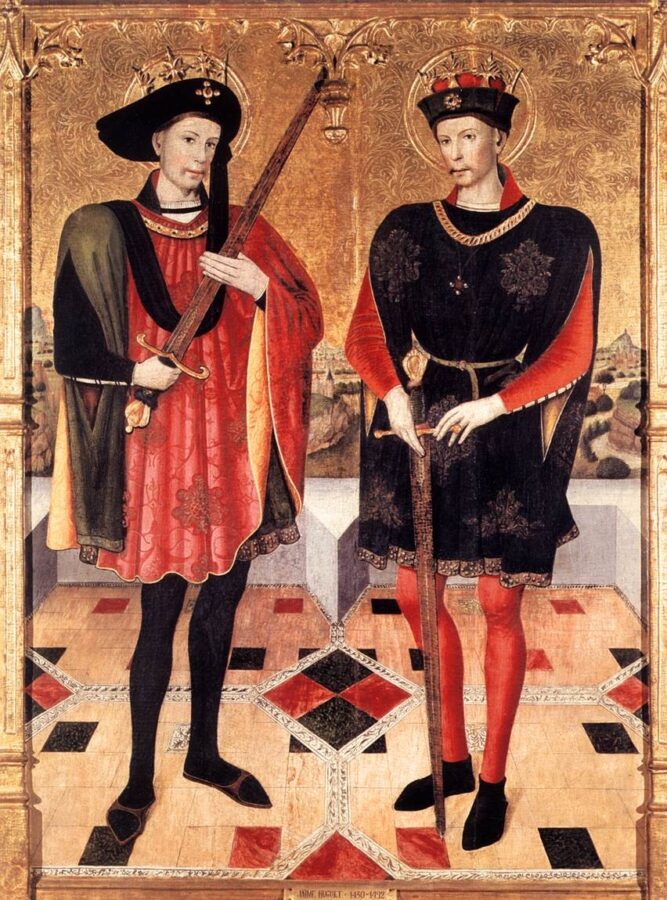
The Hieromartyr Polychronius, Bishop of Babylon; the priests Parmenius, Elimas, and Chrysotelus; the deacons Luke and Mocius; Abdon and Sennen, princes of Persia; and the holy martyrs Olympius and Maximus suffered in the third century, in the reign of the God-hating emperor Decius (249–251).
Decius defeated the Persians and conquered their land; finding many Christians among its inhabitants, he began to persecute them. The torturers seized Polychronius, bishop of Babylon, the priests Parmenius, Elimas, and Chrysotelus, and the two deacons Luke and Mocius, and brought them before the impious ruler. The emperor commanded them to offer sacrifice to the idols. Saint Polychronius replied: “We offer ourselves as a sacrifice to our Lord Jesus Christ; your wretched idols, made by human hands, we will never worship.” Enraged by this bold answer, Decius ordered the holy confessors cast into prison. At the next interrogation Polychronius stood silent. Decius turned to the priests: “Your leader has grown dumb.” Saint Parmenius answered him: “The holy bishop has not grown dumb, but he does not wish to defile his holy lips and cast his pearls before swine (Matt. 7:6).” By order of the savage emperor Parmenius’s tongue was cut out. Even so, he said quite distinctly to the hierarch Polychronius: “Master, pray for me — I behold the Holy Spirit upon you.” At Decius’s command the executioners crushed the holy bishop’s lips with stones. The blessed martyr lifted his eyes to heaven and gave his soul to the Lord. The impious left the saint’s body before the temple of Saturn; by night the Persian princes Abdon and Sennen, secret Christians, bore it away and buried it with honor beside the city wall.
Soon Decius set out for the city of Cordula and ordered the three priests and two deacons brought along in his train. In Cordula he again pressed the martyrs to offer sacrifice to the idols, but the tongueless Parmenius answered for them all, loudly and boldly, with refusal.
The emperor concluded that the blessed priest spoke without a tongue by the power of sorcery, and gave orders first to intensify the confessors’ tortures and then to cast them into the fire. At that moment a voice rang out from heaven: “Come unto Me, ye humble of heart.” Decius ascribed this voice also to sorcery, and had the martyrs beheaded. The Persian princes Abdon and Sennen carried off the holy bodies by night and buried them near Cordula, in their own village. The deed did not remain hidden: the princes were seized and brought before the emperor, who ordered them shut up in prison.
That same day two more Persian Christians, Olympius and Maximus, were brought before Decius. For their firm confession of the faith of Christ the holy martyrs, after cruel tortures, were slain with the sword. For five days their bodies lay unburied; on the sixth day Christians committed them to the earth with honor.
Returning to Rome, the emperor took the fettered Abdon and Sennen with him. Once in the imperial city, he summoned a pagan priest and demanded that the confessors offer sacrifice to the idols. Receiving a firm refusal, the enraged Decius resolved to throw the saints to the wild beasts to be torn apart; but the lions and bears lay down meekly at their feet. Then the torturers hewed the blessed martyrs down with swords. For three days the martyrs’ holy bodies lay before the idol to terrify the faithful; then, by night, a secret Christian named Quirinus bore their remains away and buried them on his own estate. The holy martyrs Abdon and Sennen died in the year 251; their incorrupt relics rest in Rome, in the church of Saint Mark.
May the intercessions of the Hieromartyr Polychronius and those with him be with us all.