✝ Great Martyr Eustathius Placidas, His Wife Theopista, and Their Sons Agapius and Theopistus
September 20 / October 3 (Julian Calendar)
On this day, September 20 according to the Julian Calendar (October 3 civil calendar), the Georgian Orthodox Church commemorates the holy Great Martyr Eustathius Placidas, his wife Theopista, and their sons Agapius and Theopistus.
Before his baptism, the holy Great Martyr Eustathius was named Placidas. He served as a general in the Roman army under the emperors Titus (79–81) and Trajan (98–117).
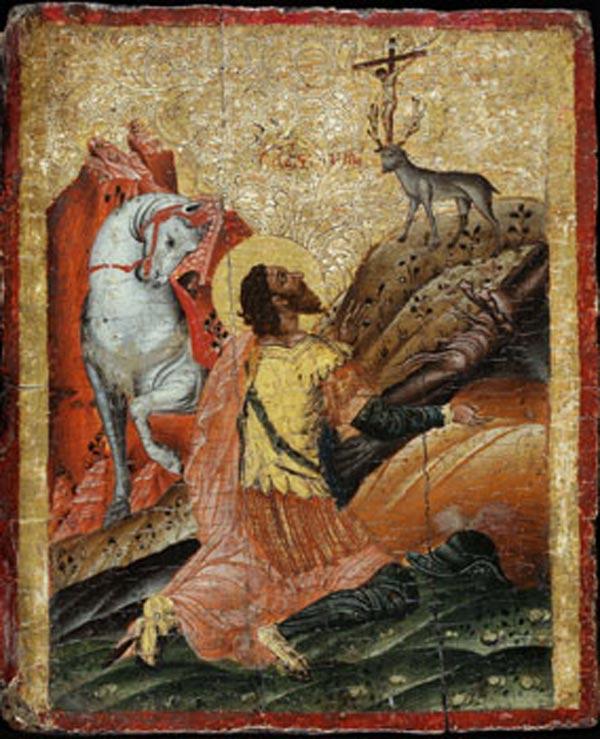
Eustathius was such a towering warrior that even the mention of his name struck fear into his enemies. In his leisure hours the saint loved to hunt. During one such hunt he pursued a stag for a long time, until it climbed a high cliff and stopped there. Suddenly, between the stag’s antlers, the sign of the life-giving Cross shone forth with the image of the crucified Savior. “Placidas, why do you pursue Me?” the Savior asked. Frightened, the commander asked in return: “Who are You, Lord?” “I am Jesus Christ, who made all things out of nothing and fashioned man with My own hands, and who have not ceased to show My love for mankind, but have renewed him again, shattered by sin.” And He told him everything: His incarnation, crucifixion, death, burial, resurrection on the third day, and ascension into heaven, “by which He granted freedom from the adversary to our race.” The good seed fell on good soil: the Lord’s chosen one believed with a sincere heart and begged the Savior to tell him how he should act next. The blessed man again heard the voice, which commanded him to go into the city, to approach a priest, and to be cleansed by baptism together with his wife and children.
Rejoicing, Placidas returned home and told everything to his wife, who in turn told him how, the night before, she had heard in her sleep: “You, your husband and your children, come to Me tomorrow, and know clearly that I am Jesus Christ, who gives life to those who love Me.”
The spouses did as they had been commanded: they went to a Christian priest, who baptized their whole household and gave them to partake of the holy Body and Blood of Christ.
The next day Eustathius went to the place of his miraculous conversion and offered fervent prayer of thanksgiving to the Lord who had set him on the path of salvation.
Then the blessed one was again granted a wondrous revelation. The heavenly King Himself warned him of the trials to come: “From now on you must endure a testing of your faith, for the tempter will soon come against you… But you shall raise up a brilliant victory over him, like Job of old… and at the end of the contest for My sake your head will be adorned with a crown.” Eustathius humbly answered: “Thy will be done, O Lord!”
Soon a series of misfortunes fell upon the blessed man: his servants died and his livestock perished. Impoverished in goods but rich in spirit, Eustathius secretly left his native home with his family, to live in a foreign land in humility and poverty. They boarded a ship and set out for Egypt. On the way, the ship’s owner was captivated by the beauty of Eustathius’ wife, Theopista, and, inflamed with passion, put the father and children ashore while keeping the woman for himself. Terribly grieved, the former commander continued on his way and came to a raging river that he could not cross with both boys at once. He first carried one son across on his shoulders and set him down, then went back for the other, but saw that a lion had seized the child and was carrying him off into the wilderness. Nor could the saint keep the son he had left on the far bank: a wolf carried him off into the forest as well.
Eustathius, who had lost everything, wept bitterly, yet he firmly believed that all this came about by God’s providence. In the village of Vladisos the chosen one of God hired himself out as a laborer and spent fifteen years in tireless toil. He did not know that, by God’s ineffable mercy, one of his sons had been saved by shepherds and the other by farmers, and that they were now living near him; nor did he know that God soon punished the lawless ship’s owner, who died of a grievous illness, while his wife, unharmed, supported herself by honest labor.
At that time the emperor Trajan was forced to begin a very difficult war for Rome. He remembered the renowned commander Placidas and sent his friends, Antiochus and Acacius, to find the saint.
After a long and fruitless search, the soldiers came to the very village where Saint Eustathius lived. They met the former general in a field but did not recognize him; they told him whom they were seeking and, promising a great reward, asked for his help. The saint recognized his friends but did not reveal his identity; he invited them to his master’s house and fed them. When the travelers looked closely at their host, they noticed that he strongly resembled Placidas, and then they saw on his neck his distinctive mark, a battle wound, and understood that their friend stood before them. Moved to tears of joy, the soldiers embraced the blessed man and told him why they had been searching for him. Eustathius returned to Rome and once more became the emperor’s commander. Many new recruits were added to his army, and the saint did not know that the two young soldiers to whom he often gave assignments, and whom he loved dearly for their skill and stature, were his own sons. Nor did they know that they served under their father’s command and were brothers to one another.
Once, during a campaign, Eustathius’ army encamped in a certain village. The brothers sat in their tent talking. The elder told of his lot: how he had lost his father and mother and his poor brother. The younger, overjoyed, realized that before him sat his own brother, and told him his own story as well.
Their conversation was overheard by a woman whose house stood near the tent: their mother. She understood that the Lord had brought her sons to her door. The blessed woman revealed nothing to them, but she greatly desired not to be parted from her sons, and so she resolved to go to the commander and ask to follow the army. She recognized her husband and told him of herself and of the two soldiers who proved to be their sons. By God’s mercy the whole family was thus reunited.
Meanwhile the war ended in victory. Eustathius returned to Rome with honor and glory. Hadrian (117–138), who had ascended the throne in place of the deceased Trajan, resolved to mark this remarkable event with a solemn sacrifice. To everyone’s astonishment, Eustathius was not found in the pagan temple. By the emperor’s order he was quickly sought out.
“Why did you not wish to come with us to offer sacrifice to the gods of our fathers?” Hadrian asked the blessed man. “You owe more gratitude than others, for the gods not only protected you in war but also helped you find your wife and children.” Eustathius answered: “I am a Christian, O king, and I offer thanks to Him who gave me the victory and who restored my children and my wife. But I neither know nor serve any other besides Him, least of all these lifeless and deaf idols, lest I be found a partaker of abominations.” The enraged emperor stripped the former commander of his rank and brought him with his whole family to trial. Eustathius, Theopista, Agapius and Theopistus were thrown to wild beasts to be torn apart, but the animals would not touch the saints. Then the furious ruler ordered the entire family to be shut inside a red-hot bronze bull. When, after three days, the fiery vessel was opened, the bodies of the holy martyrs were found completely unharmed: not a hair of their heads was singed, and their faces shone with unearthly beauty. Many who witnessed this miracle believed in Christ. The faithful buried the bodies of the martyrs with honor, and later, when the persecution of the Orthodox faithful subsided, they “built a house of prayer” to the glory of the Lord.
May the intercessions of the holy Great Martyr Eustathius and his family be with us all.