✝ Feast of the Robe of the Lord and the Life-Giving, Myrrh-Streaming Pillar (Svetitskhovloba); Holy Equals-to-the-Apostles King Mirian and Queen Nana; Saint Sidonia and Abiathar the Priest (4th Century)
October 1 / October 14 (Julian Calendar)
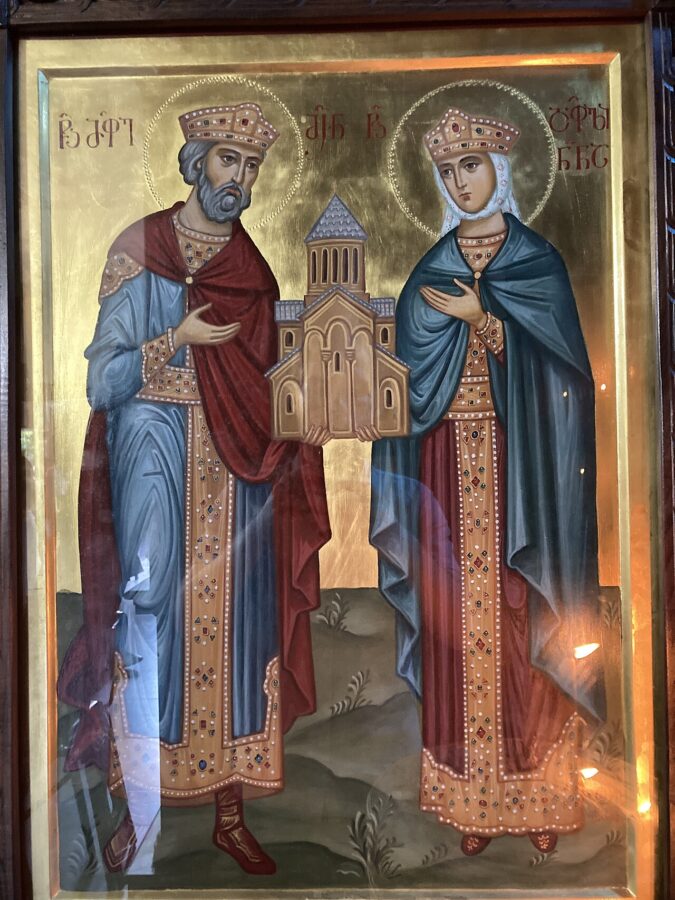
On this day, October 1 according to the Julian Calendar (October 14 civil calendar), the Georgian Orthodox Church commemorates the Feast of the Robe of the Lord and the Divinely-Radiant, Myrrh-Streaming Pillar (Svetitskhovloba), together with the Holy Equals-to-the-Apostles King Mirian and Queen Nana, and Saint Sidonia and Abiathar the Priest.
In the year that Aderki ascended the royal throne of Kartli, word spread in Mtskheta that the Persians had conquered Jerusalem. Grief and sorrow seized the Jews of Georgia, but after a short time all were calmed, for they learned that “the Persians had not come to conquer Jerusalem; instead of weapons they brought royal gold, healing myrrh and fragrant frankincense, and were seeking a child of the tribe of David. And indeed they found a stranger, born of a poor woman at an untimely time and in an unfitting place. They worshipped that child and offered Him gifts.”
Thirty years passed. The high priest Annas sent a messenger to the Jews of Mtskheta: “He for whom the Magi came and offered gifts has grown up and calls Himself the Son of God, and preaches to us some new law. We have now sent messengers to all the Jews so that the learned in the Law may come. Come, all of you who are bound by the Law of Moses, and let us pass judgment upon Him.”
From Kartli, Elioz of Mtskheta and Longinoz of Karsani went to the council of the Sanhedrin. The mother of Elioz was of a priestly line. Before his departure she begged her son not to take part in the shedding of the Messiah’s blood, “for He is the Word of the Prophets and the parable spoken by the wise.”
When the Saviour was crucified on Golgotha, the mother of Elioz in Mtskheta heard the sound of the hammer; with a terrible cry she called out: “Farewell, kingdom of the Jews, for you have killed the Saviour and Redeemer and from this day have become enemies of the Creator!” — and at once she gave up her spirit.
When the Jews cast lots for the Robe of the Lord, by the providence of God it fell to the men of Mtskheta. Elioz and Longinoz brought the Robe to Kartli. On arriving in Mtskheta, Elioz was met by his sister Sidonia. She clasped the Robe of our Saviour to her breast, heard from her brother with weeping and lamentation the account of the Crucifixion, and gave up her spirit. News of this miracle spread quickly throughout Kartli. King Aderki wished to clothe himself in the Robe, but no one could remove it from the cold arms of Sidonia, and Elioz buried his sister together with the holy Robe. A cypress tree grew up over the grave of Sidonia.
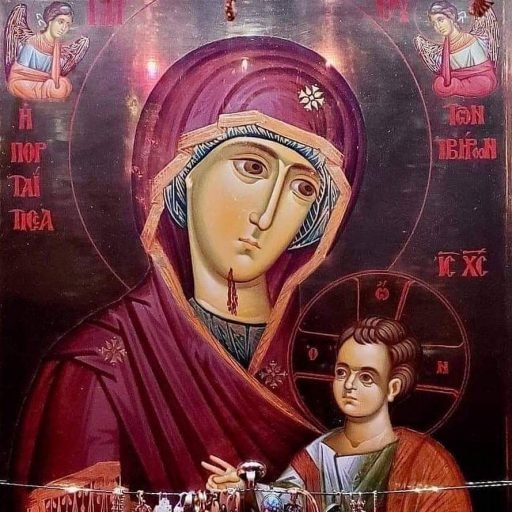
After Pentecost the Apostles cast lots. The conversion of Kartli fell to the Most Holy Theotokos, but the Saviour appeared to her and commanded: “O My Mother, I will not neglect that chosen people above all other nations, through your intercession for them. But do you send Andrew the First-Called to the portion allotted to you, and send with him your image, formed by its being laid upon your face, so that in your place that image of yours may dwell as their guardian unto the ages.” By the providence of God and with the blessing of the Theotokos, Saint Andrew the First-Called (commemorated November 30) set out to preach in Georgia.
Saint Andrew preached in Didachara; by the grace of the wonderworking icon of the Most Holy Theotokos he converted the pagans, ordained priests and deacons, and built a church in the name of the Theotokos. He then crossed the mountain called the Iron Cross, passed through the gorge of Odzrkhe, reached the border of Samtskhe and stopped in a village called Zaden-gora. Here, by the grace and power of prayer, he crushed the idols. Atskuri was ruled by a widow of the Samdzivari family, whose only son had died. The holy Apostle Andrew, by the will of the Cross and the grace of the icon of the Most Holy Theotokos, raised the dead youth to life. Samdzivari, with her son and all her household, was baptized. The holy Apostle appointed a bishop, priests and deacons in Meskheti; afterwards he preached in Klarjeti, Artanuji and Armenia, and returned to Jerusalem to celebrate Pascha.
King Aderki turned the baptized Georgians and Megrelians back to paganism and rebuked the eristavi of Klarjeti, who had let Saint Andrew depart in peace. The Apostle returned to Kartli once more, this time accompanied by Matthias and Simon the Canaanite. Saint Matthias (commemorated August 9) went to preach in Svaneti; Saint Andrew and Saint Simon (commemorated June 30) went to Ossetia and converted many, and then turned toward Abkhazia. Saint Simon the Canaanite remained in Tskhumi, while Saint Andrew went on to Jiketi. The Jiks did not accept the preaching of the Apostle and sought to kill him, but by the grace of God he was saved.
Time passed. Under the dominion of the godless and out of fear of the pagans, the Georgians forgot their Creator and the crucified Saviour.
At the time of the martyrdom of Saint George of Cappadocia (commemorated April 23 and November 10), there lived in Cappadocia a pious husband and wife, Zabulon and Sosana (commemorated May 20). They had a daughter, Nino (commemorated January 14 and May 19). Sosana was the sister of Juvenal, Patriarch of Jerusalem. The couple decided to devote themselves to the Lord; they distributed their possessions to the poor, entrusted their young daughter to a nurse to be raised, and themselves took up the life of hermits. Nino’s guardian told her about the Passion, Crucifixion, Burial and Resurrection of the Lord, and also about His winding-sheet and shroud. When she learned that the seamless Robe of the Lord lay buried in a city of pagans, she resolved to convert the Georgians to the faith of Christ. She befriended the king’s daughter Rhipsime and her guardian Gaiane (commemorated September 30), who with fifty virgins were fleeing from the impious emperor Diocletian, and went with them to Armenia. After the holy virgin-martyrs were slain by the Armenian king Tiridates, Nino, miraculously saved from death, crossed over the mountains of Javakheti into Kartli.
At that time Mirian reigned in Kartli. His wife was Nana, daughter of a commander from Pontus. Mirian was distinguished by religious tolerance: he worshipped fire and the Georgian idols, yet through long dealings with the Greeks he had also heard of the Christian teaching, and the news of the miraculous victory of Saint Constantine the Great (commemorated May 21) over his enemies had reached his ears.
Having come to Kartli, Nino went down to Urbnisi and settled in the Jewish quarter. Some twenty days later all Kartli set out for the festival of the pagan deity Armazi. The whole royal court attended. Saint Nino raised a prayer to God, and the idols of Armazi, Gatsi and Gaim were miraculously shattered. Nino settled in Mtskheta. She asked everyone about the Robe, but no one remembered where it lay. In the course of this search Nino came to know Abiathar, the priest of the Jews of Mtskheta and a descendant of Elioz, his daughter Sidonia, and six other women. Saint Nino converted them to the faith of Christ, but since she was not a priest, the Mystery of Baptism was not performed.
Saint Nino received from the Lord the gift of healing. In the name of the crucified Saviour and by the grace of her cross of vine she healed the infirm.
Queen Nana fiercely opposed the preaching of Nino and reviled the new teaching and its preacher. King Mirian, however, “had a desire for the faith of Christ and did not hinder Nino and her disciples from preaching.” Once he secretly rescued Abiathar the priest, his daughter Sidonia and other Christians from persecution by the Jews.
Time passed. Once Queen Nana fell ill, and the prayer of Saint Nino saved her from certain death. After the healing of the queen, King Mirian became interested in the faith of Christ and often questioned Abiathar, the former Jew, about the books of the Old and New Testaments. Abiathar had him read the Book of Nimrod. The king conceived the desire to be converted to the faith of Christ.
One day Mirian went hunting on Mount Tkhoti. The unseen enemy assailed him and once again put into his heart the love of the idols and of fire, and the slaying of Christians by the sword. He resolved that on returning to Mtskheta he would expel the Christians and put Nino to death. As the king climbed the mountain the sun went dark and deep night fell. The frightened Mirian begged the idols for help, but they were deaf to his prayer. Then the king entrusted himself to the crucified God, and a miracle occurred: it grew light and the sun shone forth. Mirian stretched out his hands toward the east and said: “Thou art God above all gods, Lord above all lords, the God of whom Nino speaks.” Returning to Mtskheta, the king went to Nino, and on her advice the very next day sent envoys to Greece, to the Emperor Constantine, asking him to send priests for baptism.
While awaiting the priests sent from Constantinople, King Mirian decided to build a church in the royal garden. The carpenters made seven pillars from fir-wood. Six were raised, but the seventh, the largest, could not be moved from its place. Saint Nino and her disciples stood in prayer. At dawn a youth clothed in light, “all wrapped about in fire,” descended from heaven, took hold of the pillar and raised it. The pillar shone with divine light and stood in the air at a height of twelve cubits. All Mtskheta came to venerate the pillar of light; as they drew near to it the sick were healed, the blind received their sight, and the paralyzed arose.
Meanwhile the envoys returned from Constantinople. With them came Bishop John, priests and deacons. Saint Constantine the Great sent to the king and the people who had embraced the faith of Christ a cross and an icon of the Saviour, a portion of the Life-giving Cross — the footrest — and a nail of our Lord Jesus Christ. At the confluence of the Mtkvari and the Aragvi the king, the queen, the royal court and all Kartli were baptized. After the solemn baptism Bishop John and his companions went to Erusheti, built a church and left there the nails of the Lord; then they began building a church at Manglisi and there placed the portion of the Life-giving Cross.
King Mirian was troubled. He wished the holy relics to rest in the royal city as well. Saint Nino told the king that a great holy treasure, the Robe of the Lord, was kept in Mtskheta. The king summoned Abiathar the priest, questioned him about the Robe, and was filled with joy.
In Mtskheta, on the top of a rock, stood a beautiful, fragrant, wonderworking tree. A dying beast struck by an arrow was healed by its leaves. When Bishop John was told of this, he declared: “Truly that tree has sprung up from God and has been preserved for this time, and now the grace of God has been poured out upon Kartli; from that tree a precious cross must be made, which all the multitude of Kartli shall venerate.”
Rev, the son of King Mirian, with the blessing of the bishop and accompanied by the people, cut down the tree, brought it with its branches and set it up to the south of the church. For thirty-seven days the tree neither changed its colour nor shed its leaves. Afterwards three crosses were made from it.
Then for many days the people beheld one and the same vision: at night a fiery cross surrounded by stars would stand over the church; two stars of the dawn would separate from the rest, one going toward the east and the other toward the west, while the fiery cross itself would halt over the rocky hill across the Aragvi and from there vanish into heaven. Because of this miracle, on the advice of Saint Nino the king had one cross raised in the west on Mount Tkhoti and the second in the town of Ujarma, but for the third cross no place could be chosen.
King Mirian prayed to the Lord to show him the place where the cross should be raised. God heard the entreaty of the pious king and through the mouth of an angel made known that the cross should be raised on the rocky hill across the Aragvi.
When this precious cross was raised in Mtskheta, at once every idol in Kartli was shattered.
Before his death the king blessed his son Bakar, leaving him as his testament faithfulness to the Holy Trinity and the struggle against the idols, and reposed in God. By his own wish the holy, right-believing king was buried in the Upper Church (the church of the Samtavro convent). He did not wish to be buried in the Lower Church (Svetitskhoveli), which was called the “Holy of Holies,” out of the reverence and awe he felt before the glorious Pillar of Light. Two years later Queen Nana also reposed and was buried there, beside King Mirian.
May the grace of the Robe of the Lord and the Life-Giving Pillar, and the intercessions of the Holy Equals-to-the-Apostles King Mirian and Queen Nana, Saint Sidonia and Saint Abiathar, be with us all.