✝ Saint John the Merciful, Patriarch of Alexandria
November 12 / November 25 (Julian Calendar)
On this day, November 12 according to the Julian Calendar (November 25 civil calendar), the Georgian Orthodox Church commemorates Saint John the Merciful, Patriarch of Alexandria.
Saint John the Merciful, Patriarch of Alexandria, was born on Cyprus into the family of the nobleman Epiphanius. When he was fifteen years old, he saw in a dream a wondrous maiden wearing a crown of olive branches, who said to him: “I am the eldest and most beloved daughter of the Great King. If you become my friend, I will obtain mercy for you from Him and bring you before His throne, for no one has such boldness before the King as I.” The saint understood that this maiden was compassion — the highest of virtues. “You must show mercy to your neighbour if you wish the Lord to have mercy on you,” he thought as he made his way to church at dawn. On the way the blessed youth saw a naked beggar shivering from the cold; he took off his outer garment, gave it to him, and thought to himself: “Now I shall learn whether last night I saw a divine vision or was tempted by the devil.” But before he reached the church, a stranger clothed in white met him, handed him a purse and said: “Friend, accept these hundred gold coins for your needs.” John accepted the gift and at once understood that his vision had been a heavenly revelation, and he said to himself: “Enough, my soul — do not tempt the Lord!” From that day on the saint became wondrously merciful.
In his youth John was married and had children, but his wife and children soon died. After this he became a monk and gave himself to strict fasting and prayer.
His spiritual labours made the holy father renowned far and wide, and when the patriarchal throne of Alexandria became vacant, Emperor Heraclius (610–641) and the clergy asked him to take up the governance of the Church. Out of humility John refused for a long time, but at last he was compelled to consent.
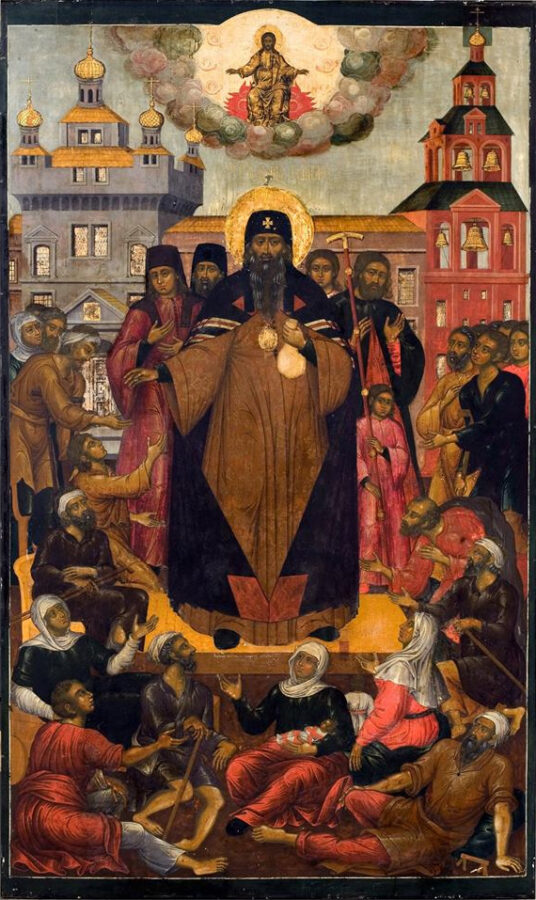
The blessed hierarch bore his heavy cross worthily: he cared for the moral perfection of his flock and fought against heretical teachings, yet he considered his chief work to be almsgiving and helping all who were in need. Shortly after ascending the patriarchal throne, John ordered the stewards of the Church to determine the number of needy people in the whole city. They compiled a list of seven thousand five hundred poor, to whom from that time on the saint provided a daily ration from the resources of the Church.
Two days a week — Wednesday and Friday — the patriarch sat at the doors of the church, listening attentively to all who came and helping them. Some marvelled at such patience, but the blessed one said: “If I can always turn to my Lord Jesus Christ and ask in prayer for whatever I wish, how can I forbid my neighbour to come to me?” On days when no one asked the holy father for help, he remained deeply saddened. The blessed one did not like to put off a work of mercy: once a poor widow, oppressed by her relatives, approached John with her complaint just as he was going to church. Those accompanying the patriarch advised him to hear her after the service, but the saint replied: “If I do not wish to hear her, will the Lord hear me?”
Three times a week John visited the hospitals and helped the sick. When the Persians sacked Jerusalem and led its inhabitants into captivity, the holy patriarch gave a large part of the Church treasury to ransom them.
The saint never turned beggars away. Once, as the hierarch was on his way to the hospital, a beggar met him, and the bishop ordered that he be given six silver coins. The beggar changed his clothes, caught up with John and again asked for alms, and the saint again gave him six silver coins. But when the beggar stretched out his hand to the blessed one a third time and the servants wanted to drive him away, the patriarch said: “Perhaps it is Christ testing me,” and ordered that the beggar be given twelve silver coins.
Once the steward told the patriarch that well-dressed people sometimes also came to ask for alms, and asked whether they too should be helped like the others. John answered: “If you are a servant of Christ, act as Christ commanded us: give alms without looking the petitioner in the face. We do not give what is ours, but what is Christ’s — and who could be richer than Christ?” Indeed, the patriarch gave away a great deal, but the Lord always raised up kind people whose offerings refilled the almost empty treasury.
Once a wealthy nobleman came to John to receive his blessing and noticed that his bed was covered with a coarse, half-worn blanket. On returning home, he sent the saint a new brocade blanket worth thirty-six gold coins. The chosen one of God did not wish to offend the sincere donor and covered himself with it that night, but when he awoke he remembered the poor, the wanderers and the homeless, and decided to sell the costly gift. In the morning the rich man, happening to pass through the market, saw his blanket put out for sale, bought it and sent it back to the chief shepherd. The saint accepted the gift with gratitude and then sent it to be sold once more. Again the nobleman bought it and returned it to the patriarch. When this had happened several times, John sent word to the rich man: “Let us see who tires first — I, who have resolved to sell it, or you, who insist on buying it and sending it back to me.” In this way the saint turned the nobleman’s goodwill toward him to the benefit of the poor.
Saint John was distinguished by wondrous humility. Once he was compelled to excommunicate a clergyman who had fallen into sin, and the sinner grew bitter against the patriarch. While the saint was celebrating the Divine Liturgy, he remembered the words of the Gospel: “Therefore if thou bring thy gift to the altar, and there rememberest that thy brother hath ought against thee; leave there thy gift before the altar, and go thy way; first be reconciled to thy brother, and then come and offer thy gift” (Matthew 5:23–24). He came out of the altar, summoned his erring spiritual son, fell on his knees before him and publicly asked his forgiveness. The shaken clergyman was moved to repentance and afterwards became a devout priest.
Once a civil official grievously insulted John for defending the poor. That same day, before sunset, the blessed one sent a man to his offender with the message: “The sun will soon set — let us be reconciled.” The official was so moved by these words that he not only made peace with the peacemaking hierarch, but vowed that from then on he would strive to avoid every quarrel.
A certain commoner treated the patriarch’s close relative George with disrespect. George was indignant; he came to the saint and asked him to take revenge on the man who had insulted him. The hierarch promised that he would repay the man in such a way that all Alexandria would be astonished, and this calmed George. Then John instructed him, teaching that we must have meekness and humility, and afterwards he summoned the offender and announced that he was freeing him from the Church’s land tax. Alexandria was indeed astonished by such “revenge.”
The blessed father was wondrously careful in judging others. He used to say that we must judge no one, because we see only the evil deed, but not the repentance and sorrow of the sinner, which are hidden from us.
Saint John — a strict ascetic and man of prayer — kept unceasing remembrance of death. He ordered a coffin for himself, but instructed the craftsmen not to finish it and to come to him on every feast day to ask whether the time had come to complete the work.
During the Persian invasion of Egypt, Saint John left Alexandria and set out for Constantinople by way of his homeland, Cyprus. On the way the blessed one received a divine revelation: in a dream a radiant youth stood before him and said: “The King of kings is calling you.” The patriarch understood that his end was near. He stopped on the island of Cyprus, in his native city of Amathus, prepared himself for death and peacefully commended his soul to the Lord (†616, 619 or 620). The blessed one was buried in that same city, in the church dedicated to Saint Tychon.
Saint John reposed on November 11, but because on that day the memory of the holy Martyr Menas was solemnly celebrated in Egypt, and in Alexandria that of Venerable Theodore the Studite, the Church appointed November 12 as the day of his commemoration.
May the intercessions of Saint John the Merciful, Patriarch of Alexandria be with us all.