Commemorated 9 November (Old Style) / 22 November (New Style)
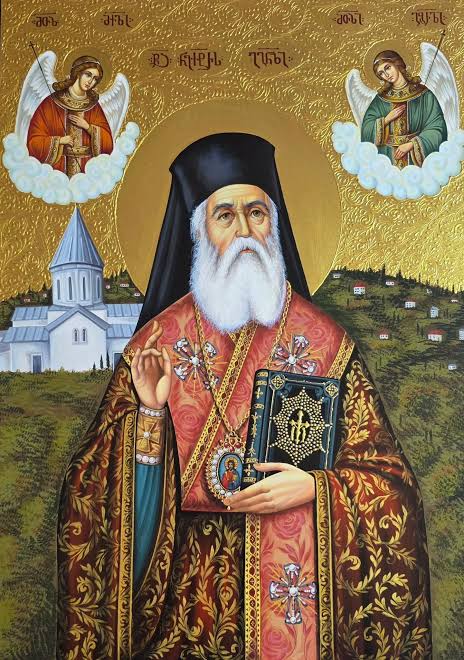
Saint Nektarios of Aegina, Metropolitan of Pentapolis, the Wonderworker (1846–1920), is one of the most beloved saints of the twentieth century. His life is a story of poverty, slander, persecution and unwavering patience, which God crowned with the grace of working miracles.
1. Childhood in Selyvria
Saint Nektarios was born in 1846 in Selyvria, in Thrace, to a poor but devout family. At baptism he was named Anastasios; he was the fifth child of Dimos and Vasiliki Kephalas. His parents strove to raise their children as true Christians, and in little Anastasios a love for God showed itself early.
He was five when his grandmother used to read him Psalm 50. At the words “I will teach the lawless Thy ways, and the ungodly shall turn to Thee,” the boy would cover her mouth with his hand and say, “Don’t read those words — I will say them. That is how I too must teach people.” At seven he stitched sheets of paper together, and when his mother asked what for, he answered, “I am making a book to write the words of the Lord in it.” He remembered everything he heard preached in church and repeated it to others; he would often build a little pulpit with his own hands, climb up and “preach” like a priest.
An old priest of Selyvria, his neighbour, recalled: “He was a very humble boy; he avoided even the most harmless childish mischief. In the evenings he would go out alone, sit on the shore and gaze at the sea. He never missed a service, served the priest in the altar and listened to everything with great attention.”
His family saw the boy’s zeal and wondered, “What will become of this child?” But they were poor and had no means to continue his education.
2. Constantinople — Work and Study
At about fourteen Anastasios received his mother’s blessing and set out for Constantinople. At the harbour he asked a ship’s captain to take him aboard, but the captain mocked him: “Go for a walk, little one; when you come back I’ll take you.” The boy did not move from the spot and gazed sadly at the ship. The captain gave the order to sail, the engine started — but the ship would not move; a second attempt failed too. The anxious captain caught sight of the boy on the shore and beckoned him aboard. The moment Anastasios set foot on deck, the ship got under way.
When the tickets were checked, the boy gathered his courage and told the inspector, “I am poor, I have no money for a ticket; I am going to look for work to help my parents.” The inspector took pity on him.
In Constantinople he found work in a relative’s tobacco factory. The wages were so small that he went about half-hungry and half-clothed; his only consolation was the church. Once he decided to write a letter to Jesus Christ Himself: “Jesus Christ, my God, I beseech Thee, help me.” On the envelope he wrote “To the Lord Jesus Christ, in Heaven” and set off for the post office. On the way he met a neighbouring merchant, who offered to post the letter. Puzzled by the strange address, the merchant opened it, read it, and, moved to the heart, put a large sum of money into the envelope and sent it to the boy as a “reply”.
This brought a trial of its own: when the factory owner saw Anastasios in new clothes, he decided the boy had robbed him, abused him and threw him out. Fortunately the kindly merchant learned of it, explained everything to the owner and cleared the boy’s name.
At night Anastasios studied on his own, reading textbooks and the lives of the saints. Having no money for paper, he wrote down sayings of the Holy Fathers on the tobacco wrappers, where customers later read them. Years afterwards these very notes grew into his book A Treasury of Sacred Thoughts.
His dearest wish was to venerate the Holy Land. When at last he sailed for Palestine, the ship was caught in a terrible storm and the captain ordered the lifeboats readied. The young man began to pray: “Lord, do not allow this — not death; I want to preach!” He took from his neck the cross with which his grandmother had blessed him, tied it to his belt and lowered it three times into the sea. The wind dropped and the sea grew calm. Everyone rejoiced, but Anastasios grieved — the waves had carried off his cross. All the way the passengers heard a strange knocking from the ship’s side, and when the sailors examined the hull in port, they found Anastasios’s cross at that very spot. The saint wore it for the rest of his life; it is clearly visible in his photographs and icons.
3. Schoolteacher on the Island of Chios
Returning from his pilgrimage, Anastasios left the factory and became an assistant teacher at a monastery school in Constantinople, teaching the younger pupils while studying in the senior class himself. At twenty he was appointed schoolmaster in the village of Lithi on the island of Chios. For seven years he taught the children reading, writing and the faith of Christ, preached in the village church and called the parents too to piety. After lessons he gave his time to solitude, prayer and study; he fasted strictly and ate once a day.
4. Monastic Tonsure
The longing for monastic life that he had nursed since childhood grew firmer with the years. Anastasios often climbed up to the monastery where the elder Pachomios taught that the shortest road to union with God is the monastic life. In 1876 he entered the famous Nea Moni on Chios as a novice and was soon tonsured. In that ancient monastery, adorned with Byzantine mosaics, he lived ascetically for three years and studied the Scriptures and the Fathers. The brethren loved him for his zeal and strict life, while he thought constantly of how he might labour for the good of his neighbour.
5. Deacon and Priest
In 1877 Bishop Gregory of Chios ordained him deacon in the church of Saint Menas and gave him the name Nektarios.
A wealthy and pious man of Chios, John Choremis, had heard much about the young deacon and resolved to help him obtain an education — what a great work this man did for the salvation of his soul! He sent Nektarios at his own expense to finish secondary school in Athens, and then gave him a letter of recommendation to Patriarch Sophronios of Alexandria. The Patriarch, convinced of his piety, sent him to study at the Theological Faculty of the University of Athens. Nektarios excelled; from his second year he received a scholarship, and in 1885 he took his degree — the diploma is still kept in his memorial room on Aegina.
When his spiritual son returned to Alexandria, the Patriarch ordained him priest. Nektarios preached, served as patriarchal secretary and as the Patriarch’s representative in Cairo. People of various confessions came to hear him; he cared for the restoration of churches and icons and spent the donations he gathered on just that. His life answered to the words of the Psalm: “For the zeal of Thy house hath eaten me up” (Ps. 68:10).
6. Metropolitan of Pentapolis
Three years later Nektarios was consecrated Metropolitan of Pentapolis. In his new rank he served the Church with the same zeal; the people loved him and said, “Here is a true servant of God, a worthy candidate for the patriarchal throne of Alexandria.” But the episcopate did not change the humble Nektarios. To a monk he wrote:
“You point to the difference between us. The rank of bishop is indeed high and honourable, but it cannot change the relationship between the one who bears it and his brethren in Christ. A hierarch must first of all be humble — he is the first, and he is also the last. Among brethren in Christ, whatever their rank, only he is exalted who follows Christ and imitates Him. I assure you, I bow before everyone who has given himself to the Lord. Of one thing only am I certain, brother: the ascetic is greater than the hierarch.”
In one letter he addressed God: “O God, why hast Thou raised me to such a height? I begged Thee to make me a theologian, not a metropolitan. But I submit to Thy will and beseech Thee — plant humility in me, and make me worthy to live each day according to the Apostle’s words: ‘It is no longer I who live, but Christ who lives in me’ (Gal. 2:20).”
7. Slander and Expulsion from Egypt
Sadly, envy drove certain people to tell the Patriarch that Nektarios laboured so zealously because he coveted the patriarchal throne. Nothing of the kind had ever entered the young metropolitan’s mind, but the Patriarch believed the slander, removed him from his see and expelled him from Egypt. What answer will those slanderers give on the day of the Dread Judgement?
The bishop accepted it all as a trial from God and in 1889 came to Athens. He wished to settle on Mount Athos, but Bishop Damaskinos advised him to remain in Athens, so that his preaching might benefit the people. He had no means of support — everything he had received in Egypt he had given to the poor or spent on publishing spiritual books, so that a saying had grown up among the people: “Money and the Metropolitan of Pentapolis cannot be found together.”
Slander followed him to Athens. Only once did he venture to answer the Patriarch — when, to an enquiry from the Greek Ministry of Education, the Patriarchate replied that he had left Egypt because of “irresponsible and immoral conduct”. Then he wrote: “Your Beatitude, four years after my unjust expulsion from Egypt I am without bread, and still I keep silent. But what ecclesiastical court has judged me? Where are my accusers and witnesses? What sin have I committed against you? God is my witness — I served the good and sought only to do good. My persecution is unjust; God is my witness and my judge.”
8. Preacher in Chalkis
For a whole year in Athens he was without means, yet asked no one for anything — he awaited help from God alone. At last he petitioned the Minister of Education to appoint him a preacher in some remote district, but was refused: he did not yet hold Greek citizenship. On the ministry stairs, in tears, he met an old priest, Father Melas. On learning the cause, the priest took him by the hand, led him back to the minister and said indignantly, “If you will not give a post to such a man, to whom will you give one?” The minister yielded. Thus occurred a case rare in Church history — a hierarch took the post of an ordinary provincial preacher. Nektarios thanked God and left for Chalkis on Euboea.
Slander got there before him: at his very first sermon the congregation showed open hostility, and again the next Sunday. Armed with prayer and patience, the bishop stayed and sought the Lord’s will. And the truth triumphed: a letter arrived in Athens signed by some hundred Christians of Cairo, who mourned the loss of their bishop and wrote that his four years of selfless ministry had won universal love and respect. He carried that letter with him and showed it to no one — “The Lord Himself will set everything right.” Indeed, a representative came from Athens to Chalkis and announced to the people that their bishop was a victim of slander. The following Sunday the church was packed. For two and a half years he laboured tirelessly in Chalkis, and when he was transferred to another diocese the faithful tried to prevent his leaving.
9. The Diocese of Phthiotis
In the diocese of Phthiotis he preached with the same zeal and set many souls on the path of truth. In the town of Lamia he lodged in the house of Kostas Sikopoulos; the bishop’s holy life brought this man to Christ, and he devoted himself to serving him. Once Kostas’s mother asked the bishop, buried in his books, what she should cook for dinner. “Whatever you like,” he replied, “but now you have broken my train of thought, and I beg you not to do it again.”
One day Kostas’s mother ran weeping to him in the field: “Son, they are taking the bishop from us — a telegram has come; he is appointed director of the Rizarios Seminary in Athens.” That evening Kostas asked whether it was true. “Listen, Kostas, I did not come here of my own will — everything is the will of the Lord.” On the day of his departure the church bells tolled mournfully, and at the station women with their children asked his blessing in tears.
10. Director of the Rizarios Seminary
In 1894 Bishop Nektarios was appointed director of the Rizarios Ecclesiastical School in Athens. The post was a true joy to him — an opportunity to form worthy clergy for all Greece. Before his arrival the school had fallen into decline; the new director brought love and peace among teachers and students alike. Chrysostomos, who later succeeded him and became Archbishop of Athens, wrote: “Thanks to Metropolitan Nektarios the Rizarios School recovered its peace and became a true ecclesiastical institution. He watched over every detail of the school’s life — he even cared for the garden.”
The metropolitan was a man of pure soul who thought ill of no one and was as trusting as a child. The theologian Konstodorakis, a graduate, recalled how the seminarians invented excuses to go into town for pastries — one had a sick uncle, another a parcel from home, a third a toothache. The director gave each his permission and wished the sick uncle a speedy recovery. Finally Konstodorakis himself went in and told the truth: “I am going to eat pastries.” “You have my blessing,” said the bishop, “but when you return, tell me whether the others told me the truth.” On his return the seminarian asked forgiveness for having doubted his friends’ honesty, and the bishop’s face shone — he was glad they had not deceived him.
If a student did wrong, the bishop punished himself and imposed a fast on himself. However unruly the seminarian, when he saw the director refusing food at the common table on account of his misdeed, he was ashamed and tried to mend his ways. Is there any higher pedagogy than this?
In 1899 the patriarchal throne of Alexandria fell vacant and many urged the bishop to stand. When he saw that the clergy favoured Photios, he withdrew his candidacy despite the people’s support — he was a man of peace and entered no contest.
11. Preaching in Athens and Piraeus
In the seminary chapel and in the churches of Athens and Piraeus the bishop celebrated and preached often; crowds gathered to hear his fervent word. People saw that he was a holy man, and his word united them with Christ. To a young priest he once said: “When a man feels that he is a child of the heavenly Father, he looks with indifference on all the goods of this passing world. Temptations trouble him too, but in his heart there is joy and peace.” Charitable societies elected him their honorary president, and he was consulted as an expert on questions of education.
12. Writer and Theologian
At night the bishop prayed and wrote. In those years positivism was in fashion in the universities; people spoke of Hegel and Büchner and lost their faith. In answer he wrote his book On Divine Revelation: God has not abandoned the world, and miracles are His supernatural revelation to men. In his Christology he wrote: “Our chief aim is to strengthen the faith of Orthodox Christians — of those who are raised on the Gospel and have their hope in Jesus Christ.” His pen was a fortress of the Church that her enemies could not take.
13. Almsgiving and Love for One’s Neighbour
The seminary’s cleaner fell ill, and the doctors forbade him to work for several months. The bishop told him, “Look after your health; the rest will somehow be arranged.” Every morning the classrooms, the yard and the lavatories shone with cleanliness, yet no new cleaner was hired. Curious, the man came to the seminary one evening and saw — the metropolitan himself was cleaning everything. “Your Eminence, I cannot bear this!” “My child, look after your health. If I hire someone else, you will lose your place. Only tell no one of this.”
Once a man in need told him he owed twenty-five drachmas and the term was expiring. The bishop called Kostas, the bursar: “We need money.” Kostas had exactly twenty-five drachmas — the month had only just begun. “We must give it; the Lord will provide!” Exactly an hour later the archbishop’s chancery telephoned: the bishop was invited with the seminary choir to the wedding of a wealthy couple. At the end everyone received an envelope — a hundred drachmas for the bishop, twenty for each singer. “You see, Kostas, we gave twenty-five and received a hundred and eighty. Remember this well for the future.”
Another time a sick man brought him a prescription — he had to buy medicine and would be off work for two weeks. This time the treasury really was empty. The bishop asked for a parcel of linen that had been sent from Egypt. “If you give that away, you will have nothing to change into!” Without a word he handed the parcel to the petitioner: “Take it, sell it at the market — it will cover the medicine and two weeks’ living.”
14. Founding the Monastery on Aegina
The bishop dreamed of founding his own monastery and withdrawing there — a true monastery is the best sermon. For years he lived frugally, and while still director he bought an abandoned old monastery on the island of Aegina, the Life-Giving Spring, where Saint Athanasia of Aegina had once lived. Little by little he restored and enlarged it.
Among his spiritual children in Athens were eight young women. Once they went to confession to a well-known elder, Father Evsevios Matthopoulos. As soon as he learned that the girls were spiritual children of Bishop Nektarios, he exclaimed, “Do not stop going to him — the grace of the Holy Spirit rests upon him.” When the bishop heard of it his face lit up: “Try to visit that man of God often.” Blessed was that age in Greece when such fathers lived — they laboured only for the glory of God, never to win followers.
All eight chose the monastic life; their tonsure took place on Aegina, in the Holy Trinity monastery. The first abbess was the blind Xenia, full of virtue. At first three sisters found themselves under the stern guidance of the nun Philothea: it was Great Lent, water dripped through the ceiling, and they were given a cup of coffee and a piece of bread a day. “Did you come to a monastery or somewhere else?” Philothea answered their complaints. “What kind of nuns will you be if you live without hardship?” A pious Athenian woman dreamed of a cage in which three birds were suffering; understanding that the sisters were in need, she brought them bread, halva and olives and told the bishop everything. Soon Kassiani was appointed abbess.
The bishop remained director of the seminary and guided the monastery from afar, striving to order its life by the rule of the Holy Fathers. At times he was strict — with the strictness of a loving father: “To keep the rule of the Fathers and to test your patience I shall use every means. The time has come to bear the weight of monastic life.” On receiving a novice he wrote: “We must find out whether she can renounce self-will, whether she will submit to the will of others, whether she forgives the sisters at once and does not hold a grudge. If she has all this — keep her.”
15. Miracles on Arriving at Aegina
Something strange happened on the bishop’s first arrival on Aegina. On the island lived a possessed boy, Spyros, who with his eyes shut would “prophesy”. That day he was shouting in the market square: “The Metropolitan of Pentapolis is coming to us! A saint is coming — he will save the island; prepare to meet him!” The archpriest Michael went down to the harbour, and indeed Metropolitan Nektarios was on the ship. They led the bishop to the square; he made the sign of the cross over the boy with his staff, touched his lips and commanded the demon to come out. Spyros rose at once, kissed the bishop’s hand, and from then on was well — he returned to school, later married and lived the life of a devout Christian.
The news spread quickly. A woman who had suffered for years from an issue of blood kissed the hem of the bishop’s cassock, like the woman in the Gospel, and was healed at once. The mayor and councillors came and asked for a service of supplication to end the drought. “We will serve the supplication next Sunday in the cathedral; until then let everyone fast and prepare for Communion.” On Sunday the service was held, and that evening the rain came — and it rained for two months. Now the farmers begged him to pray for the rain to stop. “Children,” he answered, “the Lord knows better what to do.” The weather cleared in good time, the sowing was done, and that year the harvest was abundant.
16. The Monastery Revived and Saint Menas
On his way to the monastery the bishop was met by Saint Dionysios of Aegina, the island’s bishop of old: “Nektarios, I have been waiting for you.” Behind him stood a man in military uniform. “Who is this brother?” “It is Menas; he lives here too.” The bishop asked the islanders whether they had a church of Saint Menas. “Only a small abandoned chapel, up in the mountains among the pines — there is no longer even a path.” Two years later he searched for the place with two nuns and found the tiny ruined church where shepherds sheltered from the rain. They swept the floor and lit candles, and the bishop prayed long in the altar. Coming out, he looked at the sky and pointed: “One fine day there will be a convent here.” “Your Eminence, in this wild, waterless place?” Forty years later the monastery of Saint Menas was built on that very spot.
Saint Menas evidently appeared to the bishop often. One evening a nun, sent to call him to the meal, saw him talking with a military man. Later she asked, “Who was that officer in the splendid uniform?” “You saw him too?” said the bishop, putting a finger to his lips. “It was Saint Menas — but tell no one.” He held Saint Menas in special honour also because he had been ordained in the church of that saint on Chios.
Besides being a theologian and philosopher, the bishop was a fine hymnographer: he composed some thirty hymns for the Nativity, Theophany and Pascha, and 154 poetic texts in honour of the Mother of God. The nuns of the monastery sing his hymns to this day.
While the Holy Trinity church was being built, water was carried from a neighbouring peasant’s well; the water was scarce and the owner forbade it. The bishop went to the well and prayed, and the well filled with water — the astonished peasant gave the well to the monastery. Once there was no money to pay the workmen. A nun saw the troubled bishop go to the icon of the Mother of God and show her his empty pockets. “It is already Thursday; on Saturday I must pay the men, and I have not a penny.” On Saturday a cart loaded with flour drew up, and the carter handed the bishop an envelope: “A gift from the Ponorios brothers — two hundred drachmas.” The bishop gathered the nuns and served a service of thanksgiving.
In 1917, when food imports to Greece were cut off, the nuns wanted to lay in stores. “If you do that, we really shall go hungry,” said the bishop. They obeyed, and despite the embargo the monastery lacked nothing — it even helped others.
17. Life by the Rule of the Holy Fathers
Amphilochios Makris, the bishop’s young friend, built a monastery on Patmos and asked what rule he should adopt. “The Gospel,” the bishop replied: the essence of a monastic rule is to live the commandments of the Gospel.
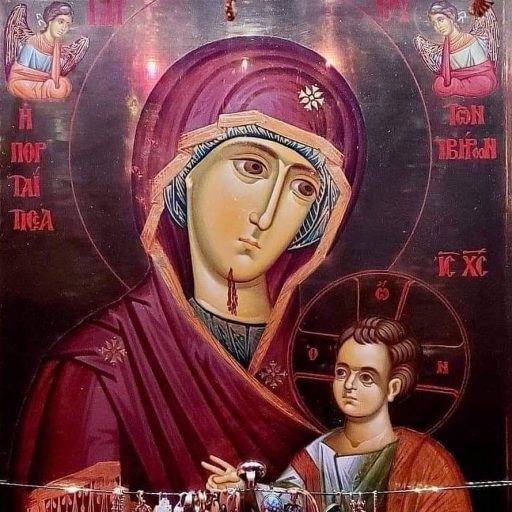
Saint Nektarios lived ascetically — humble, kind-hearted, pure in spirit. He judged no one, took revenge on no one, blessed everyone. Peace reigned in the monastery; murmuring and discontent were unknown there. The monastery had no other priest, and he served the Liturgy himself with great reverence. A nun who assisted him once saw a majestic Lady — the Most Holy Theotokos — enter the altar through the royal doors with a Child in her arms.
The metropolitan took the hardest obediences upon himself: he tended the garden, hoed the earth, carried water from afar, hauled stones himself when the cells were being built, and while the nuns slept he cleaned the courtyard and the lavatories. Father Philotheos recalled: “In the August heat I saw a monk working in the field at the monastery, the skirts of his cassock tucked into his belt. ‘Father, I am looking for the bishop!’ ‘Go to the monastery; you will find him there.’ A little later the same monk came in washed and changed, and introduced himself: ‘I am Bishop Nektarios.'”
18. Defender of Orthodoxy
The long winter evenings the bishop gave to writing. Among his most important works is the two-volume Study of the Causes of the Schism, which examines the Great Schism and papism. He saw the danger that the dogma of papal “infallibility” posed to Orthodoxy: “The postulate of infallibility abolishes the significance and authority of the Ecumenical Councils and so shakes the faith of Christians… The worship of God has been replaced by the worship of a man — the Pope of Rome.” From his pen came also Church Sermons, On the Seven Ecumenical Councils, Care for the Soul, Christian Ethics, Pastoral Theology, Christology, On the Immortality of the Soul, On Repentance and Confession, On the Mystery of the Eucharist, Know Thyself, On the Fasts and many others. He often wrote until dawn, then put out the lamp and went to the service.
19. The Gift of Prophecy
Clergy and laity came to him for confession from Athens and Piraeus. He was strict, yet took account of each person’s character; he saved many souls and showed many their path in life. God gave him the gift of prophecy as well.
To Father Philotheos, who meant to go to Mount Athos, he said: “Very well, go — but you will come back to Paros all the same.” On the way, in Thessaloniki, then still under the Turks, he and his companion were taken for spies and the death penalty was demanded; through the intercession of Saint Demetrios they were unexpectedly released, and Father Philotheos remembered the bishop’s words. Three years later he wished to go to the monastery of Chrysoleontissa — “Do not go; disappointment awaits you there.” He did not listen, and a quarrel between two monks there so shocked him that he left on foot the same night. Of a girl who had married the bishop said, “I see her in a nun’s habit — she will be tonsured.” Years later her husband died, she became a nun, and later abbess of the monastery of Saint Menas.
20. Man of Prayer
The bishop spent his nights in converse with the Lord; in his cell he prayed aloud before the icon of the Theotokos, and sometimes withdrew into the forest. Once the nuns sent a little girl after him with a stool, thinking it hard for him to sit on the stones. The girl found him and saw that he was raised from the ground, standing in the air. The saint asked her to tell no one.
Through his prayer people’s lives were set in order; the sick and the possessed were healed. A peasant passing the monastery called to a nun: “Tell the bishop to pray for rain, or everything will wither!” It rained all night without stopping. Unbelievers and militant atheists came to him, and after talking with him became fervent preachers of the faith of Christ.
21. The Last Slander
In Athens the bishop and his monastery had enemies who sent false accusations to the Synod. Its president, Archbishop Theoklitos of Athens, came to Aegina himself in 1908 and saw that the work of God was being done there. Archbishop Meletios (Metaxakis), who despised monasticism, reproached the bishop: “You build monasteries when so many churches around are empty? The modern age is not for monasteries!” The bishop did not stop. He used to say, “Aegina will be the Athos of women’s monasticism” — and today the island has nine convents, more than anywhere in Greece.
The most terrible slander came later. A woman of Aegina known as the candle-seller ill-treated her sixteen-year-old daughter; the girl took refuge in the monastery, and the bishop, on the advice of Metropolitan Theoklitos, protected her. The mother went to court and accused the monastery of immorality — claiming that newborn infants were drowned there. A public prosecutor’s agent with two policemen broke down the gate, shouted at the seventy-year-old monk, seized him by the shoulder and shook him: “I will put you all in prison!” Saint Nektarios pointed to heaven: “The Lord sees everything.” Within a week the investigator fell ill — the hand he had raised against the bishop became paralysed. He came to Aegina with his wife and begged forgiveness, and the bishop forgave him with all his heart. The monastery, meanwhile, grew and became a spiritual centre where everyone who came found peace.
22. A Holy Repose
The bishop spent twelve years in the monastery. In 1920 he fell gravely ill; he told no one of his terrible pains — he who healed others by prayer did not help himself, for “we must through much tribulation enter into the kingdom of God” (Acts 14:22). At the monastery of Chrysoleontissa he prayed for fifteen days before the icon of the Mother of God. On the way back he stopped his donkey and said with tears: “For the last time I bless my monastery and all who live in it. Soon I shall leave you.” “Where to, Your Eminence?” “To heaven.” “And what will become of us?” “You will be devout nuns; friends will come, they will care for you and protect you — laymen, priests and bishops alike.”
At the hospital in Athens the admitting staff asked, “Who is this — a monk?” “No, it is Metropolitan Nektarios of Pentapolis.” “Then where is his golden panagia, where is his money?” He had no money, and he was put in the ward for the destitute. Two months later, on 8 November 1920 (Old Style), after receiving Communion, he peacefully gave up his soul to the Lord.
The nuns dressed him in a clean shirt and laid the old one on the next bed, where a paralysed man lay — he was healed at once and began to walk. The ward filled with fragrance that did not fade for months. The saint’s body was laid in the church of the Holy Trinity in Piraeus; everyone sensed the unusual fragrance and saw that his hair and beard were covered with fragrant dew, which people gathered with cotton wool. On Aegina every church bell tolled, and the coffin was carried by hand from the harbour to the monastery. “We have lost our benefactor and protector; our island is orphaned,” they said. After forty-eight hours the body, showing no trace of corruption, was buried in the monastery courtyard — on the very spot where years before a mysterious voice had forbidden an old nun to plant a pine: “Do not plant here.”
23. Incorrupt Relics
The marble tomb was to be finished in five months, and Abbess Xenia worried about how the body would be moved. A nun saw the bishop in a dream: “Tell me, do I smell bad? Smell carefully! Abbess Xenia thinks so. Look at me — I am completely whole.” At the translation the body was indeed found incorrupt, soft and fragrant. Archbishop Chrysostomos of Athens, who came with the police, saw the face and hands white as snow: “This is a sign of holiness and of the special grace he received from the Mother of God.” The Aeginetan physician George Xydeas wrote in 1932, twelve years after the burial: “As a scientist I declare with full responsibility that I witnessed an inexplicable phenomenon. Saint Nektarios looked as if asleep; even his beard was as in life. I am no religious fanatic — I only tell what I saw with my own eyes.” Later, like other saints, his body returned to bones, so that his holy relics might be spread throughout Greece and the world.
Shortly before his death he told a spiritual child: “I go to God with joy — I have paid my debt here.” In Piraeus, on the day of his repose, an acquaintance dreamed of a dove flying over golden clouds and heard a voice: “The soul of the island is flying away from Aegina.”
24. Canonisation
After the bishop’s death the miracles began, and the people recognised him as a saint almost at once and with one voice — a rare thing in Church history. In 1961 the Ecumenical Patriarchate officially numbered Saint Nektarios among the saints. Four days of celebration were held on Aegina: on 3 November a great vigil was served by Metropolitan Prokopios of Hydra and Aegina with ten hierarchs, and on 5 November the holy relics were carried in procession across the island and the Patriarchate’s decision was read to the people.
To this day thousands of pilgrims come to his tomb. A policeman on duty there said: “If I had not seen it with my own eyes, I would never have believed that a saint helps people so.”
25. Miracles after His Repose
It is hard to name an illness that has not been healed through the prayers of Saint Nektarios: cancer, polio, pneumonia, asthma, infertility, heart disease, mental illness… One journal alone published more than two thousand accounts of miracles, with names and addresses. Here are a few.
The priest Demetrios Panagopoulos was childless for ten years. Through the saint’s intercession his wife conceived, though the doctors were sure that either mother or child would not survive. On the day of the operation Father Demetrios prayed in the church of Saint Nektarios and sensed the same fragrance he had once known at the tomb on Aegina. The child was born healthy and was baptised on Aegina with the name Nektarios.
A policeman of Aegina whom the bishop had often urged to go to church and receive Communion returned to the island after twelve years and met the elder at the harbour: “Go to church; do not forget Communion.” In the café he told his friends, “I just met the elder — how long he lives!” “But Nektarios died three years ago!” The stunned policeman went at once to venerate the holy relics.
During the German occupation (1941–1945) there was neither coffee nor sugar, and the abbess allowed the sisters coffee only in the morning. That evening the bishop appeared to her: “Why do you not give the sisters coffee at midday? Leave the coffee to me — you keep my rule.” That same night a ship laden with coffee and sugar put in at Aegina: the elder had appeared to the captain in a dream and told him, “In the morning send coffee and sugar to my house.” The Aeginetan sailors recognised Saint Nektarios from his icon.
A woman in the Saint Savvas hospital in Athens, whom the doctors had warned would not survive a haemorrhage, was brought oil from the lamp at the saint’s tomb by a relative. As soon as she was anointed, the pain and bleeding ceased and she recovered.
In 1925 the relatives of a possessed young woman of Piraeus — the very mention of Saint Nektarios threw her into convulsions — brought her to Aegina. She could not approach the tomb, so they tied her to a pine and served the supplication there. She was completely healed, remained in the monastery, was tonsured with the name Mitrodora and gave the monastery a large silver lamp. Likewise healed was Ekaterini Krakari of Piraeus, to whom the bishop appeared in a dream in 1926: “My child, do you know what ‘nun’ means? Faith and patience. Now you will receive my blessing and be made well.”
Holy Hierarch Nektarios, pray to God for us!