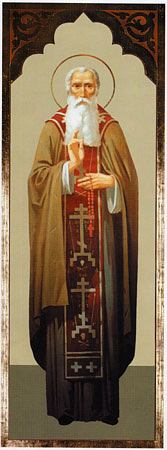
✝ Venerable Ioannikios the Great (†846)
November 4 / November 17 (Julian Calendar)
On this day, November 4 according to the Julian Calendar (November 17 civil calendar), the Georgian Orthodox Church commemorates the Venerable Ioannikios the Great.
The Venerable Ioannikios the Great was born in 752 in the village of Marykatos in Bithynia. His parents were so poor that they could not give their son even an elementary education. From childhood Ioannikios had to tend the herd that made up his family’s entire wealth. He would often make the sign of the Cross over the cattle and, withdrawing to a secluded place, would pray the whole day long. At such times neither wild beasts nor thieves came near the herd.
By order of Emperor Leo IV (775–780), envoys sent throughout the cities and villages of the land chose the finest young men for military service, and the young Ioannikios was enlisted in the imperial army. Enemies trembled before the stalwart soldier, while his comrades sincerely loved him for his gentleness and humility. During this time, under the influence of blasphemous preaching, the saint sided with the iconoclast heretics who had risen up against the holy icons and those who venerated them.
Once, as he was coming down from Mount Olympus with his troop, an unknown monk called him by name: “My child Ioannikios, how can you call yourself a Christian and yet hate the images of Christ the Saviour?” Ioannikios understood his error, was filled with repentance, and thereafter became a faithful defender of the true Faith. The saint served six years in the army, and his commanders, and even the emperor himself, honored his military merit with many awards. But his soul could not be content with earthly honor; it longed for an entirely different arena, and the Lord called him to His service.
Ioannikios was twenty-four years old when he withdrew from the world, intending to settle in the wilderness, but a holy ascetic counseled him first to pass through the school of monastic life. The saint spent several years in a community of brethren, learned to read and write, memorized thirty of the Psalms of David, and only then, at God’s direction, went out to struggle in a desolate place. There the blessed one lived in a dugout he had dug with his own hands; a certain shepherd brought him a little bread and water only once a month. The chosen one of the Lord prayed day and night and chanted the psalms, and after each psalm he offered a prayer which the Church has preserved, with slight changes, to this day: “My hope is the Father, my refuge is the Son, my protection is the Holy Spirit: O Holy Trinity, glory to Thee.” After Ioannikios happened to meet some of his former comrades-in-arms, he left that wilderness and went to the mountains of Kontouria. Countless wild beasts and serpents had their lairs there, but by God’s help they did the saint no harm. Once, at the onset of winter, high in the mountains, Ioannikios came upon a deep cave and entered it. In the darkness he noticed something glowing; drawing near, he saw an enormous serpent lying on the ground, its eyes flashing like burning embers. Saint Ioannikios was not afraid of the creature; he settled on the right side of the cave and spent the whole winter there, near the serpent.
After twelve years of ascetic struggle the blessed one was tonsured a monk. He spent the first three years after his tonsure in complete seclusion, and then traveled to Chalcedon to the great faster George (commemorated February 21). The chosen ones of the Lord lived together for three years, during which the Venerable Ioannikios learned the entire Psalter by heart. In deep old age the saint finally settled at the monastery of Antidion and remained in seclusion there until the end of his life.
Over seventy years of ascetic labor, the Venerable Ioannikios attained a lofty degree of spiritual perfection. According to the testimony of his disciple Pachomius, he received the gift of foreknowledge. During prayer the blessed one would rise into the air; once he crossed a flooded river on foot. He was able to become invisible to people and to make others unseen as well: once, for example, he led captive Greeks out of prison before the eyes of a multitude of guards. Poison and fire, with which envious men tried to destroy the saint, could do him no harm. It is also known that the chosen one of the Lord delivered the island of Thasos from countless serpents.
The holy ascetic foresaw the day of his repose and departed to the Lord on November 4, 846, at the age of ninety-four according to one account, or one hundred fifteen according to another.
May the intercessions of the Venerable Ioannikios the Great be with us all.