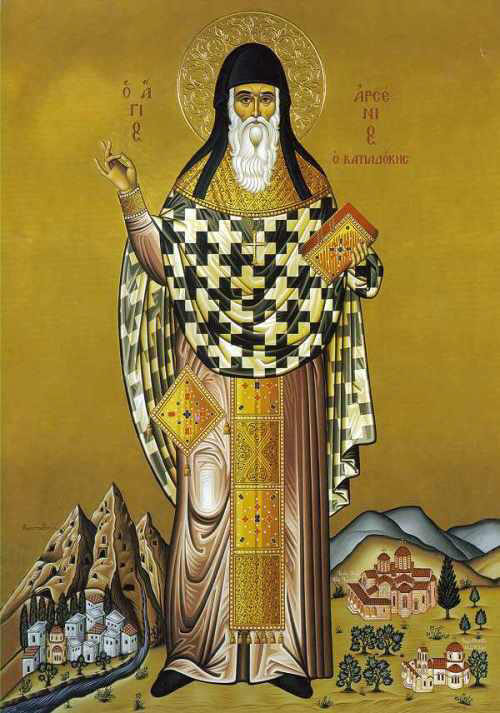
✝ Venerable Arsenios of Cappadocia (†1924)
October 28 / November 10 (Julian Calendar)
On this day, October 28 according to the Julian Calendar (November 10 civil calendar), the Georgian Orthodox Church commemorates Venerable Arsenios of Cappadocia.
Father Arsenios (Anitsalikhos) was born around 1840 in Cappadocia, in the district of Pharasa. His God-fearing parents were named Eleftherios and Barbara. Because his father had made a pilgrimage to Jerusalem, as a pilgrim to the Holy Land he was called Hadji-Eleftherios. They had two sons: Vlasios and Theodoros. The parents died early, and an aunt took care of the boys. Once Vlasios took his brother to their father’s field. They had to cross a small but swift river. Suddenly the water swept Theodoros away. Close by stood a little chapel of Saint George. Vlasios begged the saint for help. He was still weeping when he saw his brother standing beside him. The boy said: “A horseman who looked like a monk set me on his horse and brought me out.” From that time on Theodoros conceived a desire for the monastic life. Vlasios, too, dedicated his life to God. He became a teacher of Byzantine music and finally died in Constantinople.
When he had grown a little, his aunt sent Theodoros to study at the home of his father’s sister in Nigde. When the aunt saw the boy’s intelligence, she consulted her family, and they decided that once he finished his studies in Nigde he would be sent on to Smyrna (present-day Izmir). Returning to his father’s house on school holidays, Theodoros would gather children his own age and teach them whatever he himself knew. Once his aunt decided to keep him with her and marry him off, but the girl she chose refused to marry Theodoros, saying: “He is from a good family, but he is a monk.” When Theodoros heard this, he said to his aunt: “You see, even a stranger understood that I want to be a monk, while you do not understand me.” The very next day he left the place and went to Smyrna, where, besides Greek and church subjects, he learned Armenian, Turkish and French. At the age of 26 he was tonsured a monk in a monastery in Caesarea. He was given the name Arsenios.
Brother Arsenios was not to enjoy quiet for long. Teachers were then sorely lacking, so Metropolitan Paisios II ordained Arsenios a deacon and sent him as a teacher to his native Pharasa. Arsenios set to work with great zeal. He set up the school in his own room. After the Russo-Turkish War, in 1878–79, Russia took the Orthodox Greek population living in Turkish territory under its protection by the peace treaty; but even then, and all the more so ten years earlier, the Greeks were very careful not to provoke the Turks. For this reason Father Arsenios carefully hid his school, and often took the children away from the village to a cave, where he taught them to read and write.
At the age of thirty Arsenios was ordained a priest and raised to the rank of archimandrite. Now the venerable father’s ministry expanded: he traveled about the Christian Greek villages and encouraged his countrymen. The hopeless situation of the Greeks conquered by the Turks gave the venerable father courage and strength. Countless miracles took place through his prayer; he read prayers over everyone, whether the sick person was a Christian or a Turk. The Turks too sensed the great power of Orthodoxy and respected him. Once he was in a certain village with his chanter. The local Turks did not allow him to speak with the Christians. Father Arsenios was silent, and then said to the chanter: “Let us leave here, and the Turks themselves will call us back.” They walked for half an hour and passed beyond the village. Hadji-Efendi (as the Turks called Father Arsenios) knelt and began to pray. Suddenly the cloudless sky filled with clouds and a torrential rain began, followed by a terrible storm. The Turks at once understood their mistake and sent two horsemen after the elder. These fell to their knees and begged forgiveness in the name of the village. Father Arsenios returned to the village, made the sign of the cross toward all four sides, and the rain stopped as suddenly as it had begun.
But no less dangerous than the Turks were the Greek Protestants. Once they sent one of their men to Pharasa as a teacher. Father Arsenios said to him: “Go away from here; one Protestant is enough for us — the Turk who lives in Pharasa.” When the man could accomplish nothing, Father Arsenios warned the people of Pharasa: “Whoever greets that Protestant will not be saved.” Isolation from the people, together with Father Arsenios’s separate talks with him, set the Protestant thinking, and he returned to the faith of his fathers.
“Pray, children,” Father Arsenios would urge his pupils, and he taught them to pray. Whoever sinned in anything had to ask God’s forgiveness with repentance. He took great care of human souls. Often, when baptizing children, against the wishes of the parents he would give them a name whose feast did not exist in the calendar — for example, Jordan, Gethsemane, Jerusalem. He knew that celebrating one’s name day often ended in drunkenness, which became a cause of quarrels among brothers. “If you are able to do anything, there is the enemy, the Turks — fight them,” he would tell the young men. “His conduct, which was a ‘stumbling block’ to some, moved me more than the miracles he performed by God’s power. He tried to appear stern in appearance (especially toward women) or even greedy, in order to hide his soul from people’s eyes and from empty praise,” says Father Paisios the Athonite of him. But he could not fully conceal the grace of God with which he was filled.
In those hard times, where among the Christians of Cappadocia, on this little island set in a Muslim sea, would one find a doctor? But the people of Pharasa had another “doctor” — Father Arsenios. They brought every kind of sick person to him, and through his prayer all were healed. When it was impossible to bring someone, they sent the sick person’s clothing to Father Arsenios; he blessed it and returned it to the sufferer. The sick person would put it on in the fear of God and be healed. Often, for their consolation, Father Arsenios sent them some prayer, which they would hang about their necks as an amulet. When he could not find a fitting prayer in the Euchologion for an illness or some other human trouble, he read Psalms over them. The Gospel he read over the sick only in severe cases, such as blindness, deafness, paralysis or demon possession. If a person was sick in soul as well as body, he would bring him to himself several times, healing the soul first and then the body. Of course, he never took money for this. “Our faith is not for sale,” he would say. Once a demon-possessed Turkish woman was brought to him for healing; she was tightly bound, but they still could not hold her. Father Arsenios ordered her released. Freed of the ropes, the woman threw herself on the elder and bit his foot. Father Arsenios had the Gospel in his hand; without even opening it, he struck the woman lightly three times, and the demon departed at once. The woman’s father laid a purse full of money before Father Arsenios; he gave it back. Once a Turk brought him two donkeys as a “peshkesh” (gift), because through his prayer the Turk’s barren wife had borne two children. Father Arsenios said sternly to him: “Is there no poor man left in your village, that you bring it to me?” Through his prayer Father Arsenios healed the barrenness of women in particular. Women would send him their headscarves, which the elder blessed; they would then put them on and bear children within the year. They often sent ropes as well, which barren women wore around the waist as a belt and so received the grace of fruitfulness. Sometimes they asked for the wick of an icon lamp, sometimes for the ashes of the censer, which they dissolved in water and gave the sick to drink, and they were healed.
Merciful to others, Father Arsenios was merciless toward himself. He had a tattered hut with an earthen floor. He would spread a thin blanket on the ground and rest so. God knows when he slept. Wearied by worldly tumult, two days a week he shut himself in his cell and received no one. If people came from far away and troubled him by knocking at the door, he would open it, look at what ailed the sufferer, then read the appropriate prayer silently, and the sick person was healed. The people of Pharasa knew this and refrained from disturbing him on those two days. They would go to his cell, take earth from the threshold, sprinkle it on the diseased spot, and be healed. It was as if Hadji-Efendi’s cell absorbed the sicknesses of these afflicted people. In his cell Father Arsenios always had a sack slung on his back, and however great the person who visited him, he did not take it off: “My mother gave it to me,” he would say. Perhaps there were ashes in it, for in his cell before the icons there was always ash and cinder, on which he stood in token of humility and so prayed. Often Turks, who did not consider themselves worthy of Hadji-Efendi’s prayer, would take only these ashes from the chanter, drink them dissolved in water, and recover. Once, on a Wednesday, a Muslim woman brought her blind daughter to Father Arsenios. The elder did not open the door. The woman left her child at the door and went off to the center of the village. Just then a woman of Pharasa, whose hand was twisted with pain, ran up to Father Arsenios’s cell. She took earth from the threshold, rubbed it on her hand and was healed. She also said to the Muslim girl: “What are you waiting for? Don’t you know that Hadji-Efendi does not open his door on Wednesdays and Fridays? Take earth from the threshold and rub it on your eyes.” The woman went about her business. The girl groped her way to the threshold, took earth, rubbed it on her eyes and saw. Overjoyed, she began pounding on the door. When she would not stop, Father Arsenios looked out and signed with his hand to ask what she wanted (on these days he kept silence). When he learned the reason, he took the Gospel, laid it on her head, read, and she was completely healed. The overjoyed woman bowed to him and kissed his feet. Then the venerable father said to her: “If you want to bow, bend your knee to Christ, who gave you sight.”
When he healed a paralyzed or demon-possessed child, he laid the penance on the parents, who in his view were the cause of the child’s illness. In other cases he almost never imposed penance on the sinner; instead he brought him to a sense of sin. Once a Turk was brought to him who had defiled the spring of Saint John and whose neck had been twisted for it. Father Arsenios kept him for a week and did not heal him. “Why do you keep the Turk so long, Father?” they asked. “So that he may feel repentance,” he answered. After a week he read a prayer over him and set the man’s head back in its place. Father Arsenios said to him: “From now on, when you see anything Christian, bow your head from afar, go your way, and do not approach it.” Once a mute Turk was brought to him. Father Arsenios began reading the Gospel over him. He had not yet finished the prayer when the mute man found his tongue.
The venerable father celebrated the bloodless sacrifice every day. In prayer, it was said, his heart seemed to part from his body, rise to Christ, embrace His feet and not let go until He fulfilled the request.
The power of Father Arsenios’s word was felt many times. Once two sheikhs visited him. The venerable father treated them to coffee, and they offered him an amulet they had made. Father Arsenios said sternly: “I have greater power. By the power of Christ I can fix you to the spot so that you cannot stand up.” Then he rose and left his guests. The sheikhs drank their coffee but could not get up. They were forced to call for Father Arsenios. The venerable father merely signed to them: “Go.” The sheikhs rose freely and left in shame.
Once thieves entered his cell. The venerable father was praying there. He said nothing. They took Father Arsenios’s blanket and wanted to leave, but could not find the door. Father Arsenios rose, took one of them by the hand and said: “Here is the door by which thieves come in — but they journey to hell.”
Something else happened too: three Turkish bandits wanted to rob Father Arsenios. They thought he would have a lot of money. They chose a Wednesday for the robbery. Two stayed outside; one of them slipped in through the window and opened the cell door. Father Arsenios was praying at the time. He looked up at the noise. His gaze turned the dagger-wielding Turk to stone in the middle of the doorway. Father Arsenios calmly went on praying. Meanwhile day broke. The bandits who had stayed outside grew anxious, climbed in through the window themselves, and saw their friend frozen in a strange posture. They began to plead with Father Arsenios: “Have mercy on us.” He signed to them to go, and the bandits left the place in fright.
Once the Turks seized their chance and attacked Pharasa when the men were away from the village. They even took ten men captive. Father Arsenios stood before them and demanded the return of the people: “Otherwise I will turn you into stones.” Indeed, his word turned the Turks into statues. Only after their captured countrymen were returned did he remove their “chains.”
Along with other “peculiarities,” the venerable father had one more: he never mounted an animal. Several times he journeyed barefoot to Jerusalem.
Patriarchs held him in high esteem; they even offered him the episcopate, but received a refusal.
In 1923, by the Treaty of Lausanne, Turkey and Greece exchanged populations: the Greeks of Asia Minor were resettled in Greece, and the Turks living there in Turkey. This new tidings threw the people of Pharasa into turmoil. Father Arsenios calmed them. First of all he baptized every unbaptized child. At that time he also baptized Father Paisios the Athonite. Father Arsenios gave the child his own name. “I know that you wish to leave an heir,” he said to the parents, “and I too wished to leave behind me a monk who would continue my path.”
After the baptism, for a whole week he buried the holy things of the church in the ground, so that the Turks would not defile them. Some he buried in the church, some in the cemetery. There was no way to take them along.
The deportation began on August 14, 1924 (Old Style). They had gone 60 kilometers when Father Arsenios remembered that he had left on the holy altar of the church in Pharasa the holy relics of Saint John Chrysostom. Alone, he went back to Pharasa, took the holy relics, and caught up with his people.
In Nigde, many local sick people were waiting together with the Pharasiotes. The venerable father healed them, and they continued on their way. After five exhausting days of travel they saw that Father Arsenios could no longer walk, and they forced him to sit on a cart. On the road he comforted everyone. He also said: “When we reach Greece, the people of our village will be scattered to different places. I will live forty days and then I will die.” They reached Greece by the Exaltation of the Cross. The Pharasiotes were temporarily settled on the island of Corfu. Three weeks later Father Arsenios fell ill. His fellow villagers made him lie down in a hospital by force. On the eve of his death the Mother of God appeared to him and showed him the monasteries of Mount Athos. She showed him that blessed land “toward which he had strived all his life and of which he had not been found worthy.”
On November 10 (New Style) of 1924, Father Arsenios reposed. The people of Pharasa were not with him at that time…
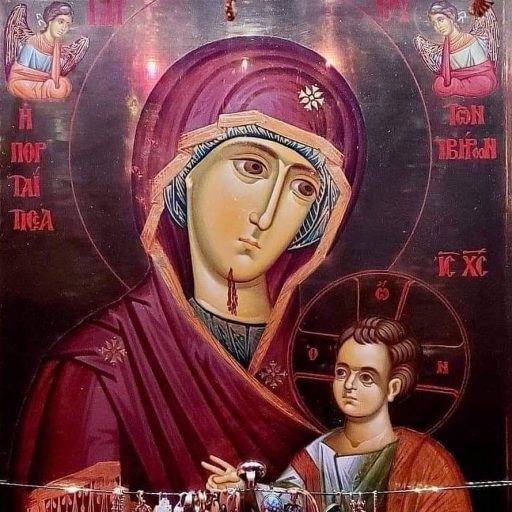
Once, it is said, Father Arsenios celebrated the liturgy far from Pharasa, in a chapel dedicated to the Mother of God, in a cave on a sheer cliff. After the liturgy he stepped out onto a wooden balcony. Suddenly a plank broke and Father Arsenios fell into the abyss. Peasants noticed this from afar. They went down into the ravine. They did not expect to find Father Arsenios alive, but they found him unharmed: “As I was falling into the abyss, suddenly a woman took my hand, slowly set me on the ground and departed from me.” Afterward he often said: “I felt then like an infant in its mother’s arms.” Such is the lot of one obedient to the Mother of God: the Lord’s Mother always helps and stretches out her hand to her children by grace…
Father Paisios the Athonite loved his great countryman very much. In 1958 he visited the venerable father’s grave in Corfu, opened it and moved the holy relics to Konitsa. In 1970 he enshrined the holy relics in the newly built convent. When he first placed the holy relics in his cell and began to pray before them, it was evening. Father Paisios heard someone’s angry voice: “What bones are these?!” Then some force wrapped itself around him and tried to strangle him. “Father Arsenios, help me!” he cried. Father Paisios felt that this dark force was driven away by another, stronger force.
Father Paisios gathered materials on the life of Saint Arsenios. It was February 21, 1971. On this day the memory of the two Saints Theodore is kept. Father Paisios sat reading these materials. The sun had not yet set. Then Father Arsenios visited him and caressed him: he stroked his head as a teacher caresses a pupil for a lesson well learned. This visit filled Father Paisios’s heart with inexpressible divine joy.
On February 11, 1986, the Patriarchate of Constantinople glorified Father Arsenios as a saint.
May the intercessions of Venerable Arsenios of Cappadocia be with us all.