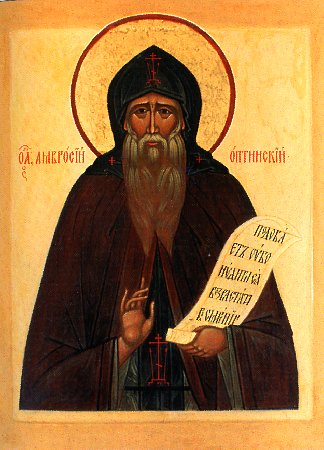
✝ Venerable Ambrose of Optina (†1891)
October 10 / October 23 (Julian Calendar)
On this day, October 10 according to the Julian Calendar (October 23 civil calendar), the Georgian Orthodox Church commemorates Venerable Ambrose of Optina.
The venerable Father Ambrose (in the world Alexander Mikhailovich Grenkov) was born on November 23, 1812, in the village of Bolshaya Lipovitsa in the Tambov province. His father, Mikhail Feodorovich, served as a sexton in the church, and his grandfather was a priest. Alexander was the sixth child of Mikhail’s large family. Little Alexander was a very lively, restless, and cheerful child. He learned Church Slavonic, the Book of Hours, and the Psalter at home. On feast days his father always took Alexander with him, and in church the boy sang and read the Psalter together with his parents.
After graduating from the Tambov theological school, in 1830 Alexander fell gravely ill. In his hopeless condition the young man made a vow before God that if he recovered he would enter a monastery. The Lord heard his prayer, and he was healed. “After my healing I wavered for four whole years; I could not make up my mind, and it was very hard for me to part with the world,” Father Ambrose himself later recalled. After finishing seminary he taught Greek at the Lipetsk theological school, but the years passed, and the voice of conscience over his unfulfilled vow weighed ever more heavily on the young man’s soul. He turned for advice to Father Hilarion (Fokin), from whose lips came truly prophetic words: “You are needed at Optina,” he told the future monk. “Go to Optina!” On October 8, 1839, Alexander set out for Optina. He was received by Venerable Leo, and on April 2, 1840, the saint was enrolled among the brethren of the monastery.
For some time he was the cell-attendant of Venerable Leo. In November 1840 he was transferred from the monastery to the skete and appointed assistant to the cook. In the summer of 1841 Alexander was clothed in the riassa. Owing to the needs of his obedience, he often turned to the venerable fathers Leo and Macarius. “He will be a great man,” Father Leo said of him prophetically, seeing in him his spiritual heir.
On November 29, 1842, Alexander was tonsured a monk with the name Ambrose, in honor of Saint Ambrose of Milan, and on February 2, 1843, he was ordained a deacon. After this Father Ambrose was placed under the obedience of Venerable Macarius, assisting the saint in receiving visitors. The years spent in this obedience beside the God-bearing spiritual guide gave great experience to the future spiritual lamp of Optina.
On December 9, 1845, Bishop Nicholas of Kaluga ordained Father Ambrose a hieromonk. Because of illness and, in part, because of his rank, on January 2, 1846, he was released from his duties as cell-attendant to Father Macarius. In August of that year His Eminence Nicholas blessed him to bear, together with Venerable Macarius, the labor of spiritually guiding the brethren of the monastery and its visitors. Hieromonk Ambrose was then thirty-four years old.
The Lord, who was preparing the young spiritual father for great service, permitted a severe and prolonged illness to befall him, lasting from September 1846 until the summer of 1848. Father Ambrose’s condition was so grave that no one hoped he would survive, and he was tonsured into the Great Schema without a change of name. In the summer of 1848 the elder’s health gradually improved, yet he never fully recovered, and the illness periodically made itself sharply felt again. In 1860, in 1868–69, and in 1871 he again had to endure serious illness, which left him greatly weakened. “In a monastery the sick do not die quickly,” Father Ambrose later said, “but their illness drags on and lingers until it bears true fruit. In a monastery it is even necessary to be somewhat ill, so that the flesh is less stirred up and rebellious, especially in youth, and fewer foolish things come into our heads.” “God does not require bodily labors from the sick,” the saint said, “but only patience, with humility and thanksgiving.”
After his recovery Father Ambrose greatly assisted Venerable Macarius in his many labors: he received visitors, translated and prepared books for publication with his blessing, and some of the brethren led their lives under his spiritual guidance. Toward those who had sinned but repented with a pure heart and set out on the path of amendment, he was merciful beyond measure. He made no distinction between rich and poor, worthy and unworthy, like the Savior who ate and drank with publicans and harlots in order to set them on the path of truth. The saint never condemned the sins of others and drew converts to himself with love; only slander could he not endure, and he was utterly uncompromising toward those who slandered their neighbor.
The foundation of Venerable Ambrose’s ministry was the spiritual guidance of the brethren of the Optina Hermitage, whom he loved dearly, laboring tirelessly for the salvation of each one of them. Once the elder warned Hieromonk Palladius, who was in perfect health, several times to receive the Mystery of Holy Unction and to be tonsured into the Great Schema, which at Optina was usually done before death; but the hieromonk refused. At last he agreed, but while he was preparing for the anointing he was struck by paralysis and lost the power of speech. The fathers anointed him, communed him with the Holy Mysteries of Christ, and he died that same night. The saint’s gift of foresight was revealed many other times as well, and Father Ambrose always directed it toward the spiritual benefit of the brethren.
After the repose of Venerable Macarius, Father Ambrose gathered disciples around himself and continued the publishing work begun by Father Macarius. Under his direction some twenty books were published — writings of the Holy Fathers and other books of spiritual profit.
Venerable Ambrose greatly helped the poor and needy. He spoke with simple village people with wonderful humility and attentiveness, felt their pain as his own, and always sought to console them. Once a peasant woman came to Father Ambrose in tears and asked him to teach her how to feed the turkeys her master had entrusted to her, so that they would not die. The elder asked her how she fed them and gave her suitable advice. When Father Ambrose was told that he was wasting his time on idle talk, he answered with love: “But her whole life is in those turkeys! Her peace of mind depends on them! And her soul is just as precious to the Lord as the soul of a person with loftier problems!”
Father Ambrose showed particular care for sick women, maidens, widows, orphans, and the destitute, and he sought to settle them in one of the monasteries under his spiritual care. Among these a special place belonged to the Shamordino Convent, which the saint himself had founded.
Countless were the miracles worked by the saint. Through his prayers the sick were healed and those in peril were delivered from misfortune. Suffering and sorrowing people found consolation in his grace-filled words. Well-known writers and public figures of the nineteenth century came to Father Ambrose at Optina: F. M. Dostoevsky, V. Solovyov, K. Leontiev (later the monk Clement), A. P. Tolstoy, L. N. Tolstoy, M. P. Pogodin, and others. People streamed to him in an unbroken flow, and not one of them went away unconsoled. The saint instructed everyone with the word of God, explained to them the meaning of the Gospel and the words of the Holy Fathers, and directed their lives and labors in a God-pleasing way. Asked how to understand the words of Holy Scripture, “Be ye wise as serpents,” Venerable Ambrose explained: “A serpent that wishes to exchange its old skin for a new one always seeks a narrow opening and passes through it, leaving its old skin behind along the way. So too a person who seeks to put off the old man must begin his course along the narrow path of fulfilling the Gospel commandments. In time of danger and trial the serpent guards its head above all other members of its body. So too a person must strive above all to preserve the beginning and head of every good thing — the faith. As long as true faith is preserved, it is still possible to set everything right.”
The elder’s strength gradually declined. In the summer of 1890 Father Ambrose went, as was his custom, to the Shamordino Convent. Toward the end of the year he tried three times to return to Optina, but illness prevented him. The venerable father accepted this threefold obstacle as a revelation of the will of God and no longer thought of leaving Shamordino.
On October 10, 1891, Venerable Ambrose reposed. News of his death quickly spread throughout all Russia, and the stream of believers did not cease. The saint’s spiritual children gathered at the Shamordino monastery from every side; some eight thousand people attended the funeral. Out of love and reverence for the departed elder, a disagreement arose between the Optina and Shamordino monasteries: where should the father, dear to both communities, be buried? The question was referred to the Holy Synod, which designated the Optina Hermitage as the venerable father’s final resting place. “Father Macarius was a great man. May God grant that I be worthy to be buried at his feet!” Father Ambrose often said during his lifetime. And indeed, his body was laid to rest beside Venerable Macarius. On his tombstone are engraved the words of the Apostle Paul: “I am made all things to all men, that I might by all means save some” (1 Corinthians 9:22). These words precisely express the essence of Venerable Father Ambrose’s earthly labor.
May the intercessions of Venerable Ambrose of Optina be with us all.