✝ Twenty-Six Venerable Martyrs of Zographou (†1284)
October 10 / October 23 (Julian Calendar)
On this day, October 10 according to the Julian Calendar (October 23 civil calendar), the Georgian Orthodox Church commemorates the Twenty-Six Venerable Martyrs of Zographou.
In 1274, at the Council of Lyon, the Emperor Michael VIII Palaiologos resolved to strengthen his tottering state through a union of faith with Catholic Rome. This step provoked universal discontent in Byzantium. The monks of the Holy Mountain of Athos also rose up to defend the purity of the faith. They sent the emperor an epistle explaining with sound reasons that the Pope may not be regarded as the head of the Church, that unleavened bread may not be used in the Eucharist, and that the Orthodox Creed may not be altered, and they called upon the emperor to come to his senses. “We see clearly,” they wrote, “that you are a heretic, but we beseech you: abandon all this and return to the teaching that you received.”
Michael Palaiologos requested military aid from the Pope. The crusaders who entered the country invaded the Athonite peninsula, plundering and laying waste to it.
The invaders offered the monks of the Iveron Lavra union and communion with them in faith. The blessed fathers firmly refused, denounced the lawless ones, and anathematized them. This enraged the enemies of Christ. They drove the monks out of the monastery. Two hundred of them, the elders, were put aboard the monastery’s own ship and sunk together with it; the others, the younger ones, were taken captive and sent to Italy along with the monastery’s property, stripped of their monastic habits, and sold to the Jews.
The godless then moved on to Vatopedi Monastery. A silent witness to the merciless slaughter they carried out there is Mount Fourkovouni, the “Mount of the Gallows,” where the papists hanged the fathers who remained faithful to the faith.
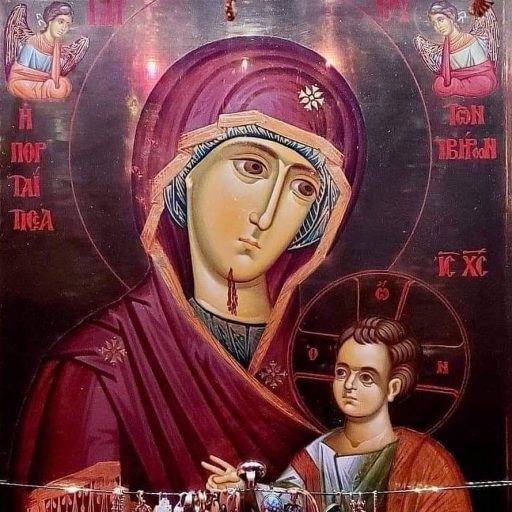
The Bulgarian monastery of Zographou learned in advance of the approaching calamity. In the monastery’s vineyard, half an hour’s walk to the southwest, there lived a certain monk. In his cell stood an icon of the All-Holy Theotokos, before which he burned incense every day and read the Akathist. Once, during prayer, he heard a voice coming from the icon, announcing the approach of the crusaders and commanding him to warn the brethren at once. The monk found it hard to leave the icon, but the Queen of Heaven said to him: “Do not worry about Me; go quickly.” When the father drew near the monastery he was amazed: by wondrous providence the icon had moved, arriving before him and standing over the monastery gate. Hearing of this miracle, the brethren glorified the Lord together.
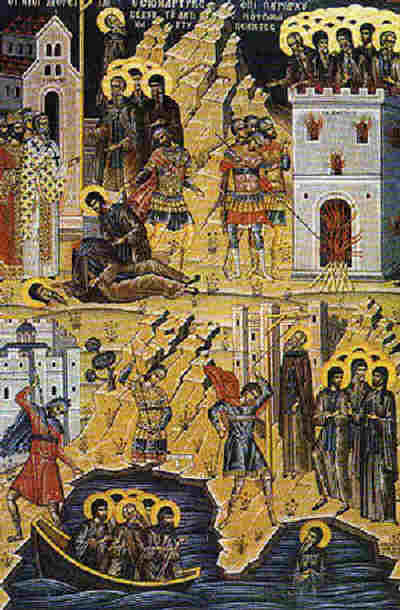
Then Abbot Thomas told them of the calamity that was approaching and said: “Whoever is not afraid and is ready for martyrdom, let him remain with me in the monastery; as for the rest, take the church vessels and withdraw from here until the wrath of the heretics passes, so that you do not renounce your faith and sin through blasphemy.” Thus those who feared torture took refuge in ravines, caves, and mountain gorges, while the holy abbot shut himself in the tower with the remaining monks — not out of fear, but in order to denounce the heresy.
The crusaders surrounded the monastery and demanded that the gates be opened. Venerable Thomas replied: “Depart from us, you workers of iniquity, for as the Apostle says: Though we, or an angel from heaven, preach any other gospel unto you than that which we have preached unto you, let him be accursed” (Galatians 1:8). Then, citing Holy Scripture and the decrees of the Ecumenical Councils, he exposed all the errors of the papists. The enraged Catholics plundered the monastery and set it on fire. Standing in the blazing tower, the venerable fathers prayed, beseeching the Savior to strengthen Orthodoxy and overthrow heresy. When their prayer was finished, a voice was heard from heaven: “Rejoice and be exceeding glad, for great is your reward in heaven.” Hearing this voice, the tormentors trembled, yet they did not grasp the meaning of what had happened.
According to Greek manuscripts preserved at the Protaton (Karyes) and in the Iveron and Vatopedi monasteries, the holy martyrs committed their souls to the Lord on October 10, 1280. There were twenty-six of them in all: twenty-two monks and four laymen. The names of the laymen remain unknown to us, but the names of the monastics have been preserved: Thomas, Barsanuphius, Cyril, Micah, Simon, Hilarion, James, Job, Cyprian, Sabbas, James, Martinian, Cosmas, Sergius, Menas, Joseph, Ioannicius, Paul, Anthony, Euthymius, Dometian, and Parthenius. The last of them, Parthenius the ecclesiarch, fell from the tower engulfed in flames. He lived for thirty days and told the brethren who came out of their hiding places what had happened.
The crusaders were not satisfied with this: after the destruction of Zographou they swept over the entire Holy Mountain and left their baleful mark on every corner of it. The venerable martyrs who suffered at that time are commemorated together with all the saints who shone forth on the Holy Mountain of Athos on the second Sunday after Pentecost. In addition, the venerable martyrs of Iveron are commemorated separately at the Iveron Monastery (May 13), and those of Vatopedi at Vatopedi (January 4).
May the intercessions of the Twenty-Six Venerable Martyrs of Zographou be with us all.