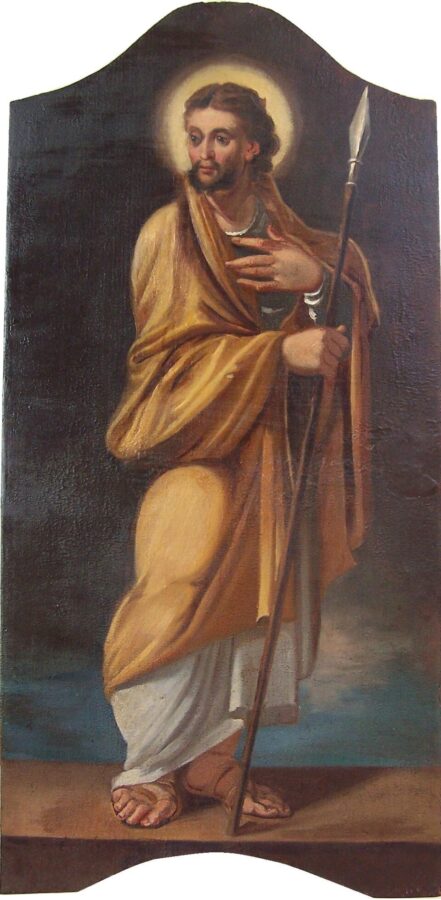
✝ Holy Apostle Thomas
October 6 / October 19 (Julian Calendar)
On this day, October 6 according to the Julian Calendar (October 19 civil calendar), the Georgian Orthodox Church commemorates Holy Apostle Thomas.
The holy Apostle Thomas, called Didymus (in Greek, “the Twin”), was born in Paneas, a city of Galilee, which Philip, son of Herod, later renamed Caesarea in honor of the Roman emperor Tiberius (Caesarea Philippi). The city lay at the foot of Mount Hermon, at the eastern source of the Jordan River, where the inheritance of the tribe of Naphtali came to an end.
When our Lord Christ went about the cities and villages of Galilee and Judea during His public ministry, teaching the people and healing every sickness, Thomas also heard His divine preaching and beheld His wondrous miracles. For this reason he clung to the Lord with his whole being and never departed from Him. Together with the other closest disciples, Thomas delighted in the words of Jesus Christ and in the contemplation of His most pure countenance; he followed the Lord inseparably and was found worthy to be numbered among the twelve Apostles. He was an eyewitness of all the Lord’s works on earth, of His Passion on the Cross and His voluntary death. After the Resurrection of Jesus Christ from the dead, the holy Thomas, through his own unbelief in the words of the other Apostles, strengthened the Church’s faith in the Lord’s Resurrection all the more. For when Christ’s other disciples told him, “We have seen the Lord,” Thomas did not wish to believe it, and said to the Apostles:
“Unless I see in His hands the print of the nails, and place my finger into the place of the nails, and place my hand into His side, I will not believe” (John 20:25). So great is the mystery of the Resurrection of our Lord Jesus Christ that even this “unbelief” of Thomas was permitted by divine providence, so that all of us might believe deeply and without doubt in the resurrection of the Lord’s human nature, its ascension into heaven, and its sitting at the right hand of the Father forever. As a confirmation of this divine mystery, by which every human being was granted the possibility of deification and return to heaven, eight days after His glorious Resurrection the Lord appeared again to His disciples, among whom Thomas was now present, and said to him:
“Reach your finger here, and look at My hands; and reach your hand here, and put it into My side. Do not be unbelieving, but believing!” (John 20:27).
Then, seeing the risen Christ and touching both His life-giving side and His hands, Thomas cried out:
“My Lord and my God!” (ibid., verse 28).
This event convinces us all, more clearly than clear, of the truth of the Resurrection of our Lord Jesus Christ; for He did not appear to His disciples as a phantom, nor in some other body, but in the very body in which He suffered on the Cross for our salvation.
After the Lord’s Ascension into heaven and the descent of the Holy Spirit upon the Apostles, they cast lots, as is well known, to determine in which country each would preach the word of God. The lot of the holy Thomas was India, that in that far region of Asia he might enlighten the Parthians and Medes, the Persians and Hyrcanians, the Bactrians and Brahmans, and the inhabitants of all the remotest corners of India (in ancient times all the countries of southern Asia were called India, including present-day India itself).
Thomas grieved greatly that he had to go to such distant lands and to savage peoples, but the Lord appeared to him in a vision, strengthened him and commanded: “Always be courageous and fear nothing, for I will be with you forever.” Soon Thomas also learned from the Lord how he was to reach that country…
At that time the following events took place:
Gundaphorus, king of India, wished to build himself a great and splendid palace, and sent a merchant named Avan to Palestine: “Go there and find me a skilled master builder who can construct for me a palace like those of the Roman emperors.” It was with this very merchant Avan that the Lord sent His Apostle. While Avan was searching for a skilled builder in Palestine, he met Thomas, who told him, “I am a man very experienced in the art of building.” Avan hired him at once and took him aboard a ship, and soon, with a following wind, they set sail for India.
After several days they came to the harbor of a certain city where the king’s daughter was being married, and the king was inviting everyone without distinction to the wedding. Avan and Thomas also went to the wedding feast. There Thomas foretold divine punishment for one of those who insulted him. This prophecy was fulfilled with astonishing accuracy that very day, which struck the people with terror. The king was informed of what had happened. He summoned Thomas and said to him:
“Come into my palace and bless my daughter, who was married today!”
The Apostle entered the palace and with reverence began to instruct the newlyweds: “Preserve your virginity, keep your purity undefiled, and this lot will be far better for you.” Finally he prayed for the bride and groom, blessed them and departed. In their sleep the newlyweds saw Jesus Christ, who appeared to them in the likeness of Thomas and embraced them lovingly. The husband of the king’s daughter, thinking that Thomas had returned, asked:
“You were the first to leave us; how is it that you are here again?”
But the Lord answered him:
“I am not Thomas, but his brother! And everyone who renounces this world and follows Me as Thomas does will not only be My brother in the endless life to come, but also My heir, for he will inherit My whole Kingdom! So you also, My children, do not forget all that My brother Thomas advised you. And if, following his counsel, you preserve your virginity undefiled, you will be found worthy to receive incorruptible crowns in My heavenly palace!”
(This exaltation of virginity and the unmarried life does not at all testify that salvation is impossible in married life. But according to the teaching of the ancient holy Fathers of the Church, those who preserve virginity will receive the highest reward in the Kingdom of Heaven, as the Revelation of John also testifies (14:1-5). Therefore the all-foreseeing Lord, who knows the spiritual strength of these newlyweds, calls them to a virginal life so that they might dedicate their whole lives to the service of God. It is worth noting that in this place in the Greek original of the Life of Thomas, the Lord also tells the couple that if they bear children, those children will be sickly, wicked and unfortunate.)
At these words the Lord became invisible; and the couple, awakened from sleep, told each other what they had seen in the vision. When they realized that they had seen the same thing, they rose and prayed earnestly before God all night long, and kept the words they had heard from the Lord deep in their hearts like precious pearls.
In the morning the king entered the bridal chamber and found them sitting apart from one another. Astonished, he asked why they were sitting so far from each other.
They answered him:
“We are praying and entreating God to grant us the strength to preserve perfect purity to the end of our lives, as we are keeping it now, so that in the heavenly palace we may be adorned with incorruptible crowns. This is what the Lord who appeared to us here promised us!”
Then the king understood that it was that stranger who had been in the palace the day before who had inspired them to keep their purity. The sovereign was enraged and immediately sent servants to seize Thomas and bring him to him. But they searched for the holy Apostle in vain, for he had already boarded the ship with Avan and set out for India…
Arriving in India, they presented themselves to King Gundaphorus, and the merchant Avan said to the sovereign:
“Here, O king, I have brought you from Palestine a skilled master builder! He will build you palaces such as befit your Majesty!”
The king was pleased, showed Thomas the place where he wished the palace to be built, determined its dimensions, and gave him a great quantity of gold for the construction; then he himself went away somewhere.
Having received so much gold from the king, Thomas began to distribute it to the poor and the destitute; at the same time he labored tirelessly in preaching the Gospel, turning many to the true faith and baptizing them in the name of the Father and of the Son and of the Holy Spirit.
Meanwhile the young man who, together with his newly wed bride, the king’s daughter, had made a vow on the Apostle’s counsel to preserve their purity, learned that Thomas was preaching Christ in India, and came to him with his wife. The holy Thomas instructed them in the true faith and baptized them. At baptism the girl received the name Pelagia, and later shed her own innocent blood for the faith of Christ; the young man was named Dionysius, and later was found worthy of the rank of bishop. Having received the Apostle’s blessing, they returned to their homeland, where they spread the glory of God’s name, brought many unbelievers to the true faith, and founded churches of Christ in cities and villages…
Several years later the king of India sent servants to the Apostle Thomas to learn whether the construction of the royal palace would soon be finished. Thomas instructed the servants to tell the sovereign that only the roof remained to be put on. The king rejoiced greatly, for he thought that Thomas was indeed building him a magnificent palace in this world. So he sent him yet more gold in abundance, and commanded him to finish the construction as quickly as possible and to raise the most beautiful roof for it.
When Thomas again received a great amount of gold from the king, he raised his eyes and hands to heaven and gave thanks to God:
“I thank You, Lover of mankind, O Lord, for You order the salvation of men by diverse means!”
And the gold he had received he again distributed to those who came to him asking for help, while he himself continued to preach the word of God with zeal. After some time the king learned that Thomas had, it seemed, not even begun the building, and that he had given all the gold to the poor and needy; that he was not thinking of carrying out the sovereign’s command at all, but was going about the cities and villages preaching some new God to the people and working many miracles. The king was greatly enraged at this and immediately sent servants to seize the Apostle. And when he was brought to the king, the latter asked him:
“Have you built my palace?”
The holy Thomas answered:
“Yes, I have built it, and moreover, the most beautiful and magnificent!”
Then the king said to him:
“Well then, let us go and see the palace you have built!”
“In this earthly life you cannot see that palace!” the Apostle replied. “Only when you depart from this world will you be able to behold it, dwell in it with joy, and live there forever!”
The king thought he was mocking him and took Thomas’s words as an insult. He therefore commanded that Thomas and the great merchant Avan who had brought him be thrown into prison, where both were to await death by torture. The king intended to have them flayed alive and then burned on a pyre. While in prison, Avan reproached the Apostle and said:
“You deceived me and disappointed the king when you presented yourself to us as a master builder. And now you have squandered the king’s gold in vain and have destroyed my life as well! For your sake I, an innocent man, am suffering and must die a terrible death! The king is a cruel man, and he will have us killed!”
The holy Apostle calmed Avan and comforted him with these words:
“Do not be afraid! The time for our execution has not yet come! We will remain alive and will be free, and the king will show us great honor for the palaces I have built for him in the heavenly kingdom!”
That very night the king’s brother fell gravely ill, sent servants to the king, and sent word:
“Your grief has made me sorrowful as well, and now this sorrow has seized me with a grave illness of which I am dying!”
And indeed, very soon afterward the king’s brother died. The king forgot his former anger, and an even greater grief seized him: inconsolably he mourned and bitterly wept for the death of his beloved brother. But an angel of the Lord took up the soul of the deceased, led it up to the heavenly dwellings, took it through everything, and showed it countless magnificent, splendidly built and radiant palaces, one of which was so especially distinguished and so beautiful that no human tongue could describe it.
And then the angel of the Lord asked the soul of the dead man:
“In which of these palaces would you choose to live?”
The soul of the king’s brother looked at the most beautiful palace of all and answered:
“If I were permitted to live in even a single corner of that palace, I would wish for nothing more!”
Then the angel said to him:
“You cannot live in this palace, for it belongs to your brother, with whose gold the stranger known to you, Thomas, built it for you!”
“I beseech you, lord!” the soul addressed the angel of the Lord, “let me go to my brother, and I will buy this palace from him, for he does not yet know its beauty. And when I have bought it, then bring me back here again!..”
And indeed, the angel returned the soul to the body, and the king’s dead brother came to life at once, as if awakening from sleep. As soon as he opened his eyes, he asked those around him, who were greatly astonished, to send for his brother at once: “Let him come to me immediately.” When the king learned of his brother’s revival, he rejoiced beyond measure, hastened to him at once, and when he saw him face to face, alive and perfectly healthy, his joy knew no bounds. The one risen from the dead addressed him thus:
“O king! I am certain that you love me as your own brother! I know too that you mourned me inconsolably when I lay here lifeless, and that if it had been possible to free me from death, you would have given even half of your kingdom for it!”
“Yes, that is the complete truth!” the king answered.
“Then, if you love me so, I ask you for only one gift, and I beg you not to refuse me!” said his brother.
The king replied:
“Everything I have in my realm I will give to you, my beloved brother!” and he confirmed his promise with an oath.
Then the brother who had risen from the dead asked:
“Give me your palace, which you have in the heavens, and in exchange take all my possessions!”
Hearing these words, the king was stunned and stood for a long time without a word, for in his amazement he had even lost the power of speech. At last he said only:
“Where would I get a palace in the heavens?!”
“Truly, you have one!” his brother exclaimed. “You really do have in the heavens a palace of which you know nothing, such as you have never seen under the sun! Thomas built this palace for you, the very man whom you threw into prison and condemned to death! I saw that palace and was amazed at its unspeakable beauty and splendor. I asked that they let me dwell in even some corner of it, but they would not permit me, because my guide, the angel, said to me:
‘It is impossible for you to live here, for this palace belongs to your brother, for whom Thomas, known to you, built it.’
And I begged the angel to release me to you so that I might buy the palace from you. And now I stand before you and beseech you: if you love me, sell me your heavenly palace, and in exchange take all my property and inheritance!”
Then the king rejoiced greatly over everything, both over his brother’s return to this world and over the palace that, as it turned out, the foreigner Thomas had built for him. So he said to his brother who had risen from the dead:
“Beloved brother! I swore that I would refuse you nothing that is subject to my authority in this world. But I cannot grant you that palace which has been built in heaven. Nevertheless, if you wish, you may take that builder whom we have, who is able to build you a similar palace as well!”
Having said this, he immediately sent servants to the prison to bring the holy Thomas and the merchant Avan, who had brought him, to the sovereign. And when they were brought, the king hastened to meet the Apostle, fell at his feet, and begged: “Forgive my sin against you, for I did not know what I was doing.”
The holy Apostle Thomas gave thanks to the Lord God for such mercy, and began to instruct both brothers in the true faith. They received the Apostle’s words with fervor and were enlightened by faith in our Lord Jesus Christ. Soon Thomas baptized them and taught them the Christian life, and through many acts of almsgiving the brothers acquired an eternal inheritance in the heavens.
The holy Apostle Thomas stayed for a time with the king and his brother, strengthened them in the holy faith, and then went out to the surrounding cities and villages to preach the word of God, laboring effectively for the salvation of men.
And at the time when the Apostle Thomas was enlightening the lands of India by preaching the Gospel, the hour came for the repose of the most holy Mother of God, and all the Lord’s Apostles from various countries were caught up to heaven by the Holy Spirit and brought in a single moment to the Garden of Gethsemane, to the bedside of the all-blessed ever-virgin Mary (according to Church tradition, this took place in the fifteenth year after the Lord’s Ascension), that is, in the year 48 after the Nativity of Christ, when the Mother of God was sixty-four years old. Then Thomas, who was in India, was also caught up by the Holy Spirit and brought to Jerusalem, but he nevertheless did not arrive in time for the burial of the Mother of God’s holy body. This came about by divine providence so that the faithful might be plainly convinced of the bodily Assumption of the Mother of God. For just as we were all the more firmly assured of the Resurrection of our Lord Jesus Christ precisely through the “unbelief” of the holy Apostle Thomas, so in this case too we learned of the Assumption of the all-holy Theotokos, the ever-virgin Mary, through the delay of the Apostle Thomas.
The holy Thomas arrived only on the third day after the burial of the Mother of God and was greatly grieved that he had not been in the Garden of Gethsemane on the day of the burial, to accompany the body of the Lord’s Mother to the tomb together with the other Apostles and to behold for the last time in this world her all-blessed face. Then the holy Apostles decided by common consent to open the tomb of the Mother of God for Thomas, so that he might see her all-honorable body, venerate it, and be comforted in his sorrow. But when they opened the tomb, they found nothing there except the Mother of God’s robe. By this all were firmly convinced that the Mother of God, like her divine Son, had risen from the dead on the third day and had been taken up in the body into heaven, where she abides, exalted above all the heavenly powers, and prays before the Lord for us all…
After this the holy Apostle Thomas again set out for the land of India to preach the word of God, and there he brought many to the true faith through signs and miracles. Arriving in the city of Meliapor (on the eastern coast of the Indian peninsula), he enlightened its inhabitants as well by preaching the Gospel. Here he confirmed people in faith in Christ by the following miracle:
In Meliapor, in one place, there lay a tree of unusual size which no men, nor even huge elephants, were able to move from its place. The holy Thomas tied his belt to the tree and drew it a distance of about half an hour’s walk, where he handed it over for use in building the Lord’s temple. Seeing this, the faithful were strengthened still more, and many of the unbelievers turned to the true faith and were baptized. The holy Apostle also performed another miracle there, greater than the first. Once a pagan priest killed his own son and laid the blame for it on the holy Apostle: “Thomas has killed my son!”
The people were greatly stirred. The assembled crowd seized Thomas as a murderer and demanded of the city court that he be put to death by torture. And since no one was found who could attest to his innocence, the holy Apostle Thomas himself addressed the judge and the people with the following request:
“I beg you, let me go! I will go to the slain man, and I will question the slain man, and in the name of my Lord I will make him tell who killed him!”
Everyone was astonished at this and agreed to go with him to the priest’s slain son. When they arrived there, the holy Thomas lifted his eyes to heaven, prayed, and then addressed the dead man:
“In the name of my Lord Jesus Christ I command you, young man, say: who killed you?”
And the dead man immediately cried out:
“My father killed me!”
Then all were greatly amazed and began to cry out:
“Great is the God whom Thomas preaches!”
The Apostle was set free, while the pagan priest himself ended up in the pit that he had dug for Thomas. After this miracle a great multitude of people turned to the true faith and received holy baptism from the Apostle.
After this Thomas set out to a more distant region, the land of Kalamida, to preach the word of God, where King Muzdi reigned. While he was proclaiming the faith of Christ there, the Apostle converted a woman named Syndicia, who was the niece of Mygdonia, the wife of Charisius, the king’s chosen friend and brother-in-law. Syndicia urged Mygdonia too to come to know the truth and to believe in the one God who created the whole world and whom the holy Thomas preached. Then Mygdonia said to Syndicia:
“I would like to see for myself that man who preaches the true God, and to hear from him the teaching of Christ!”
Syndicia replied:
“If you wish to see the Apostle of God, put on old rags, as though you were a simple, poor woman, so that no one will recognize you, and then follow me!”
Mygdonia did so and followed Syndicia. They found the holy Thomas among simple and poor people, to whom he was preaching the word of God. The women mingled with the crowd and listened to Thomas’s discourse, in which he spoke at length about the Lord Jesus Christ, the true faith, death, the day of judgment, the fire of Gehenna and the Kingdom of Heaven. Mygdonia received all this with a sincere heart and believed in Christ. Returning home, she kept thinking about the Apostle’s words, kept speaking of Christ with her niece Syndicia, and at last came to love Christ with her whole being. From that time Mygdonia shunned all association with unbelievers, as with the enemies of the Lord; she neither spoke with them nor went to their feasts, and in general refused every worldly pleasure. Moreover, she decided to end her married life with her husband. This deeply grieved her husband, and since he could not make Mygdonia change her decision, he went to the king himself and begged Muzdi: “Perhaps your wife Tertinia will manage to persuade her” (Tertinia and Mygdonia were sisters by blood). Indeed, the queen went to Mygdonia and asked what the reason was that she did not obey her husband.
“He is a pagan,” Mygdonia answered, “an enemy of God, while I am a handmaid of the one true God, Jesus Christ, and I do not wish to defile myself by living together with an unbelieving and unclean man!” (According to the teaching of the holy Apostle Paul, this circumstance should not prevent a Christian wife and a pagan husband (or vice versa) from living together (see 1 Cor. 7:12-14), for through living with a Christian spouse the unbelieving person is sanctified and may even be converted. Mygdonia, however, is strict with herself and has the right to be so.)
Hearing this, Tertinia too wished to learn who Jesus Christ was, whom Mygdonia called the true God. Then Mygdonia told her the whole substance of Thomas’s preaching and urged her: “You also believe in the true God.” Tertinia, wishing to learn more about Jesus Christ and to be better instructed in the true faith, asked Mygdonia: “Show me Thomas, so that I may hear everything from him myself.” On Mygdonia’s advice, she secretly sent servants to the Apostle and summoned him to her. When the holy Thomas came to the queen, both women fervently begged him: “Instruct us in the true faith.” He preached Christ to the sisters, enlightened them with the light of faith, washed them in the baptismal font, and taught them to fulfill the commandments of God and to lead a godly life. The women imprinted deeply in their hearts all that they had heard from the holy Apostle, and resolved to dedicate their whole lives to the Lord and to serve Him in holiness and purity, so that they would no longer live with their husbands as with unbelieving men.
The holy Thomas, by divine power, continued to work innumerable miracles and to heal every kind of sickness. Hearing his preaching and seeing his wonderworking, many were converted, not only among the common citizens but also among the courtiers of the king himself. The king’s only son, named Azan, also believed in Christ and received holy baptism from the Apostle; for through His Apostles the Lord Jesus Christ Himself was at work, multiplying His Church and spreading the glory of His name everywhere!
Returning to the palace, Queen Tertinia gave herself to fasting and prayer and refused her husband conjugal life. The king was astonished at the change in his wife’s life, and once said to his friend and brother-in-law Charisius:
“I wanted to bring your wife back to you, and now I have lost my own! She treats me just as Mygdonia treats you!”
For this reason the king and Charisius carefully investigated the reason for such a change in their wives, and learned that a certain stranger named Thomas had taught the women faith in Christ and persuaded them to end conjugal life with their own husbands. They also learned that through Thomas’s preaching the king’s son Azan had believed in Christ, as had many servants of the royal court and high officials, and that among the common people the number of followers of the new faith was immeasurably great. At this the king and his brother-in-law were greatly enraged and commanded their servants to seize Thomas and throw him into prison. Soon he was brought before the king’s court.
The sovereign asked him:
“Who are you, a slave or a free man?”
Thomas answered:
“I am the slave of One over whom you have no authority!”
“I see that you are a cunning slave!” said the king. “Probably one who has run away from his own master and come to our land to lead the people astray and trouble our wives… Well then, say who your master is?”
“My Master is the Lord of heaven and earth!” the holy Apostle replied. “God and Creator of every creature. He sent me here to preach His name and to turn men to the true faith from their former error.”
The king was enraged:
“Stop, you false man, your crafty talk, and hear my command: just as you have led our wives astray by your cunning and made them withdraw from us, so now bring them back to us again, or you will regret it! For if you do not bring it about that our wives live with us again in their former love and unity, I will put you to a cruel death!”
To the king’s harsh words Thomas replied no less sternly:
“It is not right for the handmaids of Christ to remain in conjugal life with lawless husbands! It is not right for believers to be defiled and polluted by wicked unbelievers.”
Hearing this, King Muzdi became terribly angry and commanded that the torture of the holy Apostle begin. First they brought plates of red-hot iron to make Thomas stand on them barefoot. But as soon as the Apostle stepped on them, water suddenly appeared beneath his feet and cooled the iron. Then they threw him into a heated furnace and left him all night in its blazing fire; but the next day, when they opened the furnace door, Thomas came out alive and completely unharmed.
These miracles did not persuade the king and Charisius, who gave the sovereign the following counsel:
“Compel him to worship and offer sacrifice to our ‘god’ — the sun — so that he may thereby anger his own God, who has until now protected him unharmed from torments!”
But as soon as the holy Apostle was brought to the idol of the sun, it melted at once like wax. The faithful rejoiced beyond measure at seeing such power of the Creator God, and a great multitude even of the unbelievers were added to the Lord. But the servants of the idol murmured greatly against Thomas for the destruction of their “deity” and demanded of the king that the Apostle be put to death. The king, too, was at a loss and did not know what means to devise for his destruction; yet he feared the people, as well as his own servants and high officials, many of whom already believed in Christ as the true God.
Then the king took Thomas and went out of the city with his horsemen. Everyone supposed that the king wished to see some miracle from the Apostle. But when they had gone about half an hour’s walk from the city wall, the sovereign handed Thomas over to five horsemen and commanded them to take him up a mountain and there pierce him with spears. He himself went off to the neighboring city of Axium. Meanwhile the king’s son Azan and another Christian named Sifor had come out of the city, followed the Apostle’s trail, and now, seeing him in the hands of the horsemen, condemned to death, they wept bitterly for him. Then Thomas asked the horsemen for permission to offer a prayer, and when he had prayed, he ordained Sifor a presbyter by the laying on of hands, and Azan a deacon, and charged them to care for the increase of the faithful and the spread of the Church of Christ. After this the horsemen pierced the holy Apostle Thomas with five spears. Sifor and Azan stayed a long time beside their teacher and then buried his holy body with great honor (the place of the Apostle’s martyrdom is still shown today at Kalurmin, about six kilometers from the city of Mylapore, where the holy Thomas often withdrew to pray in solitude). After the burial they sat a long time by the Apostle’s grave, deeply grieved. And behold, the holy Thomas appeared to them in a vision and commanded them to return to the city and to strengthen the brethren in the faith. They returned and, strengthened by the prayer and blessing of the holy Thomas, successfully governed the Church of Christ.
King Muzdi and Charisius long tormented their wives, but accomplished nothing and could not persuade them to conjugal life. And when they understood that they could not subdue them, they were forced to give them freedom to live as they chose, for they saw that the women would sooner choose death than live with them. Thus the godly sisters were freed from the yoke of married life and gave themselves to a strict and godly life: they prayed constantly, fasted, and faithfully served the Lord, thereby bringing the greatest benefit to the Church.
Several years later one of King Muzdi’s sons was seized by an evil spirit, and no one could heal him, because a most cruel demon had made its dwelling in him. The sovereign was deeply troubled by his son’s illness, and since he had heard that during his lifetime the holy Thomas had cast out many evil spirits from men, he decided to open his grave, take one of the Apostle’s bones, and hang it about the neck of his afflicted son, so as to deliver him from the demonic torment. And just as he was about to carry out his intention, the holy Thomas appeared to him in a dream and said:
“While I lived you did not believe, and now do you want help from my bones? Do not remain in your unbelief, and my Lord Jesus Christ will be merciful to you.”
This vision only strengthened the king’s desire to open the Apostle’s grave and carry out his plan. Indeed, King Muzdi went to the place where the holy Thomas was buried and opened the tomb, but found nothing there, for a certain Christian man had secretly taken the Apostle’s holy relics and transferred them to a fitting place in Mesopotamia. Then the sovereign took a handful of earth from that place, wrapped it in a cloth, and hung it about his son’s neck. And at the same time he addressed the Lord in prayer:
“Lord Jesus Christ! I beseech You, heal my son through the prayer of Your holy Apostle Thomas! And then I too will believe in You as the true God!”
And as soon as he had finished speaking these words, the demon immediately left the king’s son, and the boy was completely healed. King Muzdi therefore believed in Christ and, together with all his nobles and servants, received holy baptism from the presbyter Sifor. Then the greatest joy filled the hearts of the faithful, for the idols were everywhere cast down and their temples destroyed, and in their place Christian churches were built. The word of God was preached everywhere, and the true faith, through the intercession of the prayers of the holy Apostle Thomas, was established throughout India.
After receiving baptism Muzdi sincerely repented of his former sins and begged everyone for the help of their prayers. The presbyter Sifor too urged all the faithful to help the sovereign:
“Pray for King Muzdi, that our Lord Jesus Christ may look upon him with mercy and forgive him all his sins!..”
And indeed, the whole Church prayed for the king, and forgiveness of sins was granted him: the converted king lived in a manner pleasing to God and greatly aided the Church of Christ. And in the place where the relics of the holy Apostle Thomas had rested, many miracles and wondrous healings were wrought through his prayer.
According to the testimony of church writers, the holy relics of the Apostle Thomas were later (in 385) transferred to the city of Edessa. But, as is known, some of his relics remained in India as well. In Edessa a magnificent church was built over these holy relics, to which pilgrims came even from distant lands. In the reign of the emperor Anastasius (490-518) the holy relics of the Apostle Thomas were transferred to Constantinople, where a church was built in his name. During the Fourth Crusade (1204), King Andrew II of Hungary carried the right hand of the holy Thomas to his homeland. The skull of the Apostle Thomas rests in Georgia, in the Sioni Cathedral of Tbilisi. Through the prayers of this holy Apostle of the Lord many miracles were wrought and continue to be wrought, as help for all Orthodox Christians and as honor and glory of our Lord and God Jesus Christ, to whom is due worship, with the Father and the Holy Spirit, unto ages. Amen.
May the intercessions of Holy Apostle Thomas be with us all.