✝ Hieromartyr Gregory the Illuminator, Bishop of Armenia (†ca. 335), and the Holy Martyrs Rhipsime, Gaiane, and the 35 Holy Virgins (4th c.)
September 30 / October 13 (Julian Calendar)
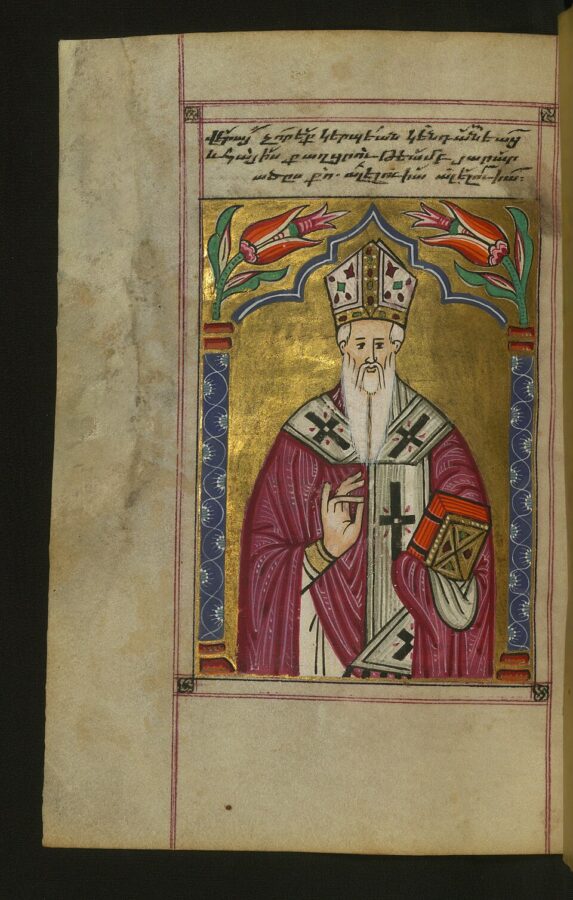
On this day, September 30 according to the Julian Calendar (October 13 civil calendar), the Georgian Orthodox Church commemorates Hieromartyr Gregory the Illuminator, Bishop of Armenia (†ca. 335), and the Holy Martyrs Rhipsime, Gaiane, and the 35 Holy Virgins (4th c.).
Hieromartyr Gregory, Bishop and Illuminator of Armenia, was born in the year 257. He was a descendant of the Parthian royal house of the Arsacids. The saint’s father, Anak, killed his kinsman King Khosrov in the struggle for the Armenian throne, and for this his entire family was exterminated. Only two infant sons of Anak survived, “who were still nursing at the breast.” One of them was smuggled away to Persia; the other, Gregory, was taken by a relative to Caesarea in Cappadocia and raised in fidelity to Christ’s commandments. When he came of age, Gregory married and had two sons, but he was soon widowed. The saint raised his sons in piety. One of them, Orthanes, later became a priest; the other, Aristakes, took monastic vows and withdrew into the wilderness to labor in asceticism.
To atone for his father’s sin, Gregory joined the retinue of Khosrov’s son Tiridates and faithfully served the young prince. Tiridates loved Gregory as a friend, but could not bear his confession of faith. After ascending the Armenian throne, he demanded that the blessed one renounce Christ. Gregory answered with a firm refusal. Enraged, the tyrant had his faithful servant cruelly tortured: a stone was tied to his neck and he was hung upside down; nails were driven into his heels and he was forced to run; he was mercilessly beaten, and a leather sack filled with burning coals was placed over his head. By God’s help, Gregory bore these and other torments with patience. Still more infuriated by the saint’s boldness, Tiridates intensified the torture and threw the lacerated, bloodied martyr into prison. There God healed His chosen one of his wounds, but the lawless ruler did not understand the miracle and handed him over again to be tortured. The martyr remained unbending and “laughed at the torments and at his tormentors.”
Molten lead was poured into Gregory’s mouth, which, protected by the grace of the Holy Spirit, he received like cool water, and he continued to preach the word of God. Amazed, King Tiridates resolved to spare the holy Gregory, but one impatient courtier cried out, “He is not worthy of life, nor even of beholding this sun,” for he was a Parthian, the son of Anak, the murderer of the king’s father and the ravager of Armenia. These words filled the king with a thirst for vengeance, and he ordered Gregory, bound hand and foot, to be cast into a dark pit at Ararat, filled with venomous reptiles and worms. The Lord protected the blessed one: the creatures did him no harm, a pious woman brought him bread, and a holy angel strengthened and sustained him. Fourteen years passed in this way. During this time Tiridates committed yet another outrage: he put to death by torture the holy Rhipsime, Gaiane, and the thirty-five virgins with them.
God’s wrath did not pass over the lawless Tiridates and the courtiers who had slain Christ’s handmaidens. Possessed by an evil spirit, they roamed the forests, tearing their garments and rending their own bodies. As Armenia was “bitterly wasting away from such affliction,” Tiridates’ sister Khosrovidukht was told in a dream that if Gregory, who long before had been cast into the pit at Ararat, were brought up, their affliction would end. The vision was repeated several times. Then one of the king’s nobles, named Awtay, approached the mouth of the pit and called the saint by name. Gregory answered from the depths. The courtier lowered a rope to the blessed one and called down: “God has commanded that you be brought up.”
The miraculously preserved martyr’s body was covered with hair, withered and blackened, but the strength of his spirit was unshaken. He was washed, clothed in splendid garments, and brought with honor to the city of Vagharshapat, “for there was their king, Tiridates.” First of all, Gregory sought out and gathered the incorrupt relics of the holy virgin martyrs and reverently buried them. Then he built a church over the martyrs’ graves. He led the king, already stricken with repentance but still afflicted by the evil spirit, to this church and bade him offer prayer to the virgin martyrs. The Lord accepted Tiridates’ repentance, Gregory’s prayer, and the intercession of the holy martyrs, and the king was healed. His other courtiers were healed as well.
After this the saint built many more churches. In 301 the Cathedral of Etchmiadzin, dedicated to Pentecost, was built. In 305 the blessed Gregory traveled to Caesarea in Cappadocia, where Archbishop Leontius laid hands on him as Bishop of Armenia. Returning, the hierarch baptized first Tiridates and his household, and then the whole Armenian people in the river Euphrates. For this apostolic work the saint is called the Illuminator of Armenia. He also converted many inhabitants of neighboring lands, Persia and Syria.
After establishing the Church of Armenia, Gregory withdrew with a few of his disciples into the wilderness, settled in a cleft of the rock, and spent his days in prayer, receiving bread only once in forty days. Tiridates had Gregory’s son, the hermit Aristakes, sought out and brought to Armenia, and begged Gregory to hand over to him the throne of the Church. When Gregory saw every virtue planted in the soul of his son, he immediately laid his hands upon him and consecrated him bishop. Bishop Aristakes took part in the First Ecumenical Council of Nicaea in 325, which condemned the heresy of Arius. Saint Gregory the Parthian gave up his soul to the Lord in his ascetic labors in the wilderness in 335. His incorrupt right hand and some other holy relics rest in the cathedral of Etchmiadzin in Armenia.
May the intercessions of Hieromartyr Gregory the Illuminator and the Holy Martyrs Rhipsime, Gaiane, and the thirty-five virgins be with us all.