✝ Repose of Saint Sergius of Radonezh, Abbot and Wonderworker (†1392)
September 25 / October 8 (Julian Calendar)
On this day, September 25 according to the Julian Calendar (October 8 civil calendar), the Georgian Orthodox Church commemorates Repose of Saint Sergius of Radonezh, Abbot and Wonderworker.
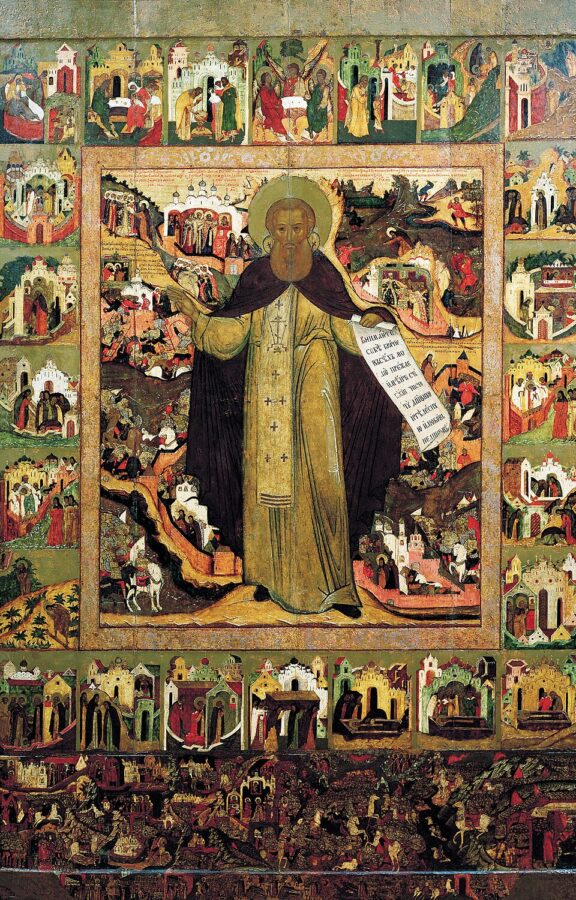
Venerable Sergius of Radonezh was born on May 3, 1314, in the village of Varnitsa near Rostov, into the family of the pious boyars Cyril and Maria. His divine election was revealed early: while he was still in the womb, during the Divine Liturgy, his mother and all the people clearly heard the unborn infant cry out three times. The newborn was named Bartholomew. From his first days the child amazed everyone with his fasting: on Wednesdays and Fridays he would not take his mother’s milk, nor would he accept it on any day when she had eaten meat. When Maria noticed this, she gave up meat altogether. The saint was seven years old when he was sent to school. He longed with his whole being to learn, but nothing came of it, and the distressed boy tirelessly begged the Lord to open his mind. One day his father sent Bartholomew into the field to look for horses. On the way, under an oak, he noticed an unknown priest-monk standing in prayer; he approached, bowed his head, and humbly waited for the elder to finish. The monk blessed the child, kissed him, and asked what troubled him. Bartholomew confessed his grief—that he could not learn to read and write—and begged the monk to ask the Lord’s help for him. The stranger fulfilled the request: he prayed, then made the sign of the cross and handed the boy a piece of prosphora taken from a small reliquary, saying: “Take this, child, and eat. It is given to you as a sign of God’s grace and for the understanding of Holy Scripture.” From that day the boy learned to read and write, and was granted a remarkable ability to grasp the meaning of what he read. He avoided childish amusements and games, prayed zealously and fasted strictly; humble, of few words, gentle and affectionate, he obeyed his parents’ will without a word of objection…
Around the year 1328 the parents of the future saint moved to Radonezh. When the elder sons had married, the venerable Cyril and Maria (commemorated January 18 and September 28) took the schema at the Khotkovo Monastery of the Protection of the Mother of God, and soon reposed in labors pleasing to the Lord. After this Bartholomew left the village and settled with his elder brother Stephen, who had been widowed and then become a monk, by the river Konchura, about ten versts from Radonezh. The brothers cleared the forest, built cells with their own hands, and raised a small church, consecrated in the name of the Most Holy Trinity. Thus was laid the foundation of the renowned Lavra of Saint Sergius. Stephen could not bear the hardship of the hermit’s life and went to the Monastery of the Theophany in Moscow, while Bartholomew, left alone, was tonsured a monk with the name Sergius on October 7, 1337.
The venerable father made his struggle still more severe. Wild beasts often prowled around the saint’s cell, yet they did no harm to the blessed one. Once Saint Sergius fed bread to a hungry bear, and afterward the beast came to visit him often. The hermit would share with it the last crust of bread, sometimes giving it the whole piece and remaining hungry himself. The holy father spent two years completely alone; then, little by little, those who desired the monastic life gathered around him. Once, as the blessed one stood in prayer in his cell at night, commending his brotherhood to the Lord, a voice was heard: “Sergius!” Astonished, the saint crossed himself, opened the window, and in a dazzling light saw a multitude of beautiful birds that covered the Lavra and its surroundings. The heavenly voice continued: “Sergius, like these birds your spiritual children will multiply, and like the beauty of these winged creatures their virtues will be varied and wonderful.” In 1354, after long and fervent entreaty, the monks of the monastery persuaded the saint to become their abbot. Bishop Athanasius of Volhynia ordained him priest-monk and appointed him hegumen. The tall ascetic governed the monastery wisely; not only in word but in deed he gave the brethren an example of piety: he chopped wood, carried water, baked the prosphora, and always dressed in the poorest clothing. The abbot worked more than anyone, yet he also managed to help everyone in their time of need. In the words of the saint’s disciple Epiphanius, Venerable Sergius was “first in everything and last in everything; no one could compare with him.” The newly founded monastery was in great material want: services were conducted by the light of a birch splinter, and the brothers received Communion from a wooden chalice. It happened that the whole brotherhood was left without a crumb of bread and a time of severe hunger set in, but even then, to instill in his spiritual children hope in the all-powerful and all-seeing God, Blessed Sergius strictly forbade them to leave the monastery to beg alms for it. The monks of the monastery had no personal property: they received everything they needed from the common stores of the brotherhood and took equal part in the work of the monastery.
The life of Blessed Sergius and his brothers, radiant with holiness, gradually drew the attention of their contemporaries, and soon the Lavra became famous throughout Russia. Many boyars and princes among the saint’s spiritual children offered a portion of their wealth to the monastery, which made it possible to build a new, larger church. The monastery’s resources grew, but Saint Sergius and his brothers continued to live in their former poverty. The abbot spent rich offerings on works of charity. He showed a special fatherly love for orphans, the poor, the destitute, and the wanderers entrusted to the monastery. In times of famine the saint would open the monastery’s granaries and give out grain generously to the hungry… Blessed Alexis, Metropolitan of Moscow, wished before his death to pass the hierarchal throne to Venerable Sergius, but the saint firmly refused.
For his holy life and tireless labors, the Lord rewarded Blessed Sergius with the gifts of discernment and wonderworking. The clairvoyant father blessed the pious prince Demetrius of the Don (commemorated May 19) and his whole Russian army before the battle with the Horde, and prophesied their victory over the Tatars.
Before his death the holy father was granted a miraculous appearance of the Mother of God. Radiant with heavenly light, the Most Holy Virgin, accompanied by the holy apostles Peter and John the Theologian, appeared to the blessed one in his cell and promised that the monastery he had founded would flourish. Saint Sergius peacefully gave his soul to the Lord on September 25, 1392. His body was buried by the south wall of the monastery church, near the altar.
In 1408, when Moscow and its surroundings were devastated by the Tatar hordes, the Holy Trinity Lavra was also burned and left empty. On the night before the expected attack of the infidels, Venerable Sergius appeared to his disciple and successor, Abbot Nikon, informed him of the coming misfortune, and comforted him: the trial was temporary, the monastery would be restored, and would flourish and be reborn still more. Later, before the construction of the new Trinity church began, the blessed father appeared to a pious layman and commanded him to tell the brothers: “Why do you keep me so long in the coffin, where the earth covers me and water troubles me?” When the foundation of the church was being dug, the workers came upon the saint’s tomb, around which there was indeed standing water.
On July 5, 1422, in the presence of a multitude of clergy, nobles, and people, the relics of the blessed father were solemnly uncovered. When the coffin was opened, a wondrous fragrance spread all around; not only the body but even Sergius’ garments showed no trace of corruption.
The Holy Church commemorates Venerable Sergius—the tall ascetic well-pleasing to the Lord and renewer of monastic life in a Russia laid waste by the Mongols—twice a year: on July 5, the uncovering of his relics, and on September 25, the day of his repose.
May the intercessions of Saint Sergius of Radonezh be with us all.