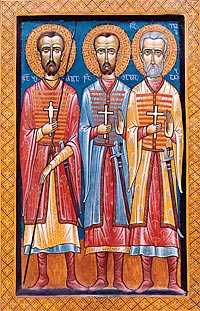
✝ Holy Martyrs Bidzina Cholokashvili and the Eristavis of Ksani, Elizbar and Shalva (†1661)
September 18 / October 1 (Julian Calendar)
On this day, September 18 according to the Julian Calendar (October 1 civil calendar), the Georgian Orthodox Church commemorates the Holy Martyrs Bidzina Cholokashvili and the Eristavis of Ksani, Elizbar and Shalva.
Saint Bidzina Cholokashvili and Elizbar and Shalva, the Eristavis (ruling princes) of Ksani, suffered martyrdom in the seventeenth century. Shah Abbas I and his son, Shah Abbas II, laid waste to Kakheti with extraordinary cruelty. Like ill-omened ravens, father and son circled over Iveria, setting churches, monasteries and fortresses ablaze, driving thousands of Georgians from their native land into Persia and settling Persians in their place.
The people fled from their tormentors and hid wherever they could. The Georgian Chronicles relate that “the name of Christ was no longer invoked anywhere, save only among a few in the mountains, among the Tushetians, Pshavians and Khevsurs.” Yet the providence of God is beyond human understanding: precisely in such a time of distress, when it seemed that sin and grace could no longer be told apart, when Georgia, turned into a threshing floor of fire, stood on the brink of annihilation, the Lord chose His faithful host. In this century there joined the heavenly Georgia the Holy Great Martyr Queen Ketevan, the Holy Martyr King Luarsab, the six thousand holy monks of Gareja, the Holy Hieromartyr Catholicos Evdemoz, and the Holy Hieromartyr Theodore of Kvelta. In this century the nine Kherkheulidze brothers, together with nine thousand warriors, laid down their lives on the field of Marabda for the glory of God and the nation; and in this same century the All-Merciful Lord sent to the land, as its salvation and hope, the heroes of Kakheti: Bidzina Cholokashvili and Shalva and Elizbar, the Eristavis of Ksani.
The Lord, who upholds the hand of the poor and strengthens the powerless, inspired Bidzina Cholokashvili, a prince of Kakheti, with a righteous resolve: together with the Eristavis of Aragvi and Ksani he took upon himself the liberation of Kakheti from the Tatars. After long reflection, Bidzina went to his kinsman Zaal, the Eristavi of Aragvi, and opened his heart to him. Zaal’s own heart burned at so much misery and injustice; he approved the plan and summoned Elizbar, the Eristavi of Ksani, together with Shalva. Saint Bidzina told the Eristavis of the calamity that had befallen Kakheti, explained that Kartli too might very soon fall into the same trial, and called on them to fight the invaders together: “Let us now rise up against them; even if it is beyond our own strength, yet by the power and help of the life-giving Cross and with the aid of the valiant horseman Saint George, for they have seized and defiled his glorious church at Alaverdi and shattered his precious icon.”
Bidzina knew well how limited the strength of the Georgians was, yet, entrusting himself to the will of God and convinced that the homeland had to be delivered, he believed in victory.
The Eristavi of Aragvi secretly gave them “only a few men, chosen horsemen, as helpers,” while the Eristavis of Ksani, uncle and nephew, called every able man to arms and gathered Tushetians, Mtiuletians and a few Kakhetians. On a moonless night they crossed the mountains, passed through Akhmeta, and fell suddenly upon the Tatars encamped carelessly at Bakhtrioni. That same day, on the feast of Alaverdoba in 1659, they attacked the Qizilbash stationed at Alaverdi and routed them so completely that Selim Khan, the Sultan of Ardalan, barely escaped, abandoning his wife and children and fleeing to Persia.
The victorious Georgian host gave thanks to God and to the nation’s protector, Saint George, “for the Great Martyr George was clearly seen upon a white horse, darting to and fro like lightning, going before them.”
Kakheti breathed freely again and, overjoyed, cherished its faithful sons. But the joy of the heroes who had saved their homeland did not last long. The enraged Shah Abbas ordered the king of Kartli, Vakhtang, called Shahnavaz by the Persians, to send these valiant soldiers of Christ to him.
The heroes who had delivered Kakheti set out without complaint on their final journey. They knew that the Shah would show them no mercy, but they also knew that any delay would bring harm upon their country.
The cunning Shah received the Georgian nobles with honor, but then demanded that they renounce their faith as the price of wealth and honors. Through the Sultan of Ardalan the Georgians sent word to the ruler of Persia: “We have not set our hearts on your gifts and honors, nor do we seek your rewards, for we are servants of the King of Heaven and enlisted as soldiers of Christ… We are ready to endure all things, that we may reign with Him and rejoice with Him.” The Sultan of Ardalan tried long and hard, yet no promise could entice the faithful servants of Christ. Then, by order of the Shah, the saints were cruelly tortured. The sufferers encouraged one another, endured their torments, and prayed to the Lord for strength.
The saints were stripped and thrown down by the road to be stung by insects. The enraged Selim Khan decided, in order to terrify Bidzina, to behead Saints Elizbar and Shalva before his eyes. “There is nothing sweeter than death for Christ,” said Saint Bidzina.
The Eristavis of Ksani calmly bowed their heads, but the executioners could not reach to strike them with their swords, for the blessed ones far surpassed the godless in stature. Then the tormentors struck them on the shins with their swords, and when they fell, they beheaded the blessed uncle and nephew.
The death of his companions did not frighten Saint Bidzina in the least. The tormentor then resolved to break Bidzina’s courage through humiliation. They covered the valiant hero with a woman’s veil, set him on a donkey and paraded him from street to street, mocking and reviling this chosen one among the elect of Georgia; but Saint Bidzina gave thanks to God.
After this the executioners resolved to hack the saint to pieces while he was still alive. With sharpened swords they first cut off the fingers of his hands one by one, then the toes of his feet; then they cut off his hands at the wrists and his feet at the ankles; then both arms to the elbow and both legs to the knee. They dragged the severed limbs along the ground and desecrated them. At last only his head remained unharmed upon the mutilated body. From the movement of his lips it could be seen that his heart was still beating and that the saint was praying. Then one of the executioners pierced him with a spear and stilled his heart — the heart that had endured so much pain. This took place in the year 1661.
The bodies of the holy martyrs lay all day under the open sky, and no one dared to approach them. At night a light shone upon them, and Christians secretly buried the relics of the saints.
Many years later Shalva’s widow, Ketevan, and her son David sent trustworthy men to bring the relics of the saints home.
When the holy relics arrived in Kartli, many of the faithful came out to meet them with veneration, kissing them. The heroes who had saved Kakheti were buried with honor and glory in the Church of the Archangel at Ikorta.
May the intercessions of the Holy Martyrs Bidzina, Elizbar and Shalva be with us all.