✝ The Consecration (Encaenia) of the Church of the Resurrection of Christ in Jerusalem (335)
September 13 / September 26 (Julian Calendar)
On this day, September 13 according to the Julian Calendar (September 26 civil calendar), the Georgian Orthodox Church commemorates The Consecration (Encaenia) of the Church of the Resurrection of Christ in Jerusalem (335).
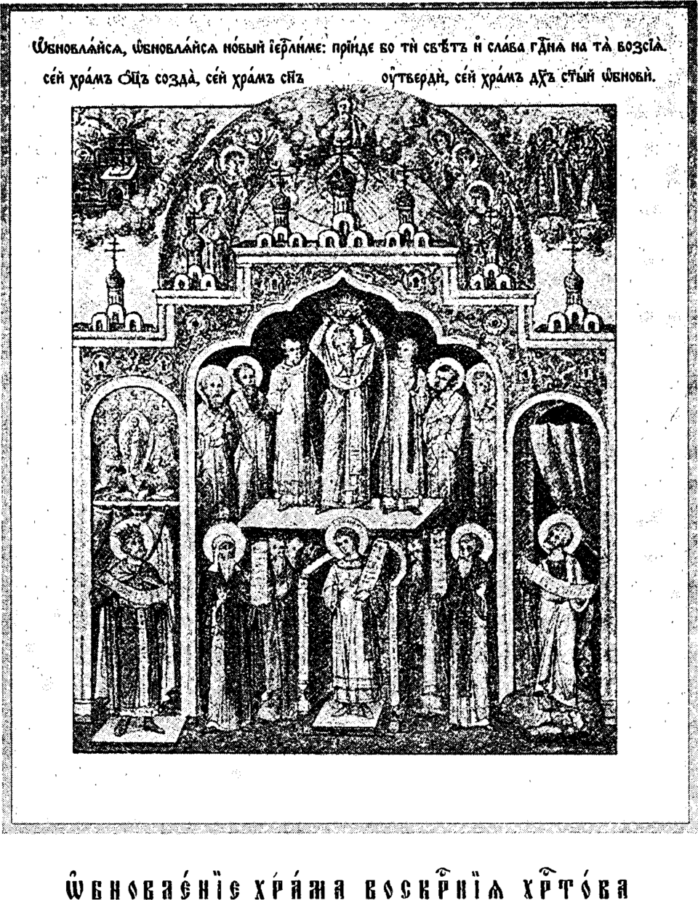
The Encaenia is the commemoration of the renewal of the holy Church of the Resurrection of Christ in Jerusalem. On this day the Church celebrates the consecration of the Church of the Resurrection built by the Equal-to-the-Apostles Emperor Constantine the Great and his mother, the Equal-to-the-Apostles Empress Helena.
In the year 70 the Roman emperor Titus (42–72) captured Jerusalem, plundered it, and so utterly destroyed the Temple of Solomon on Mount Moriah that, in fulfilment of the Saviour’s prophecy (Mk. 13:1–2), not one stone was left upon another. Later the emperor Hadrian (117–138) built a new city on the site of the Jerusalem that Titus had laid waste, gave it his own name — Aelia — and forbade the city to be called by its former name. The Tomb of the Lord was covered with earth and stones, and an idol of Jupiter was set up over it; on Golgotha, the place of Christ’s Crucifixion, a pagan temple of Venus was built in 119. Before the statue of the goddess abominable sacrifices were offered, accompanied by foul orgies. In Bethlehem, at the place where the Saviour was born of the Most Pure Virgin, the lawless ruler set up an idol of Adonis. All this was done deliberately: they wished to banish Christ the Saviour entirely from people’s minds and to make them forget the places where He had lived, preached, suffered, died and risen in glory.
The Equal-to-the-Apostles Constantine the Great (306–337), the first of the Roman emperors to recognize the Christian faith, resolved together with his mother, the pious Empress Helena, to restore the city of Jerusalem: to build a new church where Christ had suffered and risen, and to cleanse the places connected with the memory of the Saviour of their pagan shrines and consecrate them anew. Empress Helena travelled to Jerusalem. Constantine sent with her a letter to Patriarch Macarius I (313–323), asking that every help be given to the work of restoring the Christian holy places. In the Holy City the Equal-to-the-Apostles Empress destroyed all the idols and pagan temples and had the defiled places consecrated. Burning with the desire to find the Cross of Jesus Christ, Helena had the foundations of the ruined temple of Venus excavated. There they discovered the buried tomb of the Saviour and the Place of the Skull, near which three crosses and the nails were found. From among these crosses the Life-giving Cross of the Lord was miraculously identified, and Patriarch Macarius, accompanied by other clergy, elevated it for the countless people gathered there to behold (see the reading for September 14).
The holy Empress at once began building a great church that was to embrace both Golgotha and the Tomb of the Saviour. As John the Evangelist testifies, these two places lay close to one another (Jn. 19:41–42). The Church of the Resurrection was ten years in building, and Saint Helena (†327) did not live to see it completed. While in Jerusalem, the pious Empress also built churches in Bethlehem, on the Mount of Olives, in Gethsemane, and at many other places connected with the earthly life of the Saviour and with the events of the Old Testament.
The completion of the Church of the Resurrection of Christ — called the “Martyrium” in remembrance of the Saviour’s Passion on the Cross — coincided with the First Council of Tyre and with the thirtieth anniversary of the reign of the Equal-to-the-Apostles Emperor Constantine the Great. For this reason the consecration, celebrated on September 13, 335, bore an especially solemn character.
May the grace of the Risen Christ, whose holy Temple we commemorate today, be with us all.