✝ Holy Confessors John (Maisuradze) (†1957) and George-John (Mkheidze) (†1960)
September 8 / September 21 (Julian Calendar)
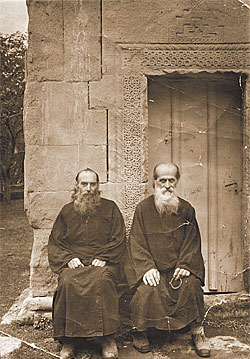
On this day, September 8 according to the Julian Calendar (September 21 civil calendar), the Georgian Orthodox Church commemorates the Holy Confessors John (Maisuradze) and George-John (Mkheidze), the fathers of Bethany Monastery. Archimandrite John (in the world, Vasil Maisuradze) was born in Tskhinvali around the year 1882. From childhood Vasil was skilled at every kind of work. As a boy of about twelve he tirelessly helped the abbot of Bethany Monastery, Hieromonk Spiridon (Ketiladze), who in 1894–96 had, with great difficulty, restored and set the monastery in order.
Inclined from his youth toward the monastic life and a seeker of holiness, Vasil, by God’s providence, began in 1903 to live on Mount Athos, in the monastery of Saint John the Theologian. The young ascetic, distinguished by his simplicity, his service to the brethren, and every virtue, was soon tonsured a monk and, as a sign of his special love for Saint John the Theologian, was given the name John. Soon the monk John was ordained a priest, which revealed his character all the more. Filled with boundless love for God and selfless service to his neighbor, the holy father strove in every way to please God and to make his life useful to his neighbor. (It should be noted that this quality remained with him throughout his life: despite his unlawful expulsion from the Holy Mountain of Athos and, later, being condemned to death by the atheist authorities, Saint John always showed remarkable love toward everyone.)
Saint John spent seventeen years on Athos; then, owing to the hard circumstances of the times, in 1920–21 he, together with other Georgian monks, was forced to leave the Holy Mountain. Returning to Georgia, Saint John settled in the Armazi Monastery, where, because of the persecution of the God-fighting Bolsheviks, only one monk was living. One day armed Chekists came to the monastery and took the monks away by force; on the way, at the edge of a ravine, they shot both monks in the back. The monks fell into the ravine, and the Chekists took them for dead. By God’s providence, the more lightly wounded monk dragged himself with difficulty as far as Mtskheta. John, too, was found, more dead than alive, and was brought to the Samtavro Convent.
Having recovered, Father John went to Bethany Monastery, where his childhood spiritual father, Hieromonk Spiridon, was still living. Very soon Father John took over the abbacy of the monastery.
Accustomed to labor from childhood, Father John soon organized the monastery’s household, and he also welcomed the people who came to the monastery for spiritual counsel with a fine table. For the people’s sake he would even make merry himself; he loved children greatly and always had sweets for them. The children were so at ease with him that on the feast of Saint John the Baptist, after Father John had blessed the parishioners and sprinkled them with holy water, the children drenched the venerable father from head to toe. To the parents, embarrassed by such behavior of their children, Father John cheerfully said: “It is a feast day, and this is how it should be.” Father John, who had such a direct relationship with children, received with remarkable honor the very young Irakli Ghudushauri, then a student at the Moscow Theological Seminary. Father John’s inexplicable behavior at that time—his undisguised tears of joy and the unusual reverence he showed toward the student—leads us to think that in the student who had come for his blessing he foresaw the future Catholicos-Patriarch of Georgia, Ilia II, and the revival of the Church of Georgia connected with his ministry.
Father John fasted very strictly, labored all day, slept only on a board, and prayed through whole nights; those who were with him could not understand when Father John rested or where he got such vigor. Apart from those who came to pray, robbers, emboldened by the connivance of the authorities, often came to the monastery and stole from the monks or seized the food and livestock they had obtained with such difficulty. Yet the monastery also had protectors in the government, in the form of secret Christians, with whose help the residence of Father John Maisuradze and Father George Mkheidze at the monastery was registered as that of caretakers of a historical monument, and the monks even received a small salary.
Many miracles worked through the prayers of Father John are known, though the venerable father always avoided revealing them. Father John and Father George healed a deaf-mute by their prayers; people suffering from various incurable illnesses were brought to them, and after staying a few days at Bethany (by this the fathers concealed their gift of wonderworking) the sick were healed. Father John himself carried out the heaviest work of the monastery and worried greatly about Father George, who was of frail health. Yet it was he who departed this world first. The sufferings of his life and his unceasing labor undermined his health, and after a short illness he reposed in 1957, at the age of 75.
Archimandrite George (Mkheidze) was born in the village of Skhvava, in the Ambrolauri district, around the year 1887. According to the tradition then prevailing among the nobility, George began his studies at a military school, but instead of pursuing a military career in the Empire he joined the national liberation movement and for a time served as personal secretary to Saint Ilia the Righteous (Chavchavadze). He often met with Saint Ilia’s spiritual father, the holy Bishop Alexander (Okropiridze), and with the Hieromartyr Nazar (Lezhava), and was closely acquainted with almost every prominent figure of his time.
Desiring to devote his whole life to God, George chose the path of monastic life; he was tonsured by the Hieromartyr Nazar. Highly educated and humble, combining refined aristocratic manners with monastic asceticism in remarkable harmony, Father George was ordained a priest and was also elevated to the rank of archimandrite. Filled with love for God and the desire to devote himself to his homeland, this holy ascetic experienced upon himself every trial that at that time befell our Church and our nation.
In 1924, armed Chekists attacked Father George, who was then laboring at the Khirsa Monastery. They beat him, cut off his hair and beard, and threatened to kill him. When he took temporary refuge with his family, an even more painful injury was inflicted on him by his own brothers, poisoned by the atheist worldview, who once again cut off the beard of the sleeping monk. (Later one of the brothers took his own life, and the other was shot together with his wife.)
In 1924 Saint George went up to Bethany Monastery, where Father John Maisuradze received him, and from that day these two holy fathers labored together for the rest of their lives; their life may truly be called “one soul in two bodies.”
Because of his frail health, Father George occupied himself in the monastery with comparatively lighter tasks: keeping the bees and tending the vegetable garden. Father George was extraordinarily merciful; because of his boundless generosity they were sometimes left almost without food, and he would say hopefully to Father John: “God will provide.”
Tall, thin, and always upright, Father George appeared outwardly more severe; he spoke less with the people who came to the monastery, and the children did not dare to play with him as they did with Father John, but always tried to please the holy father by learning their prayers by heart and by proper behavior.
Father George rarely left the monastery, but he nevertheless had to go down to Tbilisi, where he had a great many spiritual children, among whom were patriotically minded secret Christians serving in the government.
Father George was endowed with the gifts of prophecy and healing, which he diligently concealed; and whenever they were revealed, he tried in every way to explain what had happened by ordinary circumstances. Once he called by name a stranger who had come to the monastery, and he calmed the astonished guest by saying: “When you were baptized in such-and-such a church, I was there too”—though the baptism had taken place thirty years earlier, when the man was two months old. Father George sensed beforehand in spirit when his nephew was bringing to him his sisters, whom he had not seen for forty-eight years, and despite its being the last week of Great Lent, he prepared fish for his sisters’ meal.
Through the prayers of Father George and Father John, Father George’s nephew, who had been brought to the monastery condemned to death by an inflammation of the brain, was healed. A deaf-mute child was brought to the monastery, whose hearing was restored by the fathers’ prayers; people afflicted with various illnesses were brought there and taken home healed.
In 1957, when Father John reposed, Father George was tonsured into the great schema and, like his spiritual brother, was given the name John. Left alone, George-John bore the whole burden of the monastery, which further undermined his already frail health. His spiritual children came up from the city to care for him. A young woman of about twenty came to the monastery who suffered from terrible headaches. Someone had advised her that the water of Bethany Monastery would heal her, and indeed, after living at the monastery for a week she was completely healed. Father George-John accompanied the young woman on her way for a distance of eight kilometers.
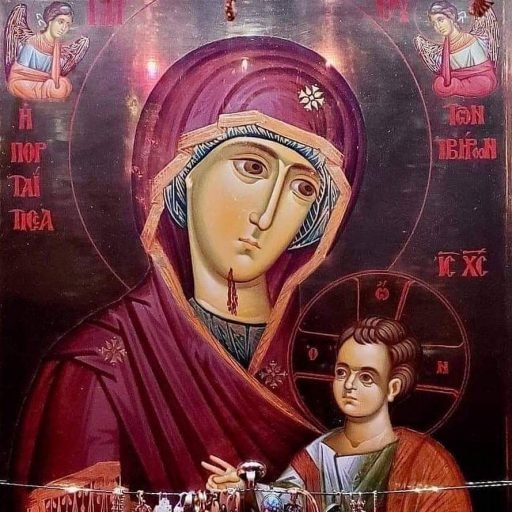
Father George had a vision of the Theotokos: the Most Holy Virgin healed the sufferer, tormented by unbearable pain. The Protomartyr Thekla appeared to the saint and offered him a cluster of grapes as a gift. A few days before his repose the elder was in the city, where an angel appeared to him, announced his approaching end, and told him to await his departure from this world in the monastery.
Holy Father George-John (Mkheidze) reposed in 1960 and is buried at Bethany Monastery beside Father John (Maisuradze).
May the intercessions of the Holy Confessors John and George-John be with us all.