✝ Holy Prophet and God-Seer Moses (†1531 BC)
September 4 / September 17 (Julian Calendar)
On this day, September 4 according to the Julian Calendar (September 17 civil calendar), the Georgian Orthodox Church commemorates Holy Prophet Moses.
The holy Prophet Moses, leader and lawgiver of the Hebrews, was descended from the tribe of Levi. He was born in Egypt at the time when the Israelites, carried there into captivity, were suffering under the yoke of slavery. By the order of Pharaoh the newborn sons of the Hebrews were to be killed, so that the people would not multiply. For fear of this order Moses’ mother hid her child for three months; then, “when she could no longer hide him,” she laid him in a basket coated with pitch and left it among the reeds by the riverbank. There the infant was found by Pharaoh’s daughter, who had come down to bathe; she took pity on him, adopted him, and named him Moses, which means “drawn out of the water.”
In the king’s palace Moses lived in luxury and was educated in the learning of the Egyptians, but he could not feel at peace: he knew that he was a Hebrew, and he was troubled by the affliction and misery that his kinsmen endured at the hands of the Egyptians. Once Moses saw an Egyptian beating a Hebrew; he killed the Egyptian and buried him in the ground, and then, fleeing Pharaoh’s wrath, took refuge in the land of Midian. There the Lord’s chosen one settled with the priest Jethro and married his daughter.
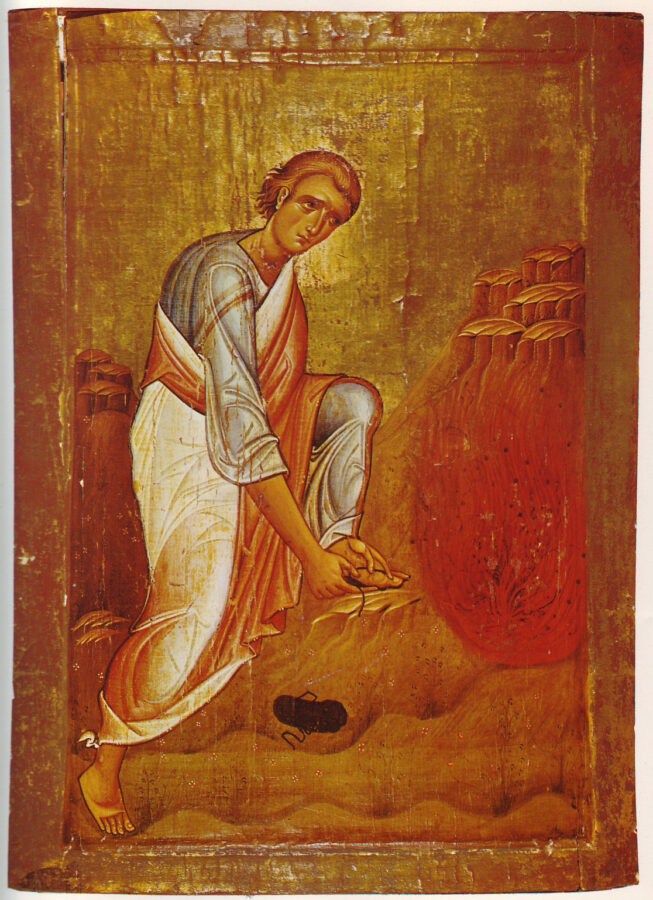
Moses tended the sheep of his father-in-law. Once, as he was leading the flock near Mount Horeb, he saw a bramble bush that was burning yet was not consumed. He drew near to the bush and heard from it: “I am the God of your father, the God of Abraham, the God of Isaac, and the God of Jacob… Now the cry of the children of Israel has come to Me, and I have seen the affliction with which the Egyptians oppress them. Come now, therefore, and I will send you to Pharaoh, king of the Egyptians, that you may bring My people, the children of Israel, out of the land of Egypt.” Moses was dismayed by his own weakness, but the Lord promised him, “I will be with you,” gave him the power to work miracles so that all might be convinced that he had been sent by God, and appointed his brother Aaron as his helper. Moses obeyed the command received from on high and went to Egypt.
The prophet, together with Aaron, stood before Pharaoh and made known to him the will of the Lord, but the impious ruler refused to let the Hebrews go. God brought ten plagues upon Egypt: at the word of Moses the water in the rivers, lakes, and wells turned to blood; hail and locusts destroyed the crops; a three-day darkness fell upon the land… But the hardened Pharaoh still stood his ground. From the second plague onward, at each calamity sent as punishment he promised to release the Israelites, but as soon as calm returned, he took back his word. The lawless one fulfilled the Lord’s command only when, by God’s will, an angel slew all the firstborn sons of the Egyptians.
Some six hundred thousand men came out of Egypt, not counting women and children. Under the protection of God and the leadership of Moses they set out toward the Promised Land. As they approached the Red Sea, the fugitives caught sight of their pursuers: Moses struck the sea with his staff and parted it. The Israelites crossed on the dry bottom, and the pursuers followed after them. Then Moses struck the sea with his staff again, the waters closed, and all the Egyptians were drowned.
The Lord worked many more miracles through His chosen one: He made bitter water fit to drink, and brought forth water from a dry rock…
At Rephidim the Hebrews were attacked by the tribe of the Amalekites, who dwelt in the desert. Moses sent Joshua the son of Nun with an army to fight the invaders, while he himself, with Aaron and Hur, went up to the top of a hill. When he raised his hands on high, the Israelites grew stronger; when he lowered them, Amalek gained strength. Then Aaron and Hur seated Moses on a stone and “held up his hands, one on the one side and one on the other.” Until sunset the prophet sat with his hands raised, and the Hebrews prevailed over the enemy.
On the fiftieth day after the exodus from Egypt the Israelites came to Mount Sinai. To Moses, who had gone up the mountain, the Lord commanded that he announce to His people: “Now if you will indeed obey My voice and keep My covenant, you shall be My chosen people out of all nations, for all the earth is Mine.” When the prophet had carried out the command, the whole people cried out as one: “All that God has spoken we will do and obey.” Moses again ascended the mountain and fasted for forty days and nights, after which he received from the Lord two tablets of stone on which the Ten Commandments were written; God also gave him other laws, which are included in the first five books of the Old Testament, and commanded him to build a tabernacle, that is, a movable temple. By the Lord’s command Moses appointed his brother Aaron as high priest, Aaron’s sons as priests, and the rest of the descendants of Levi as ministers of the movable temple.
After receiving the Law, the Hebrews soon approached the land of Canaan, but for their murmuring and lack of faith God sentenced them to forty years of wandering in the desert. In the fortieth year Moses brought the Lord’s chosen people to the border of Canaan; he himself looked upon the Promised Land from afar and reposed. He was then one hundred and twenty years old. The place of the Prophet Moses’ burial is unknown.
May the intercessions of the Holy Prophet Moses be with us all.