✝ Venerable Symeon the Stylite, Archimandrite (†459), and His Mother Martha (†c. 428)
September 1 / September 14 (Julian Calendar)
On this day, September 1 according to the Julian Calendar (September 14 civil calendar), the Georgian Orthodox Church commemorates Venerable Symeon the Stylite, Archimandrite, and his mother Martha.
Venerable Symeon the Stylite was born in the village of Sisan in Cappadocia, into the family of poor Christians, Susotion and Martha. In his youth he tended his father’s flock of sheep, and he carried out this first obedience of his conscientiously. Once, at the Divine Liturgy in church, Symeon heard the Beatitudes of the Gospel; astonished by their depth, he asked an elder standing nearby to explain the reading. The answer of that man, advanced in the spiritual life, awakened in him the desire to leave this world in order to gain the Kingdom of Heaven. He withdrew to pray, and for a long time fervently entreated the Lord to guide him on this most difficult path of serving God. When, exhausted by prayer, he fell asleep, he saw in a dream that he was digging the foundation for some building. Several times he stopped, thinking the trench was deep enough, but a man standing beside him kept ordering him to dig the foundation deeper and deeper. At last Symeon set to digging without pause and laboured until the same voice told him that the depth was sufficient and commanded him to begin building. From this vision the young man understood that salvation requires tireless and unwearying labour.
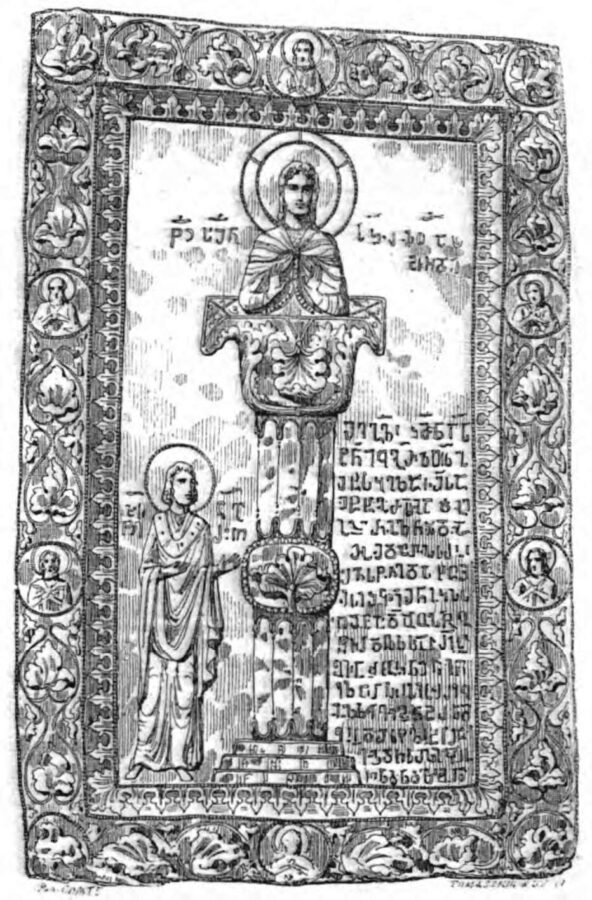
After the vision the chosen one of the Lord arose and went to a nearby monastery, where for seven days he stood at the gate, hungry and thirsty, begging with tears to be admitted. At the end of the week he was received into the brotherhood. At the age of eighteen Symeon was tonsured a monk, and he soon surpassed all the brethren in the severity of his life. He treated himself so harshly that the abbot feared that others, who were weaker, might imitate him to the point of self-destruction, and he ordered the saint to leave the monastery. The valiant ascetic wandered long through the desert and the mountains, and at last settled at the bottom of a dried-up well. Some time later the abbot saw in a vision angels who commanded him to bring Symeon back to the monastery. The abbot and the brethren sought out the father, who was near death, and brought him back to the monastery, but he did not remain there long. The chosen one of the Lord took refuge in a narrow cave near the village of Talanissus, where he spent three years in unceasing struggle. Once he resolved to take no food or drink at all for the whole of Great Lent. With God’s help he fulfilled his intention, and thereafter he kept the Holy Forty Days in this manner every year; moreover, for twenty days he prayed standing and for twenty days sitting. After three years Saint Symeon began his ascetic labour on the summit of a mountain. Here a great multitude of people came to him from many lands, and everyone wished to touch the saint in order to receive a blessing. Such veneration and commotion greatly burdened the blessed one and gave rise to a feat never seen before: he built a pillar six cubits high, settled in a narrow cell arranged on top of it, and gave himself over to intensified prayer and fasting. The pillar gradually grew higher: first to twenty, then to thirty-six cubits. The venerable father patiently endured the scorching heat of summer and the bitter cold of winter; his food was dried fruit and water.
The fathers living in the desert learned of Symeon’s unheard-of struggle and, wishing to test him, sent messengers to rebuke him for his strange and novel undertaking and to teach him to walk the well-trodden path that other saints had followed before him. They instructed the messengers that if Symeon would not listen to them, they were to bring him down from the pillar by force, but if he was willing to come down, they were to leave him, since it would then be clear that this new form of asceticism was from God. When the messengers came to the saint and told him the decision of the council of fathers, he at once prepared to descend. Seeing this, the envoys stopped him, declared to him the will of the fathers, and blessed him to remain standing on the pillar always and unchangingly.
The evil one constantly tried to shake the saint’s steadfastness, but the blessed one, with the Lord’s help, always overcame his temptations. Once the devil took on the appearance of an angel, appeared to Symeon in a chariot drawn by fiery horses, and announced that his holy life had been so pleasing to the Lord that he had been sent to carry him alive to heaven. The chosen one of the Lord was deceived and stretched out his right foot to step into the chariot, but at the same moment he made the sign of the Cross, and the demon vanished. Symeon understood that it had all been the wiles of the enemy.
Venerable Symeon spent eighty years in monastic struggle, forty-seven of them standing on the pillar. Endowed by the Lord with the gifts of foresight and wonderworking, the ascetic was also distinguished by remarkable humility and discernment.
In the year 459 Venerable Symeon gave up his soul to the Lord in prayer. His relics were committed to the earth near the pillar by Martyrius, Patriarch of Antioch (456–468), accompanied by the clergy and a great multitude of people. Later his disciple Anthony founded a monastery on the site of the blessed father’s struggles.
May the intercessions of Venerable Symeon the Stylite and his mother Martha be with us all.