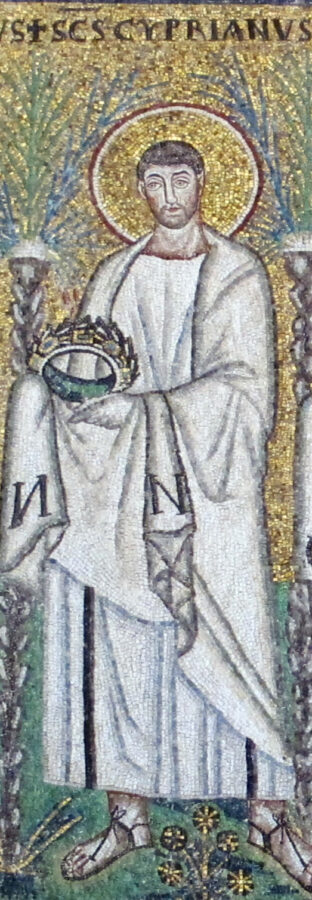
✝ Hieromartyr Cyprian, Bishop of Carthage
August 31 / September 13 (Julian Calendar)
On this day, August 31 according to the Julian Calendar (September 13 civil calendar), the Georgian Orthodox Church commemorates Hieromartyr Cyprian, Bishop of Carthage. The Hieromartyr Cyprian of Carthage was born around the year 200 in the city of Carthage in North Africa. The son of a wealthy pagan senator, he received an excellent secular education and while still young became a brilliant orator and a teacher of rhetoric and philosophy. He spent his wealth on lavish feasts and a life of pleasure, yet even then, compared with other pagans, he held to stricter moral principles and longed for something better, something still unknown to him. The Lord enlightened his mind: he sincerely believed in Christ and was baptized. Before his baptism the saint distributed all his property to the poor, and he himself went to live with the priest Caecilius. About a year later he was ordained a priest, and after the death of Donatus, Bishop of Carthage, in the year 248 he was unanimously elected hierarch.
The blessed father zealously set about the good ordering of the Church and the struggle against the vices found among the clergy and the flock. At that time, during the reign of the God-loving Emperor Philip, Christians lived in relative peace, but a great evil had crept in among the Orthodox of Africa: in the prevailing calm and security their hearts had gradually grown cold toward the faith. Their former divine zeal had been replaced by a love of earthly pleasures, wealth, and luxury; the brotherly love among the faithful had vanished, and no one remembered the poor any longer. Cyprian strove by word and by personal example to rouse the Christians and to show them the true purpose of life.
Meanwhile the God-hating Decius (249–251) ascended the throne, of which the saint had learned beforehand through a vision in a dream. A cruel persecution of Christians began.
At the insistent request of the faithful, Bishop Cyprian went into hiding, so that by preserving his own life he might help those who were persecuted. In Carthage, meanwhile, appalling things took place: it became plain how dangerous attachment to worldly comforts is, and how it cools the love of God. Lukewarm Christians, without any compulsion whatsoever, began to offer pagan sacrifices. Some did not sacrifice to the idols but bought certificates stating that they had performed the rite, and in this way kept their lives and property. The apostates were so numerous that the magistrates could not keep up with receiving the declarations of renunciation and postponed them to the following day. In his letters Saint Cyprian called on the Christians to turn to prayer as the only reliable weapon; he asked the priests to care for the weak and the infirm, to labour for the restoration of the fallen, and he ordered that all his property be distributed to the poor among the faithful, so that they would not go over to the pagans out of destitution. He asked that the days of the martyrs’ deaths be recorded, so that their memory might be celebrated on those days every year thereafter. The holy father rejoiced over those who were not afraid to confess Christ before the tormentors, but he feared that this feat might cast the confessors into pride, and he warned them in a fatherly way: “Let them be humble and meek, and let them give a good example to others by their further conduct as well. The most severe trial is still ahead. The Lord has said: ‘He that shall endure unto the end, the same shall be saved’ (Matthew 24:13). Let them imitate Jesus Christ, who showed the greatest example of humility precisely before His Passion, when He washed the feet of His disciples… Now more than ever they must fear falling into the snare of the enemy, who, stirred by the desire to avenge the defeat he has tasted, attacks the strongest with all his might.”
Cyprian’s fear proved justified: the Church of Carthage was tormented not so much by the faint-heartedness of the apostates as by the unseemly pride and reprehensible conduct of certain confessors. Some of them, made proud by the feat they had accomplished, violated the canons of the Church and issued written permissions in their own name to those apostates who wished to return to the fold; yet from the earliest times there had been a rule in the Church that grave sinners were received back only after full repentance. The period of testing was from one to three years, depending on the gravity of the sin. This violation of the canons agitated the Churches of Rome and Carthage and gave rise to a schism. The Roman priest Novatian began to maintain that receiving those who had apostatized from God back into the Church of the Lord was wholly impermissible and that no repentance could blot out their sin. He found many followers. In his epistles Saint Cyprian condemned the heresy of the Novatianists and advised choosing a middle path in dealing with the apostates: to refrain both from a frivolous leniency that demanded no repentance from those who had sinned, and from an excessive severity that did not accord with the spirit of the Gospel teaching.
Two years later, when Decius died, Cyprian returned to Carthage. To resolve the disputed questions that had arisen among the faithful during his absence, the blessed hierarch convened a local council, which sought to bring peace and establish unity in the troubled Church.
Some time later Gallienus (253–268) ascended the throne and renewed the persecution of Christians. This time Cyprian decided to remain in his diocese and to prepare his flock for the fulfilment of their Christian duties.
Contrary to expectation, the Christians living in the province of Africa this time scarcely experienced persecution at all, but another calamity befell them: an epidemic of plague. Thousands of people perished every day. Here the power of the Orthodox faith was clearly revealed. Inspired by the grace-filled words and personal example of Bishop Cyprian, the Christians spared neither their lives nor their property in order to render fitting honour to the dead and to help the dying; some of them sheltered the sick in their own homes. At this time the holy father wrote the book “On Mortality,” in which he speaks of the vanity and swift passing of this fleeting world and strives to direct the minds of Christians toward the future, eternal life.
No sooner had the pestilence ceased than barbarians invaded the province of Numidia, bordering on Carthage, and carried off many Christians into captivity. Saint Cyprian addressed his flock: “Not only feeling but the law itself obliges us to ransom our captive brethren: Christ dwells in them.” The Orthodox of Carthage indeed took the plight of the Numidians very much to heart and gave generous offerings for their ransom.
In the year 253 Emperor Valerian (253–260) ascended the throne. During the first six peaceful years of his reign Cyprian laboured diligently to set the affairs of the Church in order. But Emperor Valerian’s goodwill toward Christians turned to hatred at the instigation of his favourite courtier, Valerian Macrinus, and this is precisely what brought about the renewal of the persecution of those who hoped in the Saviour. Paternus, the proconsul of Carthage, demanded that Bishop Cyprian offer sacrifice to the idols. The saint refused both to comply with this demand and to disclose the names and whereabouts of the clergy of Carthage. For this the blessed father was exiled to the seaside town of Curubis. The deacon Pontius voluntarily accompanied him. On the day the holy bishop arrived at the place of his exile, the Lord revealed to him in a dream that exactly one year later he would die a martyr’s death. During his exile the saint wrote many epistles and books.
Around the year 258 the blessed father was recalled from Curubis and brought before the tribunal. Because of the proconsul’s illness the hearing was postponed by one day. The saint spent that night in the house of a pagan official. His whereabouts became known in the city, and a great multitude of people gathered near that house. In the morning, when the hierarch was led to the courthouse, the assembled Christians followed him. The judge demanded that the blessed one offer sacrifice to the idols, and when he received a firm refusal in reply, he sentenced him to be beheaded with the sword. On hearing the sentence, the lamb of Christ cried out: “Glory to the Lord!” And the people cried: “We too wish to die together with him!” When they reached the place of execution, Cyprian blessed everyone and gave instructions that twenty-five gold coins be given in his name to the executioner. Then with his own hands he bound his eyes, had his hands bound by the priest and subdeacon standing nearby, and bowed his neck to the sword. The blessed father died a martyr’s death in the year 258. His holy body was carried away by night and buried with honour in the private tomb of the procurator Macrobius Candidianus.
Later, in the time of Charlemagne (771–814), the incorrupt relics of the hieromartyr were translated with honour to France.
Saint Cyprian of Carthage left us a precious inheritance: his divinely inspired writings and eighty epistles. They were received as models of the Orthodox faith and were read at the Ecumenical Councils (the Third, at Ephesus, and the Fourth, at Chalcedon).
May the intercessions of Hieromartyr Cyprian, Bishop of Carthage, be with us all.