✝ The Icon of Our Lord Not Made by Hands (Anchiskhati)
August 16 / August 29 (Julian Calendar)
On this day, August 16 according to the Julian Calendar (August 29 civil calendar), the Georgian Orthodox Church commemorates the Translation of the Icon of Our Lord, God and Savior Jesus Christ Not Made by Hands from Edessa to Constantinople in the year 944, kept in Georgia as the Anchiskhati, together with the feast of Saint Anthony of Martqopi.
According to tradition, at the time when the Savior was preaching in Syria, the ruler of the city of Edessa was Abgar. He had fallen victim to an incurable illness, and his physicians had lost every hope of saving him. Abgar, who had heard the reports of the miracles of Jesus Christ, believed in Him as the Messiah and sent Him a letter in which he asked Him to come and free him from his sickness; and since the Lord was being persecuted and harassed by the Jews, Abgar offered Him his own city as a place to dwell.
The prince of Edessa entrusted this epistle to the painter Ananias, sending him into Judea and charging him also to paint the likeness of Christ. The painter came to the Savior, but because of the multitude of people he was unable to draw near to Him. He then took his place on a raised spot and tried to transfer the face of Christ onto a sheet. Every attempt failed him — a countenance shining with a grace not of this world could not be portrayed. Meanwhile Jesus, who saw what Ananias was attempting, called him by name and asked him for Abgar’s letter.
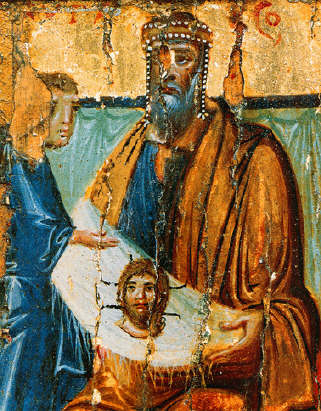
When He had read the ruler’s request, Christ asked that water and a towel be brought to Him, washed His face, and dried it with a cloth folded in four. Upon it the face of the Savior was miraculously imprinted. Together with this icon not made by hands, Jesus sent Abgar an epistle in which He wrote: “Blessed are you, Abgar, for you have believed without having seen Me… You ask Me to come to you, but I must accomplish the work for which I was sent, and afterward I must return to the Father who sent Me. After My ascension to Him I will send you one of My disciples, who will heal you completely and grant life to you and to those with you.”
Rejoicing, Ananias set out for Edessa. Night overtook him near Hierapolis, and he lodged with a potter who lived on the edge of the city; fearing that the icon might be damaged, he laid it between two fired tiles. At midnight a pillar of fire came down from heaven and stood over the icon, and it drew the attention of the head of the city as well. They told him the story of how the icon had come to be, and when it was taken up from between the tiles, they saw that the face of the Savior had passed onto the upper tile as well. The governor carried that tile to his own palace.
In the sixth century the tile bearing the image of the Savior came into a church of the followers of the Monophysite heresy. There it was found by Saint Anthony of Martqopi, one of the Thirteen Syrian Fathers, who secretly bore this great holy thing away so that it would not remain in the hands of heretics; and when the saint came down into Georgia together with John of Zedazeni, he brought the icon with him. It is known that after the repose of Anthony of Martqopi the copy that had passed onto the tile from the Icon Not Made by Hands was kept at Martqopi. Drawing near to it, the ailing King David VII Ulu of Georgia (1246–1270) was miraculously healed. In the reign of King George VII of Georgia (1393–1407), during the invasions of Tamerlane, George the Solitary hid the tile bearing the image of the Savior in a place unknown to anyone, for fear of the lawless; later George the Solitary died a martyr’s death and carried with him the secret of where that great holy thing lay.
As for the original of the Icon Not Made by Hands, Ananias brought it to Edessa. Abgar, who had already been bound to his bed for six years, received the letter and the icon of the Savior with joy and felt himself freed from his pains that very hour; yet the traces of leprosy remained upon his face until the coming of the disciple promised by the Lord, the Apostle Thaddaeus of the Seventy (commemorated August 21), who preached the Gospel and baptized the ruler of the city together with his whole household. Abgar had the Icon Not Made by Hands fastened to a board, inscribed above it the words, “O Christ God, no one who has believed in Thee has ever been put to shame,” adorned it, and set it in a niche carved above the gates of the city, in the place where an idol had formerly stood.
For many years a holy custom was kept in Edessa, that everyone entering or leaving the city should venerate this great holy thing. But afterward one of Abgar’s descendants, who had fallen into idolatry, resolved to take down the icon and raise up in its place the statue of a false god once more. The Lord revealed this lawless intention beforehand to the bishop of Edessa, who came by night with his company of clergy to the gateway, lit a lamp before the icon, and walled up the niche with a clay slab and bricks. Tradition also relates that Saint Nino, Equal-to-the-Apostles, came to Edessa together with Gaiana and Rhipsime to venerate the Icon of the Savior Not Made by Hands.
Many years passed. The inhabitants of the city entirely lost the fear of God, and they even forgot what holy thing it was that they possessed. In the year 539, or according to another account 545, Chosroes, king of the Persians, came against Edessa with his numerous army. The position of the city seemed hopeless. At that very time the Most Holy Theotokos appeared to Bishop Eulabius and commanded him to bring out the icon from the walled-up niche, for it would save them. The hierarch broke through the wall at the place indicated in the vision and brought out the holy thing. The lamp was still burning before it, and upon the clay slab another image had appeared, like the icon not made by hands. After prayer and a procession, confusion broke out in the enemy camp, and Chosroes was compelled to order his warriors to withdraw.
In the year 630 Edessa was taken by the Arabs. They did not hinder the veneration of the Icon Not Made by Hands, whose glory had by then spread through the whole East. In 944 the Emperor Constantine VII Porphyrogenitus (912–959) resolved to translate the holy thing to Constantinople, the center of the Orthodox world of that time. The emir of Edessa long hesitated, but at last he gave up the Icon Not Made by Hands and the letter written to Abgar in exchange for the release of two hundred Saracen captives, twelve thousand silver coins, and a promise that Edessa would not be attacked. On August 16 of the year 944 the clergy translated them with great honor to Constantinople. By one account the icon was enshrined in the church of Hagia Sophia; by the testimony of other sources, in the church of the Most Holy Theotokos of the Pharos.
The Icon of the Savior was kept in Constantinople until the beginning of the thirteenth century. By that time the cloth — the icon not made by hands — had been separated from the board onto which the image of the Savior had miraculously passed. At the beginning of the thirteenth century a grave political situation arose in Constantinople: besides the Muslim world, Catholic Europe also pressed upon it. In 1204 Constantinople was taken by the European crusaders. According to one tradition, at about that time the cloth with the Icon of the Savior Not Made by Hands was handed over to Dandolo, the Doge of Venice, who sent the holy thing to Venice by ship, and the ship sank in the Sea of Marmara. According to another opinion, the Icon Not Made by Hands may have been among the holy things that Louis IX, king of France, acquired in Constantinople and carried to Paris.
As for the board to which the icon not made by hands had been fastened, and onto which the image had miraculously passed: so that this greatest of holy things might somehow be preserved for the Orthodox world, it was translated from Constantinople to Georgia, namely to mountainous Klarjeti, and enshrined in the cathedral of Anchi. From this time the Icon Not Made by Hands was called the Anchiskhati. In Georgia it was also called the Very Face of the Image of God. John, Archbishop of Anchi, asked King Tamar for permission to adorn the Icon Not Made by Hands with precious stones. The icon was covered with a revetment of great artistry by the renowned goldsmith Beka Opizari, while John of Anchi dedicated a hymn to this greatest holy thing that had come to Klarjeti. Representatives of every class and rank of the Georgian people came from every corner of Georgia to Anchi to venerate the Icon of the Savior Not Made by Hands.
In 1453 Constantinople passed into the hands of the Ottomans. After this the lawless attacked the southern provinces of Georgia as well. The Georgians defended their own land bravely, but the enemy far outnumbered them, and so they pressed forward little by little. In that time the Icon Not Made by Hands was translated from Anchi to Akhaltsikhe, from where it came first to the village of Chali, into the household of Iotam Amilakhvari, and afterward was brought down to Tbilisi and given a place in the cathedral of the Catholicosate. From that time the cathedral itself, which had been built in the seventh century in the name of the Most Holy Theotokos, was also called Anchiskhati. After the establishment of Soviet rule in Georgia the Anchiskhati was moved to the State Museum, where it rests to this day in the gold treasury.
May the grace of the Icon of Our Lord Not Made by Hands be with us all.