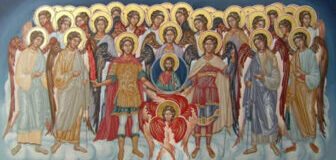
On November 21 the Orthodox Church throughout the world celebrates the Synaxis of the Holy Archangels — the feast of the Archangel Michael and all the Bodiless Powers of Heaven.
The celebration of the feast in honor of the Synaxis of Archangel Michael and the other Bodiless Powers of Heaven was established at the Local Council of Laodicea, which met at the beginning of the fourth century, a few years before the First Ecumenical Council of Nicaea.
The feast is kept in the ninth month counting from March (from which the year was reckoned in ancient times) — that is, in November — corresponding to the nine ranks of the angels. The number eight, in turn, points to the gathering of the Bodiless Powers of Heaven on “the eighth day,” as the holy fathers call the Second Coming of the Lord and the Dread Judgment: “For the Son of Man shall come in the glory of His Father with His angels; and then He shall reward every man according to his works.”
According to the holy Hieromartyr Dionysius the Areopagite, there are nine orders of angels. He beheld them and set down a complete teaching concerning them in his work “On the Celestial Hierarchy,” drawing upon Holy Scripture and Holy Tradition.
Highest of all stand the Seraphim, the Cherubim, and the Thrones.
The middle hierarchy is composed of the Dominions, the Powers, and the Authorities.
The lowest hierarchy comprises three orders: the Principalities, the Archangels, and the Angels.
What we know of the angels comes from Holy Scripture and Holy Tradition. In the Gospel the Lord Himself commands: “Take heed that ye despise not one of these little ones; for I say unto you, that in heaven their angels do always behold the face of my Father” (Matthew 18:10).
“For He shall give His angels charge over thee, to keep thee in all thy ways” (Psalm 90:11, Septuagint).
The angels were created before the visible world, and each is endowed with the grace of a particular ministry. “Who maketh His angels spirits, and His ministers a flame of fire,” the Prophet and Psalmist David tells us.
Appointed as chief over the ranks of the angels is the Archangel Michael, who cast Satan and his followers out of the Heavenly Kingdom. He guards us from evil spirits and from evil men, and to him the faithful pray in times of demonic temptation.
Other archangels are also known to us, each given by God a distinct blessing and ministry:
Gabriel — “the strength of God” (Daniel 8:16; Luke 1:26) — is the good herald of the mysteries of God, the messenger and minister of the Lord’s almighty power. He announced to the Most Holy Theotokos the conception of the Saviour, and also foretold the birth of John the Baptist.
Raphael — “the healing of God” (Tobit 3:16; 12:15) — delivers people from sickness. On icons he holds in his right hand a vessel of healing medicine, while with his left he leads the youth Tobias, the son of righteous Tobit, who carries a fish. Archangel Raphael is invoked in sickness, before setting out on a journey, while dwelling in a distant foreign land, and in times of sorrow, discouragement, and despair.
Uriel — “the divine fire and light,” the enlightener (3 Ezra 5:20) — is honored as the protector of monastics and theologians. He enlightens the mind, that we may come to know the divine mysteries and the Holy Scriptures. Uriel is also a protector of the penitent; according to church tradition he prayed together with Adam and Eve after their expulsion from Paradise and bore their tears of repentance to the altar of the Lord. On icons he is shown with a flaming or drawn sword.
Selaphiel — “the one who prays” — invisibly assists people at prayer. He is also a healer of the shaking illnesses (such as malaria and epilepsy). On icons Selaphiel is depicted in an attitude of prayer, with eyes lowered and hands folded upon his breast; at times he holds a lighted candle and incense.
Jegudiel — “the glory of God” — strengthens and intercedes for those who labor for the Lord, and is likewise honored as the protector of travelers and the helper of those in distress. On icons Jegudiel holds a golden crown in his right hand, and in his left a scourge with three red (or black) thongs — a sign that much sorrow and chastisement fall upon the slothful in this life until they come to their senses, while a crown awaits the diligent.
Varachiel — “the blessing of God” — bestows the Lord’s blessing upon good works and entreats God’s mercy for mankind. He is chiefly honored as the protector of martyrs and monastics.
Jeremiel — “the exaltation toward God” — kindles divine love in people and helps them to overcome their sins. On icons Archangel Jeremiel is depicted holding a balance in his hand.