✝ Great Martyr and Healer Panteleimon
July 27 / August 9 (Julian Calendar)
On this day, July 27 according to the Julian Calendar (August 9 civil calendar), the Georgian Orthodox Church commemorates the Holy Great Martyr and Healer Panteleimon.
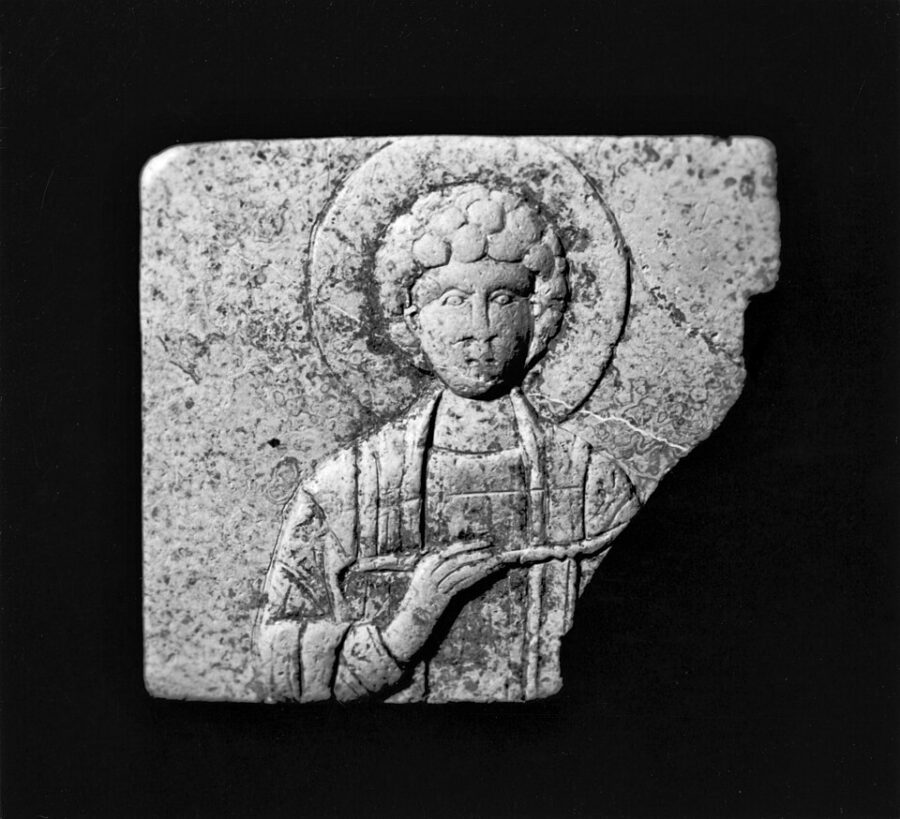
The Great Martyr and Healer Panteleimon was born in the city of Nicomedia into the family of Eustorgius, an illustrious and influential pagan who was a companion of the imperial table, and of the pious Christian woman Eubula. The newborn was named Pantoleon, meaning “in all things a lion.” His mother, who raised her son in hope of the true God, died early, while his father instilled in the boy devotion to the pagan faith, had him instructed in wisdom and letters, and then placed him under Euphrosynus, chief of the physicians, who treated the emperor and all his court, so that he might master the art of healing.
The youth, distinguished by understanding, kindness, and beauty, was always brought along by his teacher to the palace. There the emperor Maximian (284–305; 307–310) noticed him, was captivated, and ordered Euphrosynus to complete his training quickly, for he had resolved to appoint him his personal physician. On his way to his teacher, Pantoleon had to pass a small house where the holy priests Hermolaus, Hermippus, and Hermocrates (commemorated July 26) lived. Hermolaus perceived in his spirit that this youth would become a chosen vessel of God. One day he invited him in and spoke with him, and learning that the young man was diligently studying pagan teachings, the venerable father told him that the healers Asclepius, Hippocrates, and Galen were as nothing, for they served vanity, and that the gods whom the emperor served were likewise nothing; and he preached to him the true faith. The good seed fell upon good soil: Pantoleon believed in the true God, and from that time he came daily to the priest Hermolaus and drank in the teaching of the Gospel.
One day, on his way home, Pantoleon came upon a dead child who had been bitten by a viper, the serpent still lying beside him. At first the youth was shaken and drew back a little, but then he resolved to prove the truth of the words of Hermolaus. He lifted his eyes to heaven and prayed: “O Lord Jesus Christ, if it be pleasing to Thee that I serve Thee and be worthy of Thy name, let this child arise in Thy name!” At these words the boy stood up as though awakening from sleep, while the serpent burst apart and died. Then Pantoleon received the grace of faith; he gave thanks to God, hastened at once to Hermolaus, fell on his knees before him, and begged to be baptized. And the holy priest baptized the blessed one.
Afterward, with grace-filled words and penetrating questions, Pantoleon shook his father’s trust in the pagan deities. And when, by calling upon the name of the Savior, he opened the eyes of a blind man whom even the most skilled physicians of the city had been unable to help, Eustorgius with his own hands destroyed the idols, confessed the true God, and was baptized.
After his father’s death the saint freed his slaves and distributed his inherited wealth to the poor. He went about the prisons consoling the captives, served the sick with his own hands, healed them in the name of Christ, and supported them from his means as well. The people of the city began to leave the other physicians and hasten to Pantoleon, and by the grace of God he worked many miracles. The other healers grew envious of his work and sought a pretext to destroy the blessed one. At last, filled with spite, they reported to Maximian that his chosen physician was healing those who blasphemed the gods, giving them sustenance, and had fallen away from the worship of the gods, and that unless he were destroyed in time he would turn many more from the faith of their fathers. The emperor summoned Pantoleon and demanded that he refute the accusation, but the saint valiantly confessed his faith, and before the ruler’s eyes healed a paralytic by invoking the name of Christ. The enraged Maximian commanded the Lord’s chosen one to offer sacrifice to the idols, but neither threats nor flattery could bend the blessed one. Then he was subjected to dreadful tortures: he was hung upon a tree and his flesh raked with iron claws, his body was seared with burning torches, he was cast into boiling lead, thrown into the sea with a stone about his neck, given to wild beasts to be devoured, and bound to a great wheel and hurled from a height so that he might be torn to pieces — yet the martyr, strengthened by the appearance of the Lord, came out of all these torments completely unharmed by the Lord’s own power.
After this the saint’s teacher Hermolaus, and with him the priests Hermippus and Hermocrates, were brought before the tribunal and put to death for their confession of the truth (see the reading for July 26). Pantoleon, however, was told that his teachers had acknowledged the lordship of the gods, had sacrificed to them, and now dwelt in the palace in honor. The martyr of Christ replied that he knew well that the holy ones now dwelt in heaven, in the city of Christ.
The maddened Maximian again tormented him with many tortures, and then ordered his servants to put him to death and burn his body. The executioners led the blessed one out of the city, brought him to the place where it pleased the Lord that His saint’s course should be fulfilled, and set him beneath olive trees. One soldier thrust his sword at the Lord’s favored one, but the sharp blade bent like wax, and the saint suffered no harm. Shaken by the miracle, the soldiers believed in Christ and begged the martyr to entreat the Lord’s forgiveness for their sins. In answer to his prayer a heavenly voice summoned the blessed one to the Kingdom and declared that from henceforth his name would no longer be Pantoleon but Panteleimon — “the all-merciful” — for he had been merciful to all men, a calm harbor for all who fled to him, a helper of the afflicted, an upholder of the despairing, and an expeller of evil spirits.
The executioners refused to carry out the sentence, but the martyr of Christ said to them: “If you do not do this, you have no part with me.” Then the soldiers reverently kissed the blessed one, and so they beheaded him. The saint’s body became white as snow, milk flowed from his wounds instead of blood, and the olive trees were suddenly laden with fruit. Many who beheld this miracle glorified the true God, and the Christians buried him with honor (+305). Present at the execution of the Lord’s chosen one were his servants Laurence, Bassus, and Probianus; it is they who preserved for us the account of Panteleimon’s life and martyric struggle.
The incorrupt relics of the Great Martyr are dispersed throughout the Christian world. His precious head is kept on Mount Athos, in the Russian monastery dedicated to St. Panteleimon.
May the intercessions of Great Martyr and Healer Panteleimon be with us all.