
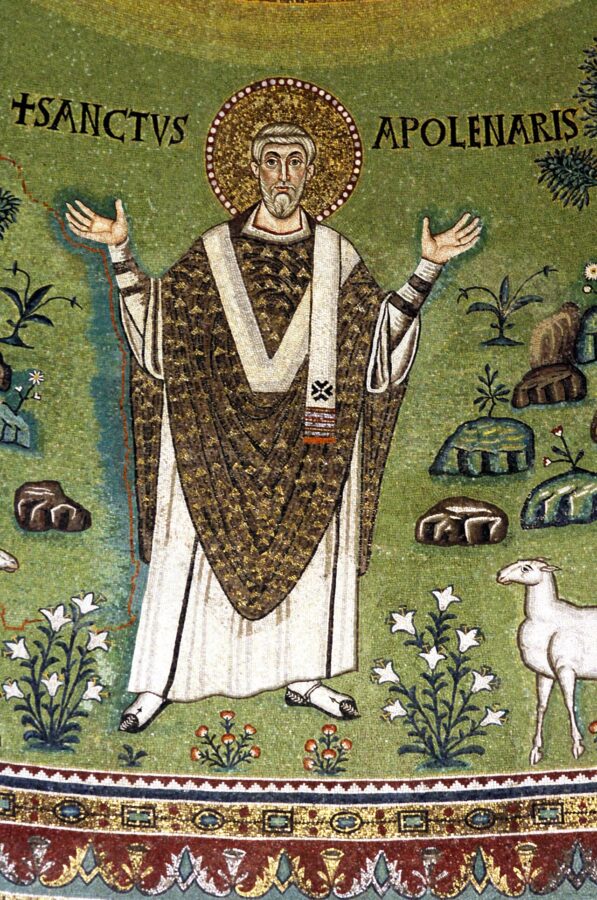
✝ Hieromartyr Apollinaris, Bishop of Ravenna
July 23 / August 5 (Julian Calendar)
On this day, July 23 according to the Julian Calendar (August 5 civil calendar), the Georgian Orthodox Church commemorates the Hieromartyr Apollinaris, Bishop of Ravenna.
The Hieromartyr Apollinaris, Bishop of Ravenna, was a native of Antioch. He was consecrated Bishop of Ravenna in Rome by the Apostle Paul, during the reign of the Emperor Claudius (41–54).
The blessed one arrived in his diocese in the guise of a simple pilgrim and asked shelter of a local resident, the soldier Irenaeus. In conversation with his host the saint revealed his high priestly rank, and then, through prayer offered to the Lord, restored the sight of Irenaeus’s blind son. Overjoyed, Irenaeus and his household — the first among the people of Ravenna — came to believe in the almighty power of the true God, and the hierarch remained to live in their house. Many miracles accompanied the saint’s preaching. When, through his prayer, Thecla, the paralyzed wife of the tribune, was healed, the tribune’s whole family was converted to the true faith, and in their palace Apollinaris established a small church. For the newly converted people of Ravenna the holy bishop ordained two priests — Aderitus and Calocerus — and two deacons. Over the twelve years of Apollinaris’s labors in the city, the number of the faithful grew ever greater.
The alarmed pagan priests denounced him to the governor Saturninus; the chief shepherd was brought before the tribunal and cruelly tortured. When they believed the saint had given up his spirit, the torturers carried his body outside the city and cast it on the seashore — but the blessed one was found to be alive. A devout widow sheltered him, revived him, and tended his wounds. In her house the holy hierarch remained for six months, preaching the faith of Christ.
Apollinaris’s whereabouts became known when he restored the power of speech to Boniface, a nobleman of the city. This miracle converted many pagans to the true faith, but the saint was again brought to trial and subjected to torment — he was made to stand barefoot on burning coals. The hierarch did not cease his preaching until the godless drove him from the city.
For some time the saint remained in Italy, continuing as before to teach the Gospel, while the priest Calocerus governed the church of Ravenna. When Apollinaris returned to his flock he was again arrested, sentenced to banishment, and, bound in heavy chains, placed aboard a ship sailing by way of the Danube toward Illyria.
Two soldiers were charged with conveying him to his place of exile, and three clergymen willingly followed the banished bishop out of the city. On the voyage the ship was wrecked and all aboard were drowned except Apollinaris, his accompanying clergy, and the two guards. Moved by the holy hierarch’s preaching, the soldiers believed in Christ and were baptized. The travelers came to Mysia, where Apollinaris healed a distinguished citizen of leprosy; filled with gratitude, the man gave shelter to his healer and his companions. The holy father tirelessly preached the teaching of the Savior and converted many pagans to Christianity, for which the lawless persecuted him. They beat the blessed one without mercy, then placed him on a ship bound for Italy and sent him back. After three years of forced separation, the faithful servant of Orthodoxy returned once more to his flock, which received him with joy.
But the pagans raged again: they attacked the church, scattered the worshippers, and dragged Apollinaris himself to the priests, into the temple of Apollo. As soon as the blessed one set foot in the shrine, the idol fell and shattered. The enraged pagans then brought Apollinaris before Taurus, the new governor of the region. There he worked yet another miracle — he healed the governor’s son, who had been born blind. Taurus sought to shield the Lord’s chosen one from the maddened crowd and sent him outside the city to his own estate, where the governor’s wife and children were baptized. Taurus himself, fearing the emperor, did not dare to receive baptism, yet he treated his benefactor with love and gratitude. Apollinaris lived four years on the governor’s estate.
The pagan priests appealed to the Emperor Vespasian, demanding that the “priest” of the Christians be put to death. But Vespasian rejected their complaint, answering: “The gods have power enough to avenge themselves, if they feel insulted!”
Nevertheless the fury of the idolaters fell upon the holy father. They attacked him as he was walking from the city toward a nearby village and beat him savagely. Christians found the blessed father already at his last breath and carried him into the village, where he lay seven days upon his deathbed. At last the martyr blessed those around him with his hierarchical blessing and committed his soul to the Lord. Saint Apollinaris governed the church of Ravenna for twenty-eight years and reposed in approximately the year 75 after the Nativity of Christ.
May the intercessions of the Hieromartyr Apollinaris be with us all.