✝ Holy Myrrh-Bearer and Equal-to-the-Apostles Mary Magdalene
July 22 / August 4 (Julian Calendar)
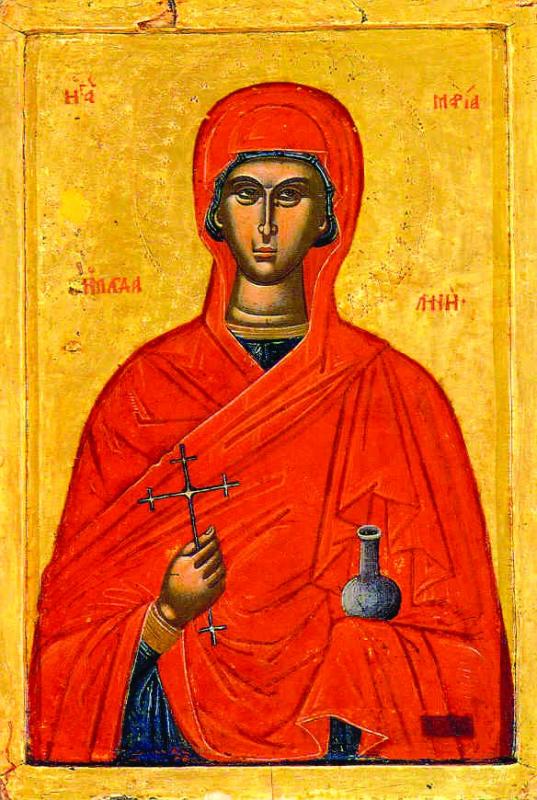
On this day, July 22 according to the Julian Calendar (August 4 civil calendar), the Georgian Orthodox Church commemorates the Holy Myrrh-Bearer and Equal-to-the-Apostles Mary Magdalene.
The holy Equal-to-the-Apostles Myrrh-bearer Mary Magdalene was born and raised in Magdala, a small town on the shore of the Sea of Gennesaret, between Capernaum and Tiberias. According to Church tradition she was beautiful and captivating, and in her youth lived without restraint. The Gospel tells us that seven demons dwelt in the future saint (Luke 8:2; Mark 16:9). After Jesus Christ healed the afflicted Mary, she was kindled with divine love and became a devoted disciple and follower of the Savior.
Mary Magdalene accompanied the Savior as He journeyed with the apostles through the cities and villages of Judea and Galilee preaching the Gospel. It appears that the Evangelist Luke counts her among the women who followed the Savior to Golgotha, who “mourned and lamented Him” (Luke 23:27). Together with the Mother of God and the Apostle John, Mary Magdalene stood beside the Teacher even then, when — crucified and humiliated — He had been forsaken by all His disciples. Among those standing by the Cross the Evangelists also name Mary the mother of the Apostle James the Less, Salome, and the other women who had become followers of Christ in Galilee, yet all of them name Mary Magdalene first (Matt. 27:55-56; Mark 15:40-41; Luke 23:49; John 19:25). This speaks clearly of how she stood out among the women who accompanied the Savior.
Filled with love and gratitude, Mary, together with the other women, hastened with fragrant myrrh to render the last honors to the holy body of the Teacher. Here too she outpaced them all. While it was still dark she drew near the tomb and found “the stone taken away from the sepulcher”; amazed and frightened, she ran to the two closest disciples of Jesus, Simon Peter and John, and told them that the body of the Savior had vanished. The apostles hastened to the tomb and saw “the linen cloths lying there, and the napkin… folded together in a place by itself”; shaken, they departed, while Mary “stood outside by the tomb weeping.” In tears she looked once more into the cave, wishing to be certain that it was truly empty — and then the Lord opened the spiritual eyes of the blessed woman: she “saw two angels in white sitting, the one at the head and the other at the feet, where the body of Jesus had lain.” To their question, “Woman, why do you weep?” Mary answered with the same words she had spoken only a short while before to Peter and John: “They have taken away my Lord, and I do not know where they have laid Him.” Then she turned and “saw Jesus standing,” but did not recognize Him — she supposed Him to be the gardener and entreated Him: “Sir, if you have carried Him away, tell me where you have laid Him, and I will take Him away.” The Savior called to the grieving woman: “Mary!” She knew the sweetest voice of the Teacher and cried out in exultation, “Rabboni!” (Teacher!) and ran to meet Him; but Christ said to her: “Touch Me not, for I am not yet ascended to My Father; go to My brethren and say to them: I ascend to My Father and your Father, to My God and your God.”
Overwhelmed with joy, Mary came to herself and ran again to the apostles, “who mourned and wept,” to bring them the good tidings that the Lord “is alive and has appeared.” This was the first proclamation of the Resurrection in the world: the apostles were to bring the good news to the whole world, but she brought the good news to the apostles themselves.
Holy Scripture tells us nothing of the life of Mary Magdalene after the Resurrection of Christ, but there can be no doubt that she who stood at the foot of the Savior’s Cross in the most grievous hour of the Crucifixion remained at His side from the Resurrection until the Ascension.
Holy Tradition relates that when the apostles, filled with the grace of the Holy Spirit, left Jerusalem and set out for the ends of the earth to preach, Mary Magdalene went to Rome. She traversed all of Italy preaching the Gospel, and even entered the court of the Emperor Tiberius (14-37), to whom she presented a red egg as a gift. It is from Mary Magdalene that the tradition of offering eggs dyed red at the feast of the Resurrection descends. The holy myrrh-bearer continued her apostolic labors in Italy and in the city of Rome, and it may well be that it is she whom the Apostle Paul has in mind in his Epistle to the Romans when he writes: “Greet Mary, who bestowed much labor on us” (16:6).
Saint Mary surrendered her soul to the Lord in Ephesus and was buried there. In the ninth century her incorrupt relics were translated to Constantinople, the capital of the Byzantine Empire, and enshrined in the church of the Monastery of Saint Lazarus. During the Crusades this holy treasure was carried to Italy and laid beneath the altar of the Lateran Basilica of Saint John in Rome. A portion of the blessed mother’s holy relics rests in France, near Marseilles, in a church dedicated to her name.
May the intercessions of Holy Mary Magdalene, Equal to the Apostles, be with us all.