

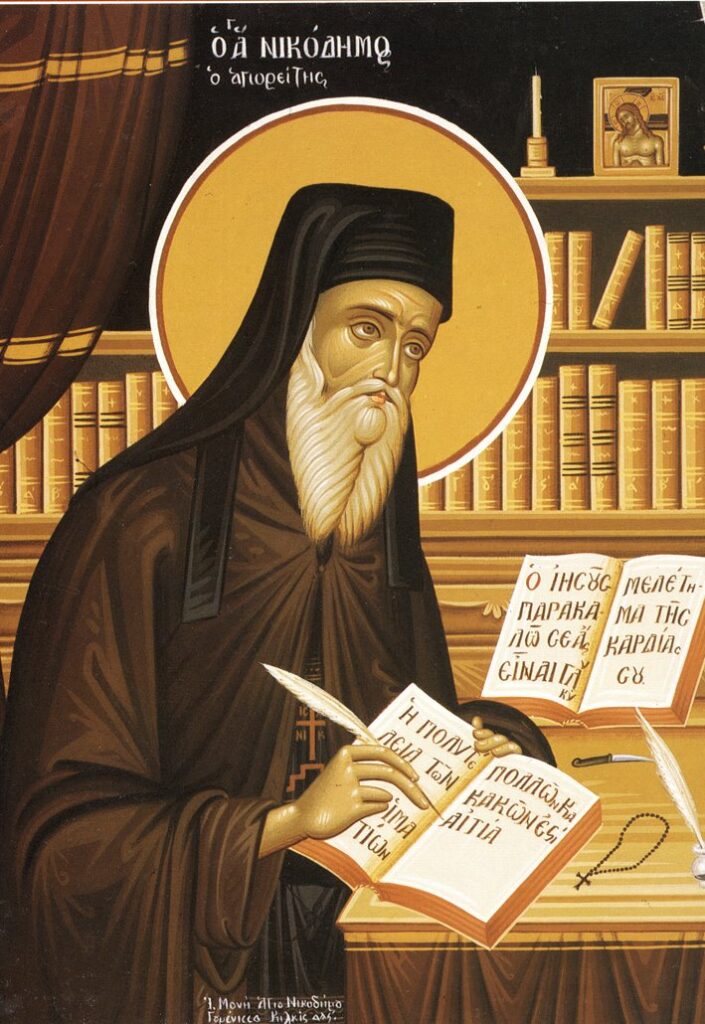
On this day, July 1 according to the Julian Calendar (July 14 civil calendar), the Georgian Orthodox Church commemorates Saint Nicodemus the Hagiorite (+1809), the great theologian, spiritual writer, and teacher of the Orthodox Church.
Saint Nicodemus the Hagiorite (Nicodemus of the Holy Mountain) was born in 1748 on the Greek island of Naxos. His secular name was Nicholas. At the age of twenty-six he came to Mount Athos and was tonsured a monk at the Monastery of Dionysiou (dedicated to the Nativity of Saint John the Baptist), receiving the name Nicodemus.
Nicodemus was endowed with extraordinary intellectual gifts and an insatiable love for the knowledge of God. He threw himself into the study of Scripture, the Holy Fathers, and the traditions of the Church with extraordinary diligence. Despite the difficult conditions of monastic life — poverty, ill health, and the demands of spiritual discipline — he produced a body of theological and spiritual writing that has few equals in modern Orthodox literature.
His most celebrated works include:
The Philokalia — compiled together with Saint Makarios of Corinth, this monumental anthology of patristic texts on the spiritual life and hesychast prayer has been translated into numerous languages and continues to be the foundational reader for Orthodox spiritual formation worldwide.
The Rudder (Pedalion) — a commentary on the sacred canons of the Orthodox Church.
Unseen Warfare — a spiritual classic adapted from the Western work of Lorenzo Scupoli, which Nicodemus transformed into a deeply Orthodox manual of the interior spiritual life.
The Handbook of Spiritual Counsel — a guide to frequent communion and the preparation of the soul.
Commentaries on the Epistles of the Apostle Paul and on the Catholic Epistles.
Saint Nicodemus was a man of deep humility who never sought recognition for his vast labors. He spent the last years of his life in great ill health, yet continued writing and praying until the end. He reposed peacefully on the Holy Mountain in 1809.
He was glorified as a saint by the Ecumenical Patriarchate in 1955. His feast is celebrated as a major day on Mount Athos, and the Philokalia he compiled has made him one of the most widely-read Orthodox spiritual writers of any century.
May the intercessions of Saint Nicodemus the Hagiorite be with us all.