

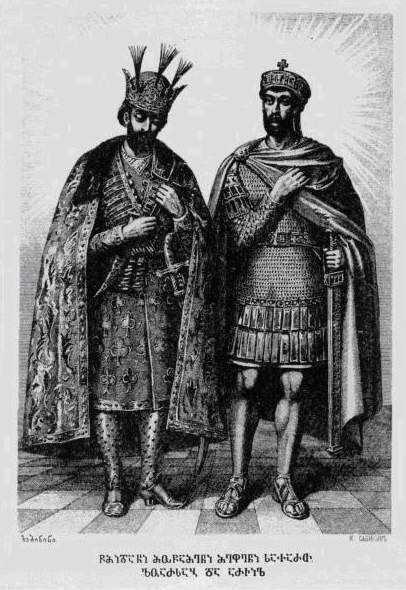
On this day, June 21 according to the Julian Calendar (July 4 civil calendar), the Georgian Orthodox Church commemorates the Holy Martyrs, Kings of Georgia: Archil (+744) and Luarsab (+1622).
Holy Martyr King Archil ruled the Kingdom of Kartli during one of the most difficult periods in Georgian history. His reign was marked by relentless struggle against ungodly conquerors and tireless effort toward the unification of Georgia. His father, Adarnase, Eristavi of Kartli, had appointed Archil’s elder brother Mir as ruler of Kartli. Archil stood faithfully beside his brother in every way, caring for the kingdom with the fear and love of God.
During Mir’s reign, Murvan the Deaf swept into Kartli. This bloodthirsty tyrant destroyed every fortification and edifice of Georgia and drenched the land in blood. Mir and Archil took refuge in Abkhazia and fervently prayed to the Most Holy Theotokos for help. The Lord heard the prayer of the righteous: one night the Most Holy Theotokos appeared to Saint Archil and commanded him: “Rise and do battle against the ungodly, for an angel of the Lord shall go before you, and the Lord Himself shall fight on your behalf.”
With a small company of warriors, trusting in God and aided by the intercessions of the Most Holy Theotokos, Mir and Archil attacked the enemy camp. The battle ended in victory for the Georgians. God sent a fierce wind and heavy rain upon the fleeing pagans, the rivers rose and swept away the Arab forces. The survivors fled to Constantinople, but divine wrath overtook them and drowned them in the sea.
King Mir, wounded in battle, soon fell ill, and before his death entrusted the kingdom to Archil, commending to his care the seven daughters who remained. He asked to be buried in Mtskheta.
King Archil fulfilled Mir’s final wishes, buried him in the upper church of Mtskheta, settled six of the seven daughters with suitable Georgian noblemen with proper dowries, and betrothed the seventh, Gurandukht, to the Emperor of Byzantium.
For twelve years Archil sat in Kutaisi and strove in every way to unite all of Georgia. He then moved to Kartli and began to restore that most beautiful region, ravaged by the Arabs, and brought together Kakheti, the mountains, Egrisi, Abkhazia, and Samtskhe-Javakheti. Arab domination could scarcely reach beyond the outskirts of Tbilisi and Mtskheta.
While the land, devastated by Murvan the Deaf, had not yet recovered, a new Arab army under the command of Jijum-Asim again ravaged Kartli and turned toward Kakheti. To resist would have been futile. King Archil decided to offer his own life for the salvation of the Christians. “Better my death,” he declared, “than the renewed destruction of Christ’s churches and the desolation of this land.” He went to Jijum-Asim to sue for peace.
Jijum-Asim received the king with honor, praised his bearing and the beauty of his face, and entertained him lavishly for several days. Then he demanded that Archil abandon the saving faith and embrace Islam, offering him great gifts in return. The king, filled with the Spirit from above, replied: “Should I agree to your demand, I would die a death after which I must suffer torment… Our God and Savior gave His life for our salvation, and therefore I do not fear death. If you kill me, I too shall rise from death just as our God did, and I shall glorify Him forever.”
Enraged, Jijum-Asim imprisoned Archil, intending through fear of torture to break his unshakeable spirit, yet he could not bring himself to condemn to death this strong and beautiful king. A renegade Armenian prince, who bore a long-standing grudge, persuaded Asim to demand from Archil the location of the Byzantine emperor Heraclius’s hidden treasury. Archil answered that he knew nothing of it, as he had been very young when Heraclius passed through the country, and that his father and brother had hidden their own treasures in Greek fortresses during the invasion of Murvan the Deaf.
Finally, Archil was brought before Asim one last time, and again refused to renounce Christ. “Know, O tyrant, that I will not abandon my Lord, I will not deny the name of Christ, I will not exchange eternal life for temporal life, nor temporary kingship for everlasting fellowship with Christ.” The king asked for a little time to pray, knelt down, gave thanks to God, commended the Church to Christ’s keeping and prayed for the strengthening of Christianity in Georgia, then calmly bowed his head to the sword. This happened in the year 744.
That night, Georgian nobles secretly carried away the body of Holy King Archil and buried him in the church he himself had built in Notkora.
Holy Martyr King Luarsab was born around 1592, the eldest son of George X, King of Kartli. After King George’s death, the fourteen-year-old Luarsab ascended the royal throne in 1606. That same year George III was crowned in Imereti and Teimuraz I in Kakheti.
In 1609, Turks and Crimean Tatars attacked Kartli. King Luarsab was at that time in Tskhirethi fortress with a small retinue and would likely not have survived the sudden enemy assault, but the holy Kveltheli priest Theodore, whom the pagans had ordered to show them the shortest road to the king’s location, led them in the completely opposite direction. Meanwhile the king assembled his army and at Tashiskari dealt a crushing defeat to the enemy. At that time the king was seventeen years old. Zaza Tsitsishvili and Giorgi Saakadze distinguished themselves with particular valor in the battle.
Giorgi Saakadze invited the king, joyful from the victory, to his home. At the feast, Luarsab took a liking to Giorgi’s sister, and despite the opposition of the royal court, soon married her.
Subsequent events brought enmity between King Luarsab and Giorgi Saakadze. The latter fled Georgia and sought refuge with Shah Abbas. The cunning Shah, famous for intrigue, stirred up every manner of plot against Georgia: first he took Luarsab’s sister Lela (Tinatin) as a wife, then became the brother-in-law of Teimuraz as well, taking his beautiful sister Elene as a bride. The Shah then offered King Luarsab the killing of Teimuraz and the Kingdom of Kakheti, and to Teimuraz he promised the Kingdom of Kartli in exchange for killing Luarsab.
The Georgian kings saw through Shah’s cunning. With God’s help, Georgia was spared the horror of fratricidal war. The Shah, alarmed at the unity of the Georgians, summoned Luarsab and Teimuraz under the pretense of hunting and recreation. The kings deliberated and chose battle; on the field of Narekvavi they swore before Christ to lay down their lives for each other and for Christ. They were certain of victory, but were betrayed and defeated, and took refuge in Imereti.
Shah Abbas devastated Kartli and Kakheti terribly and encamped at Gori. From there he sent word to George, King of Imereti, demanding the surrender of the guests, offering great treasure in return. George III kept the treacherous Shah at a distance, sent the Catholicos Malakhia and Paata Abashidze to the Shah as intermediaries, asking pardon and saying: “We beseech you, show us honor and give the kings back their kingdoms and serve them as your fathers served before you, and depart.”
When Shah Abbas saw he could accomplish nothing by force, he resorted to cunning. He summoned Luarsab’s guardian, Shadiman Baratashvili, and asked him to bring Luarsab, promising to do him no harm, while declaring Teimuraz his blood enemy. He sent with Shadiman a golden-hilted sword as a sign of friendship. Luarsab knew well what the Shah’s “friendship” meant, but his royal conscience decided otherwise: “If I do not go, he will drive out the people and devastate the land. What benefit is that to me?”
Shah Abbas received the king with kindness and flattery, treated him amicably, but shortly afterward appointed a new governor for Kartli and stationed troops there. He first took Luarsab to Qaraiya, ostensibly for hunting, and from there to Persia.
During his stay in Qaraiya, Luarsab astonished everyone with his valor and manliness. The sight of his hunting spoils filled the Shah with envy. Luarsab’s sister Tinatin, who was the Shah’s wife, asked her beautiful and noble brother to pretend to be inferior, for the jealous Abbas’s sake, but the king smiled sadly and said: “I know he will never release me; better then to show excellence than weakness.”
During Great Lent, at the Shah’s feast, Luarsab refused the fish offered to him, saying: “Today you want me to break the fast with fish; tomorrow you will offer meat; after that you will demand that I deny Christ”—thus exposing the Shah’s hidden plan. Enraged, the Shah openly commanded the king to deny Christ and confess Allah. “Even if you gave me the whole world, I could not fulfil your command, for I was baptized in the name of Christ and believe in Him alone,” holy Luarsab answered boldly.
The captive king was taken to Shiraz and thrown into a dungeon. For seven years, every day mullahs would enter his cell urging: “O King, have mercy on your youth and do not defy the Shah’s command; renounce your faith and accept Muhammad, or bitter torment and death await you!” Luarsab replied: “Do with me as you will and carry out the Shah’s command.”
The Shah sent his final ultimatum: “Either deny Christ, or accept a fierce death.” Luarsab, who had spent seven years of captivity in prayer and fasting, “unmoved by evil and awaiting the blessed hope and appearance of the glory of the great God and our Savior Jesus Christ,” now signified by his silence his agreement to a martyr’s end.
The Shah was finally convinced that nothing could shake Luarsab’s faith. Enraged, he sent executioners to the prison and ordered the king to be strangled.
The executioners came to carry out the sentence. The king understood that the hour of his departure from this world had come. He said to them: “Give me time to pray to the Lord, and then carry out the command of the ungodly one.” Holy Luarsab knelt before an icon of the Theotokos and fervently cried out: “O our Lady, Theotokos, in you I place all my hope of life; you are my protector, you are my comforter; give me help in this my contest; intercede for me before your Son; and number me among the holy martyrs, that I too may glorify the Father and the Son and the Holy Spirit.”
Immediately after his prayer the executioners entered the dungeon and mercilessly strangled the devout king with a bowstring. That night a miraculous light rested upon the unburied body of the holy martyr. The next day the body of the holy martyr was buried in the prison courtyard.
This happened in the year 1622.
A thousand years separate holy Archil from holy Luarsab, yet the Church of Georgia appointed their commemoration on the same day because of the likeness of their struggles and their martyrdom. Catholicos-Patriarch Leonidas (+1921) attributes the almost identical martyrdom of these two kings to “the same woe, the same bitterness of our martyred and long-suffering homeland in almost every age,” and laments that “the holy bones of Luarsab remain to this day in Persia, and the grave of Archil only Ertsoli Pshaveli and Khevsur have seen, and no one else.”
May the intercessions of the Holy Martyrs, Kings Archil and Luarsab, be with us all.