

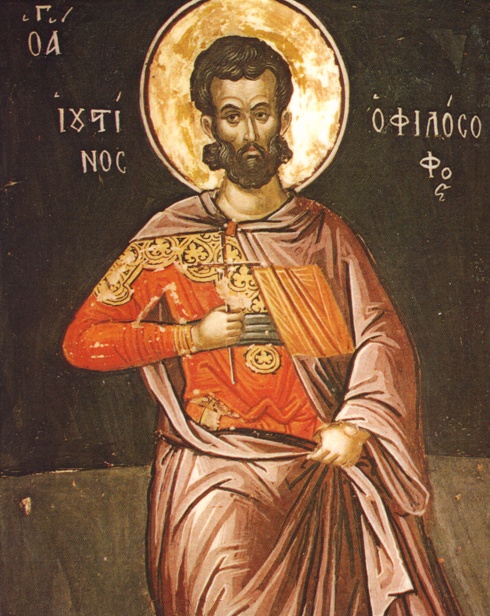
On this day, June 1 according to the Julian Calendar (June 14 civil calendar), the Georgian Orthodox Church commemorates the holy martyr Justin the Philosopher and his companions: Justin, Chariton, Euelpistus, Hierax, Paeon, Valerian, Justus, and Charita, who suffered martyrdom in Rome in the year 166.
The holy martyr Justin the Philosopher was born into a pagan Greek family. In Shechem, the ancient city of Samaria, he became acquainted with Greek philosophy and various sciences.
One day, while walking in the outskirts of the city, the contemplative Justin encountered a monk who, over the course of a long conversation, explained to him the essence of Christian teaching and counseled him to seek answers to all his troubling questions in Holy Scripture. “But above all,” said the monk, “pray earnestly to the Lord that He may enlighten your mind. No one can attain the knowledge of truth unless the Lord Himself has granted wisdom — He who grants abundantly to all who ask with faith and love.”
Justin was thirty years old when he was baptized, and from that time forward he devoted all his gifts and knowledge to spreading the teaching of Christ among the pagans. “Whoever is able to make the truth known to another, and does not do so, will be called to account before the Lord,” he wrote.
Justin opened a school where he taught Christian philosophy. The saint zealously defended the truth of Christian teaching.
Around the year 155, when the Emperor Antoninus Pius (138–161) began to persecute Christians, Saint Justin personally presented to him an “Apology” in defense of three condemned Christians, convincingly demonstrating the falseness of the charges brought against Christianity. The “Apology” made such a great impression upon the emperor that he ceased the persecution. He sent Justin himself to Asia, where Christians were being especially oppressed, and Justin joyfully announced to the inhabitants there the emperor’s decision.
In Ephesus, a dispute took place between Justin and Rabbi Tryphon. The Orthodox philosopher, drawing upon the prophecies of the Old Testament, confirmed the truth of Christian teaching. Saint Justin set down this debate in his treatise “Dialogue with Trypho the Jew.”
With a second “Apology,” Saint Justin addressed the Roman Senate. This occurred in 161, after the accession of Marcus Aurelius (161–180) to the throne.
As he journeyed toward Italy, Justin preached the Gospel after the manner of the apostles, and by his God-inspired words brought many to the faith of Christ. After returning to Rome, a man named Crescentius, who had been repeatedly defeated by the philosopher in debate and was consumed by envy toward him, brought many false accusations against the saint. Saint Justin was arrested and put to death by cruel torture in the year 166.
In addition to the aforementioned works, Saint Justin the Martyr is the author of “Address to the Greeks,” “Refutation of the Greeks,” and “On the Soul.” Saint John of Damascus preserved for us a large portion of his now-lost treatise “On the Resurrection.” According to the historian Eusebius, the saint also wrote “Refutation of All Heresies,” “Against Marcion,” and others.
The relics of Saint Justin the Philosopher rest in Rome.
The holy martyrs Justin, Chariton, Euelpistus, Hierax, Paeon, Valerian, Justus, and Charita suffered together with Saint Justin the Philosopher in the year 166. They were thrown into a Roman prison. Before the city prefect Rusticus, the saints boldly confessed the Christian faith. Rusticus asked Justin: “Do you truly believe that after the tortures you have endured, God will reward you and grant you the Kingdom of Heaven?” Saint Justin answered: “I do not merely think so — I know it with certainty and am deeply convinced of it.”
The city prefect ordered the captive Christians to be put to death. The courageous confessors of Christ were beheaded.
May the intercessions of the holy martyr Justin the Philosopher and his companions be with us all.